







- FASTA Sequence
- PDBx/mmCIF Format
- PDBx/mmCIF Format (gz)
- BinaryCIF Format (gz)
- Legacy PDB Format
- Legacy PDB Format (gz)
- PDBML/XML Format (gz)
- Structure Factors (CIF)
- Structure Factors (CIF - gz)
- Validation Full (PDF - gz)
- Validation (XML - gz)
- Validation (CIF - gz)
- Validation 2fo-fc coefficients (CIF - gz)
- Validation fo-fc coefficients (CIF - gz)
- Biological Assembly 1 (CIF - gz)
- Biological Assembly 2 (CIF - gz)
- Biological Assembly 1 (PDB - gz)
- Biological Assembly 2 (PDB - gz)
5COR | pdb_00005cor
X-RAY STRUCTURE OF MACROPHAGE INFLAMMATORY PROTEIN-1 ALPHA (CCL3) N-TERMINAL-SWITCH POLYMER
- PDB DOI: https://doi.org/10.2210/pdb5COR/pdb
- Classification: CYTOKINE
- Organism(s): Homo sapiens
- Expression System: Escherichia coli
- Mutation(s): No
- Deposited: 2015-07-20 Released: 2016-04-13
- Deposition Author(s): Liang, W.G., Tang, W.
- Funding Organization(s): National Institutes of Health/National Institute of General Medical Sciences (NIH/NIGMS)
Experimental Data Snapshot
- Method: X-RAY DIFFRACTION
- Resolution: 2.55 Å
- R-Value Free: 0.220 (Depositor), 0.220 (DCC)
- R-Value Work: 0.180 (Depositor), 0.190 (DCC)
- R-Value Observed: 0.182 (Depositor)
Starting Model: experimental
View more details
wwPDB Validation 3D Report Full Report

- 👁 Image
Download Mendeley

Structural basis for oligomerization and glycosaminoglycan binding of CCL5 and CCL3.
Liang, W.G., Triandafillou, C.G., Huang, T.Y., Zulueta, M.M., Banerjee, S., Dinner, A.R., Hung, S.C., Tang, W.J.(2016) Proc Natl Acad Sci U S A 113: 5000-5005
- PubMed: 27091995 Search on PubMedSearch on PubMed Central
- DOI: https://doi.org/10.1073/pnas.1523981113
- Primary Citation Related Structures:
5CMD, 5COR, 5COY, 5D65, 5DNF - PubMed Abstract:
CC chemokine ligand 5 (CCL5) and CCL3 are critical for immune surveillance and inflammation. Consequently, they are linked to the pathogenesis of many inflammatory conditions and are therapeutic targets. Oligomerization and glycosaminoglycan (GAG) binding of CCL5 and CCL3 are vital for the functions of these chemokines. Our structural and biophysical analyses of human CCL5 reveal that CCL5 oligomerization is a polymerization process in which CCL5 forms rod-shaped, double-helical oligomers. This CCL5 structure explains mutational data and offers a unified mechanism for CCL3, CCL4, and CCL5 assembly into high-molecular-weight, polydisperse oligomers. A conserved, positively charged BBXB motif is key for the binding of CC chemokines to GAG. However, this motif is partially buried when CCL3, CCL4, and CCL5 are oligomerized; thus, the mechanism by which GAG binds these chemokine oligomers has been elusive. Our structures of GAG-bound CCL5 and CCL3 oligomers reveal that these chemokine oligomers have distinct GAG-binding mechanisms. The CCL5 oligomer uses another positively charged and fully exposed motif, KKWVR, in GAG binding. However, residues from two partially buried BBXB motifs along with other residues combine to form a GAG-binding groove in the CCL3 oligomer. The N termini of CC chemokines are shown to be involved in receptor binding and oligomerization. We also report an alternative CCL3 oligomer structure that reveals how conformational changes in CCL3 N termini profoundly alter its surface properties and dimer-dimer interactions to affect GAG binding and oligomerization. Such complexity in oligomerization and GAG binding enables intricate, physiologically relevant regulation of CC chemokine functions.
- Ben May Department for Cancer Research, The University of Chicago, Chicago, IL 60637;
- Graduate Program in Biophysical Sciences, The University of Chicago, Chicago, IL 60637;
- Genomics Research Center, Academia Sinica, Taipei 115, Taiwan;
- James Franck Institute, The University of Chicago, Chicago, IL 60637;
- James Franck Institute, The University of Chicago, Chicago, IL 60637; Department of Chemistry, The University of Chicago, Chicago, IL 60637.
- Genomics Research Center, Academia Sinica, Taipei 115, Taiwan; schung@gate.sinica.edu.tw wtang@uchicago.edu.
- Ben May Department for Cancer Research, The University of Chicago, Chicago, IL 60637; schung@gate.sinica.edu.tw wtang@uchicago.edu.
Organizational Affiliation:
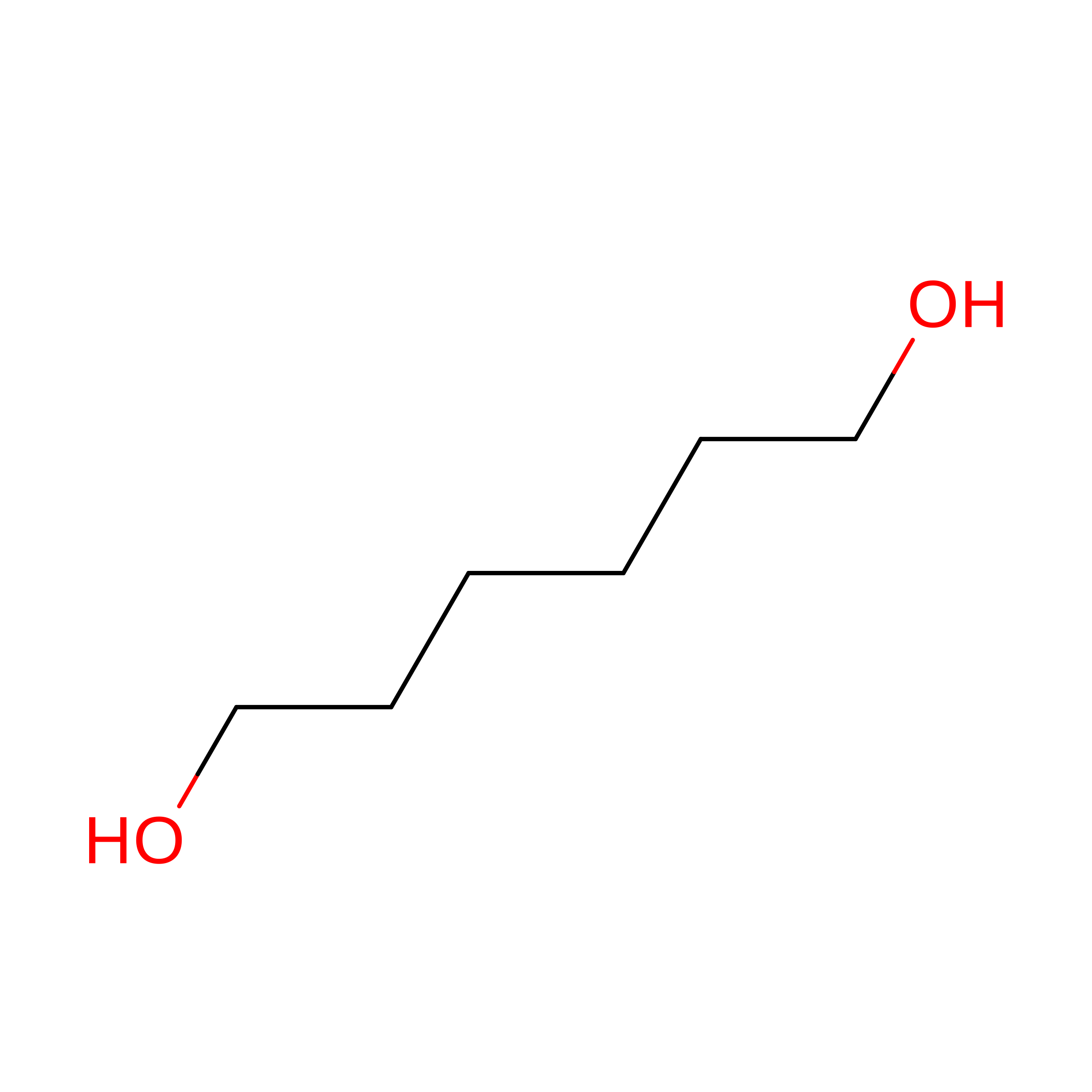
Explore in 3D: Structure | Sequence Annotations | Electron Density | Validation Report | Ligand Interaction (HEZ)
Explore in 3D: Structure | Sequence Annotations | Electron Density | Validation Report | Ligand Interaction (HEZ)
Global Symmetry: Helical - H (Explore in 3D)
Global Stoichiometry: Homo 5-mer - A5
Find Similar Assemblies
Biological assembly 1 assigned by authors.
Explore in 3D: Structure | Sequence Annotations | Electron Density | Validation Report | Ligand Interaction (HEZ)
Global Symmetry: Helical - H (Explore in 3D)
Global Stoichiometry: Homo 5-mer - A5
Find Similar Assemblies
Biological assembly 2 assigned by authors.
Macromolecule Content
- Total Structure Weight: 79.3 kDa
- Atom Count: 5,613
- Modeled Residue Count: 688
- Deposited Residue Count: 700
- Unique protein chains: 1
Entity ID: 1 | |||||
|---|---|---|---|---|---|
| Molecule | Chains | Sequence Length | Organism | Details | Image |
| C-C motif chemokine 3 | 70 | Homo sapiens | Mutation(s): 0 Gene Names: CCL3, G0S19-1, MIP1A, SCYA3 | 👁 Image | |
UniProt & NIH Common Fund Data Resources | |||||
Find proteins for P10147 (Homo sapiens) Explore P10147 Go to UniProtKB: P10147 | |||||
PHAROS: P10147 GTEx: ENSG00000277632 | |||||
Entity Groups | |||||
| Sequence Clusters | 30% Identity50% Identity70% Identity90% Identity95% Identity100% Identity | ||||
| UniProt Group | P10147 | ||||
Sequence AnnotationsExpand | |||||
| |||||



Experimental Data
- Method: X-RAY DIFFRACTION
- Resolution: 2.55 Å
- R-Value Free: 0.220 (Depositor), 0.220 (DCC)
- R-Value Work: 0.180 (Depositor), 0.190 (DCC)
- R-Value Observed: 0.182 (Depositor)
| Length ( Å ) | Angle ( ˚ ) |
|---|---|
| a = 57.073 | α = 90 |
| b = 112.592 | β = 90 |
| c = 179.074 | γ = 90 |
| Software Name | Purpose |
|---|---|
| PHENIX | refinement |
| HKL-3000 | data reduction |
| HKL-3000 | data scaling |
| PHENIX | phasing |
Deposition Data
- Released Date: 2016-04-13 Deposition Author(s): Liang, W.G., Tang, W.
| Funding Organization | Location | Grant Number |
|---|---|---|
| National Institutes of Health/National Institute of General Medical Sciences (NIH/NIGMS) | United States | -- |
Revision History (Full details and data files)
- Version 1.0: 2016-04-13
Type: Initial release - Version 1.1: 2016-04-20
Changes: Database references - Version 1.2: 2016-05-04
Changes: Database references - Version 1.3: 2016-05-18
Changes: Database references - Version 1.4: 2020-01-15
Changes: Author supporting evidence, Database references, Derived calculations - Version 1.5: 2023-09-27
Changes: Data collection, Database references, Refinement description - Version 1.6: 2024-10-23
Changes: Structure summary







