







5FWM | pdb_00005fwm
Atomic cryoEM structure of Hsp90-Cdc37-Cdk4 complex
- PDB DOI: https://doi.org/10.2210/pdb5FWM/pdb
- EM Map EMD-3342: EMDB EMDataResource
- Classification: CHAPERONE
- Organism(s): Homo sapiens
- Expression System: Spodoptera frugiperda
- Mutation(s): No
- Deposited: 2016-02-18 Released: 2016-07-06
- Deposition Author(s): Verba, K.A., Wang, R.Y.R., Arakawa, A., Liu, Y., Yokoyama, S., Agard, D.A.
Experimental Data Snapshot
- Method: ELECTRON MICROSCOPY
- Resolution: 8.00 Å
- Aggregation State: PARTICLE
- Reconstruction Method: SINGLE PARTICLE
wwPDB Validation 3D Report Full Report

- 👁 Image
Download Mendeley

Atomic Structure of Hsp90-Cdc37-Cdk4 Reveals that Hsp90 Traps and Stabilizes an Unfolded Kinase.
Verba, K.A., Wang, R.Y., Arakawa, A., Liu, Y., Shirouzu, M., Yokoyama, S., Agard, D.A.(2016) Science 352: 1542
- PubMed: 27339980 Search on PubMedSearch on PubMed Central
- DOI: https://doi.org/10.1126/science.aaf5023
- Primary Citation Related Structures:
5FWK, 5FWL, 5FWM, 5FWP - PubMed Abstract:
The Hsp90 molecular chaperone and its Cdc37 cochaperone help stabilize and activate more than half of the human kinome. However, both the mechanism by which these chaperones assist their "client" kinases and the reason why some kinases are addicted to Hsp90 while closely related family members are independent are unknown. Our structural understanding of these interactions is lacking, as no full-length structures of human Hsp90, Cdc37, or either of these proteins with a kinase have been elucidated. Here we report a 3.9 angstrom cryo-electron microscopy structure of the Hsp90-Cdc37-Cdk4 kinase complex. Surprisingly, the two lobes of Cdk4 are completely separated with the β4-β5 sheet unfolded. Cdc37 mimics part of the kinase N lobe, stabilizing an open kinase conformation by wedging itself between the two lobes. Finally, Hsp90 clamps around the unfolded kinase β5 strand and interacts with exposed N- and C-lobe interfaces, protecting the kinase in a trapped unfolded state. On the basis of this structure and an extensive amount of previously collected data, we propose unifying conceptual and mechanistic models of chaperone-kinase interactions.
- Howard Hughes Medical Institute (HHMI) and the Department of Biochemistry and Biophysics, University of California San Francisco, San Francisco, CA 94158, USA.
- RIKEN Systems and Structural Biology Center, 1-7-22 Suehiro-cho, Tsurumi-ku, Yokohama 230-0045, Japan.
- Howard Hughes Medical Institute (HHMI) and the Department of Biochemistry and Biophysics, University of California San Francisco, San Francisco, CA 94158, USA. agard@msg.ucsf.edu.
Organizational Affiliation:
Explore in 3D: Structure | Sequence Annotations | Electron Density | Validation Report | Ligand Interaction (ATP)
Explore in 3D: Structure | Sequence Annotations | Electron Density | Validation Report | Ligand Interaction (ATP)
Global Symmetry: Asymmetric - C1
Global Stoichiometry: Hetero 4-mer - A2B1C1
Local Symmetry: Cyclic - C2 (Explore in 3D)
Local Stoichiometry: Homo 2-mer - A2
Find Similar Assemblies
Biological assembly 1 generated by PISA (software)
Macromolecule Content
- Total Structure Weight: 247.5 kDa
- Atom Count: 14,807
- Modeled Residue Count: 1,818
- Deposited Residue Count: 2,142
- Unique protein chains: 3
Entity ID: 1 | |||||
|---|---|---|---|---|---|
| Molecule | Chains | Sequence Length | Organism | Details | Image |
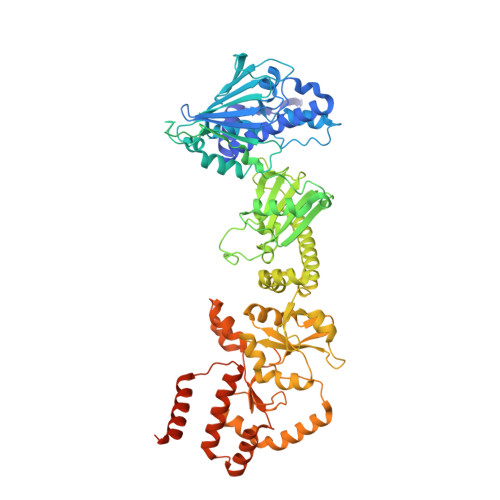
| HEAT SHOCK PROTEIN HSP 90 BETA | 727 | Homo sapiens | Mutation(s): 0 | 👁 Image | |
UniProt & NIH Common Fund Data Resources | |||||
Find proteins for P08238 (Homo sapiens) Explore P08238 Go to UniProtKB: P08238 | |||||
PHAROS: P08238 GTEx: ENSG00000096384 | |||||
Entity Groups | |||||
| Sequence Clusters | 30% Identity50% Identity70% Identity90% Identity95% Identity100% Identity | ||||
| UniProt Group | P08238 | ||||
Sequence AnnotationsExpand | |||||
| |||||

Entity ID: 2 | |||||
|---|---|---|---|---|---|
| Molecule | Chains | Sequence Length | Organism | Details | Image |
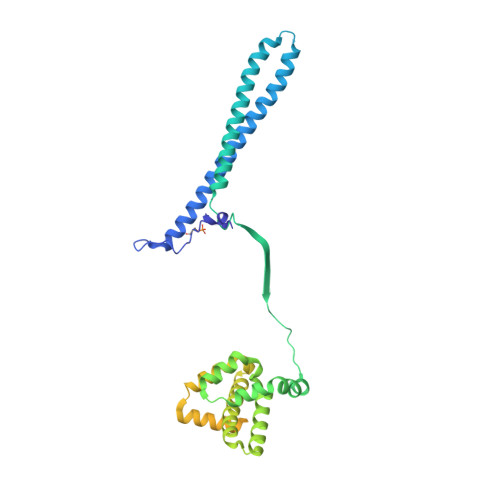
| HSP90 CO-CHAPERONE CDC37 | C [auth E] | 378 | Homo sapiens | Mutation(s): 0 | 👁 Image |
UniProt & NIH Common Fund Data Resources | |||||
Find proteins for Q16543 (Homo sapiens) Explore Q16543 Go to UniProtKB: Q16543 | |||||
PHAROS: Q16543 GTEx: ENSG00000105401 | |||||
Entity Groups | |||||
| Sequence Clusters | 30% Identity50% Identity70% Identity90% Identity95% Identity100% Identity | ||||
| UniProt Group | Q16543 | ||||
Sequence AnnotationsExpand | |||||
| |||||

Entity ID: 3 | |||||
|---|---|---|---|---|---|
| Molecule | Chains | Sequence Length | Organism | Details | Image |
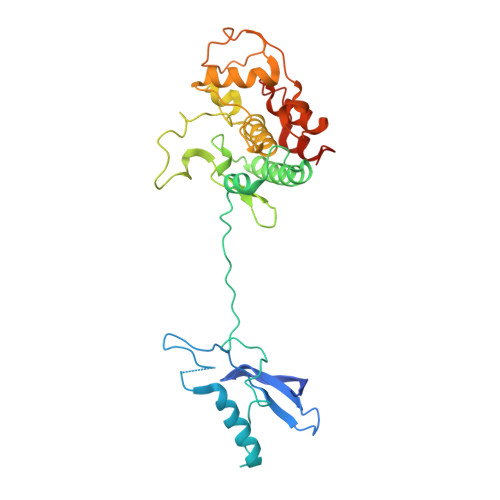
| CYCLIN-DEPENDENT KINASE 4 | D [auth K] | 310 | Homo sapiens | Mutation(s): 0 EC: 2.7.11.22 | 👁 Image |
UniProt & NIH Common Fund Data Resources | |||||
Find proteins for P11802 (Homo sapiens) Explore P11802 Go to UniProtKB: P11802 | |||||
PHAROS: P11802 GTEx: ENSG00000135446 | |||||
Entity Groups | |||||
| Sequence Clusters | 30% Identity50% Identity70% Identity90% Identity95% Identity100% Identity | ||||
| UniProt Group | P11802 | ||||
Sequence AnnotationsExpand | |||||
| |||||

| Ligands 2 Unique | |||||
|---|---|---|---|---|---|
| ID | Chains | Name / Formula / InChI Key | 2D Diagram | 3D Interactions | |
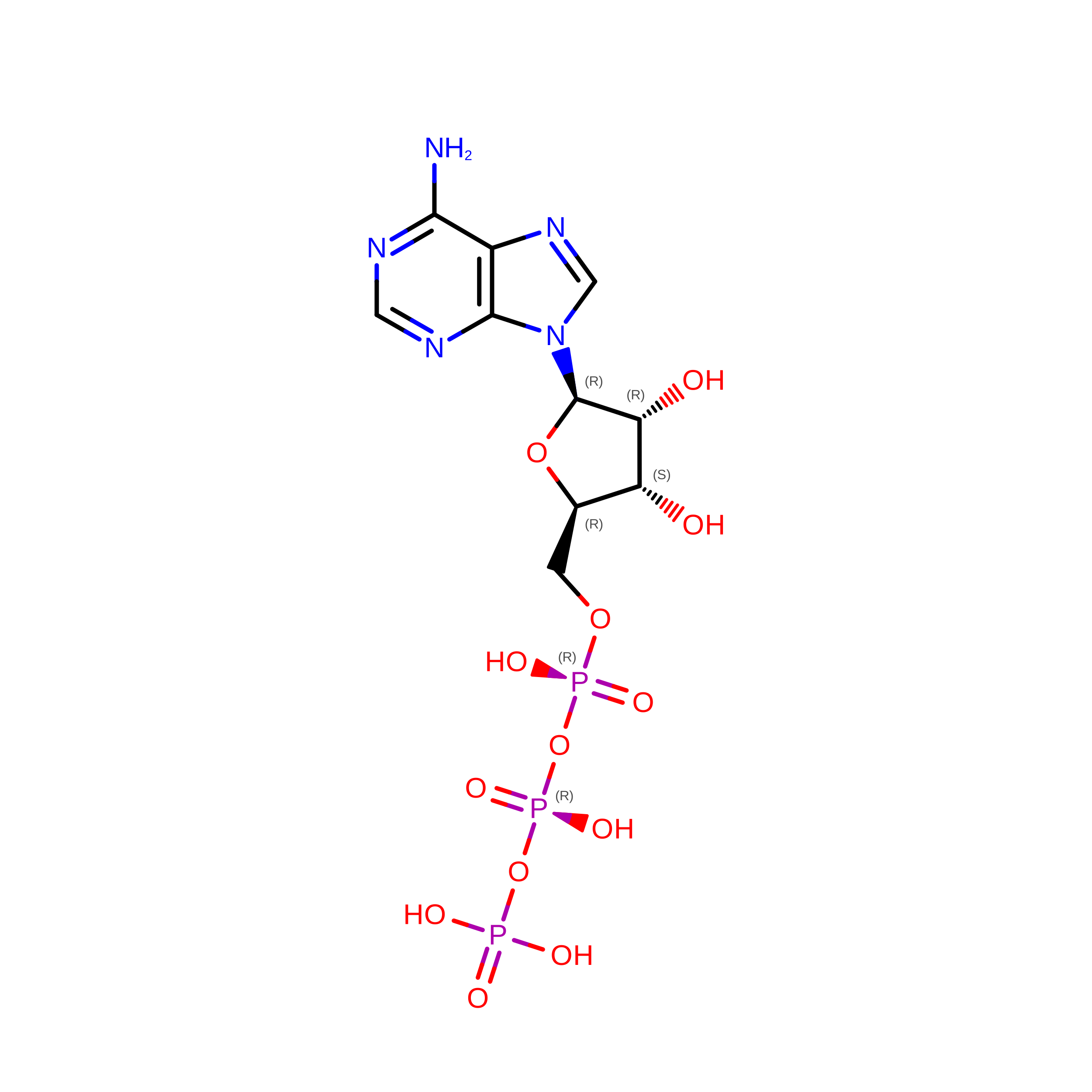
| ATP Query on ATP Download Ideal Coordinates CCD File | E [auth A], G [auth B] | ADENOSINE-5'-TRIPHOSPHATE C10 H16 N5 O13 P3 ZKHQWZAMYRWXGA-KQYNXXCUSA-N | 👁 Image | ||
| MG Query on MG Download Ideal Coordinates CCD File | F [auth A], H [auth B] | MAGNESIUM ION Mg JLVVSXFLKOJNIY-UHFFFAOYSA-N | 👁 Image | ||



| Modified Residues 1 Unique | |||||
|---|---|---|---|---|---|
| ID | Chains | Type | Formula | 2D Diagram | Parent |
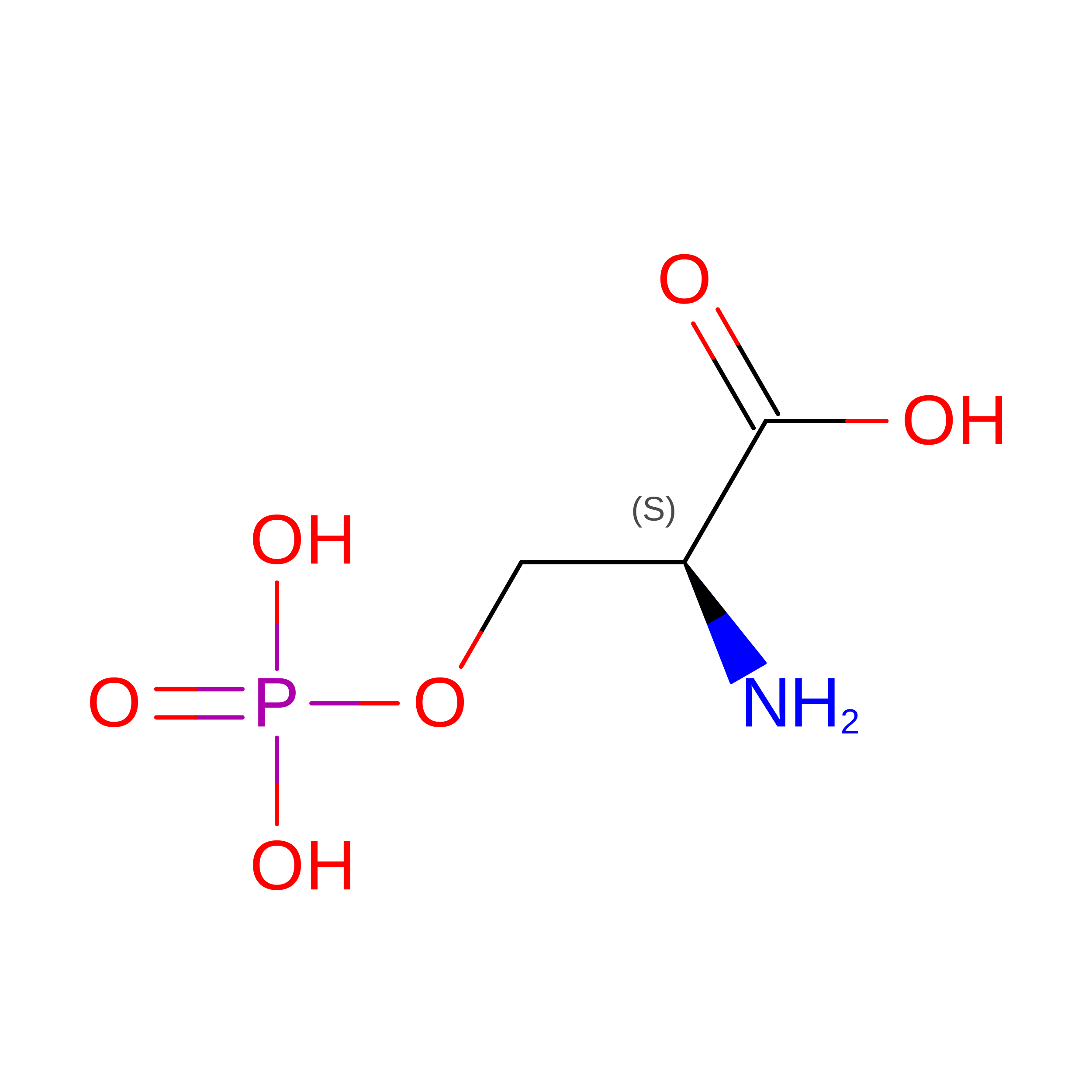
| SEP Query on SEP | C [auth E] | L-PEPTIDE LINKING | C3 H8 N O6 P | 👁 Image | SER |

Experimental Data
- Method: ELECTRON MICROSCOPY
- Resolution: 8.00 Å
- Aggregation State: PARTICLE
- Reconstruction Method: SINGLE PARTICLE
| Task | Software Package | Version |
|---|---|---|
| RECONSTRUCTION | RELION |
Deposition Data
- Released Date: 2016-07-06 Deposition Author(s): Verba, K.A., Wang, R.Y.R., Arakawa, A., Liu, Y., Yokoyama, S., Agard, D.A.
Revision History (Full details and data files)
- Version 1.0: 2016-07-06
Type: Initial release - Version 1.1: 2017-04-19
Changes: Other - Version 1.2: 2017-08-02
Changes: Data collection - Version 2.0: 2019-10-23
Changes: Atomic model, Data collection, Derived calculations - Version 2.1: 2024-11-06
Changes: Data collection, Database references, Derived calculations, Structure summary







