VOOZH about

URL: https://www.smarterdx.com/whysmarterdx

⇱ Why SmarterDx


SmarterDx is now proudly part of Smarter Technologies

LEARN MORE

AI created by someone who’s been in your shoes

The biggest disconnect between technology that works or fails comes down to understanding the end user and their needs.

SmarterDx wasn’t dreamed up by outsiders. It was built by clinicians: hospitalists who are also trained technologists β€”and wanted to make a difference for hospitals struggling both financially and operationally.

Our co-founders have been on the front lines providing care. They’ve spearheaded AI initiatives for major health systems. And they’ve successfully helped more than 85 health systems capture the clinical truth behind every patient stay... Because the more accurate the patient record, the better the outcomes for both the patient and hospital.

Michael Gao, MD

Co-founder & Chief Executive Officer

  • Hospitalist – still sees patients
  • Former Assistant Professor of Medicine at Weill Cornell
  • Former Medical Director for Transformation for NewYork-Presbyterian
  • MD from University of Michigan

Joshua Geleris, MD

Co-founder & Chief Product Officer

  • Former assistant professor and practicing physician at Columbia University Irving Medical Center
  • Former NIH- and DOD-funded medical researcher focused on bioinformatics and data science
  • MD from Technion - Israel Institute of Technology

The team driving next-level innovation

Today, we’re 500+ Smartians strong β€” it turns out fixing healthcare requires a lot of smart people, and we’ve built quite the brain trust of data scientists, data engineers, and machine learning researchers from big tech, academia, and healthcare.

Academia

Stanford Artificial Intelligence Laboratory

Harvard

Yale

Columbia

Technology

Google

Apple

Snap, Inc.

X

Healthcare

Epic

Optum

Amazon One Medical

Various hospitals & health systems

πŸ‘ Image

AI that understands clinical context

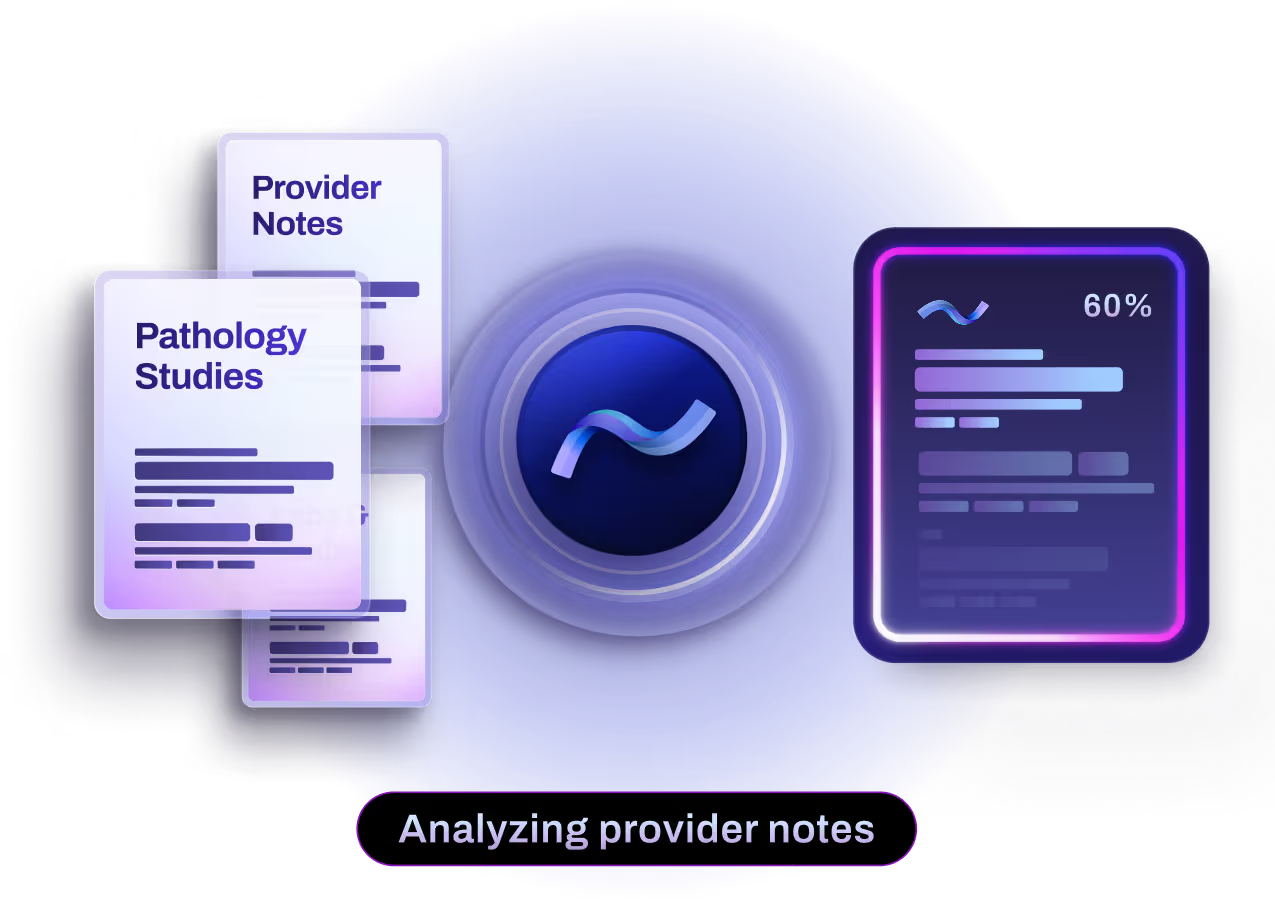
Generic AI can read a chart. Ours can translate it into value. The difference between heart failure and pulmonary edema isn’t semantic. It’s clinical. It changes the patient story, the quality picture, the reimbursement, and the defensibility of the claim. SmarterDx is built to understand that difference. Our clinical AI reasons through the chart like a clinician would: surfacing the gaps, contradictions, and missed diagnoses that general AI models miss.

Trusted, secure, and healthcare-ready

At SmarterDx, security is built in by design β€” not bolted on. Every layer of our platform is engineered to protect the data our partners trust us with, from AES-GCM 256-bit encryption and strict access controls, to continuous monitoring and annual independent testing against SOC 2 Type 2 and NIST frameworks.

We hold ourselves to rapid remediation timelines, resilient backup and recovery, and a culture where every team member is trained and accountable for safeguarding customer trust. The result is a healthcare AI platform that organizations can adopt with confidence.

πŸ‘ Image

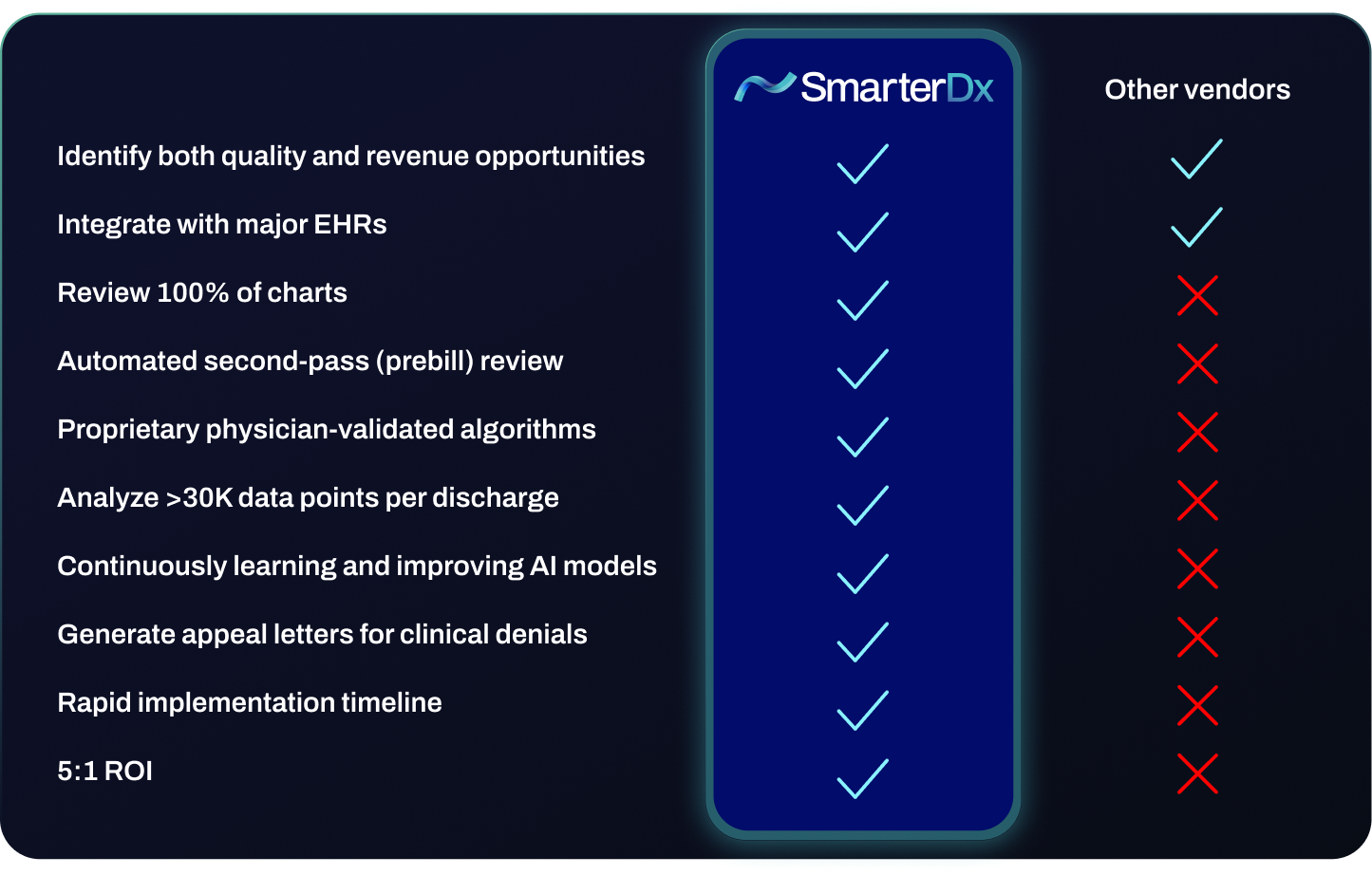
Check all the boxes with industry-leading clinical AI 
that drives real outcomes

πŸ‘ Image

Clinical AI that's Smarter by design

Tired of AI that overpromises and underdelivers? It's time for AI that's Smarter by design. Trained on real EHR data and built to address the true complexities of healthcare.

πŸ‘ Image

Meet our clinical AI

Become a Smartian

If you have data science expertise and a passion for making healthcare better, we’d love to hear from you. Check out our open roles across data science, engineering, and analytics.

πŸ‘ Image

From research to real-world results

Not only does our team walk the walk, but they talk the talk β€” and their published credentials prove it. Our team has been in notable publications, spanning medicine and informatics journals. Check out some select recent research.

πŸ‘ Image

A prospective comparison of large language models for early prediction of sepsis

Shashikumar, S.P., et al

Biocomputing 2025: Proceedings of the Pacific Symposium, 2024

πŸ‘ Image

Hypothesis generation for rare and undiagnosed diseases through clustering and classifying time-versioned biological ontologies

Bradshaw, M., et al

PLOS One, 2024

πŸ‘ Image

Standing on FURM ground: a framework for evaluating fair, useful, and reliable AI models in health care systems

Corbin, C.K., et al

New England Journal of Medicine Catalyst Innovations in Care Delivery, 2024

πŸ‘ Image

A network control theory pipeline for studying the dynamics of the structural connectome

Stiso, J., et al

Nature Protocols, 2024

πŸ‘ Image

Deep learning to detect left ventricular structural abnormalities in chest X-rays

Bhave, S., et al

European Heart Journal, 2024

πŸ‘ Image

A multi-center study on the adaptability of a shared foundation model for electronic health records

Fleming, S., et al

NPJ Digital Medicine, 2024

πŸ‘ Image

The effects of biological knowledge graph topology on embedding-based link prediction

Bradshaw, M., et al

bioRxiv, 2024

πŸ‘ Image

MedAlign: A clinician-generated dataset for instruction following with electronic medical records

Fleming, S., et al

Proceedings of the AAAI Conference on Artificial Intelligence, 2024

πŸ‘ Image

Impact of a deep learning sepsis prediction model on quality of care and survival

Shashikumar, S.P., et al

NPJ digital medicine, 2023

πŸ‘ Image

Macroscopic resting-state brain dynamics are best described by linear models

Stiso, J., et al

Nature Biomedical Engineering, 2023

πŸ‘ Image

Artificial intelligence to identify fractures on pediatric and young adult upper extremity radiographs

Altosaar, J., et al

Pediatric Radiology, 2023

πŸ‘ Image

Clinfo.ai: An open-source retrieval-augmented large language model system for answering medical questions using scientific literature

Fleming, S., et al

World Scientific Connect, 2023

πŸ‘ Image

The shaky foundations of large language models and foundation models for electronic health records

Fleming, S., et al

NPJ Digital Medicine, 2023

πŸ‘ Image

DEPLOYR: a technical framework for deploying custom real-time machine learning models into the electronic medical record

Corbin, C.K., et al

Journal of Biomedical Informatics, 2023

πŸ‘ Image

Derivation and Validation of Three Non-Critical COVID-19 Acute Lung Injury Subphenotypes Copy

Geleris, J.D., et al

American Journal of Respiratory and Critical Care Medicine, 2023

πŸ‘ Image

Assessing phenotype definitions for algorithmic fairness

Bhave, S., Altosaar, J., et al

AMIA Annu Symp Proc., 2023

πŸ‘ Image

Increasing reproducibility, robustness, and generalizability of biomarker selection from meta-analysis using Bayesian methodology

Kalesinskas, L., et al

PLoS computational biology, 2022

πŸ‘ Image

Personalized antibiograms for machine learning driven antibiotic selection

Corbin, C.K., et al

Communications Medicine, 2022

πŸ‘ Image

Computational drug repositioning of atorvastatin for ulcerative colitis

Kalesinskas, L., et al

Journal of the American Medical Informatics Association, 2021

πŸ‘ Image

Point processes for competing observations with recurrent networks (POPCORN): A generative model of EHR data

Bhave, S., et al

Machine Learning for Healthcare Conference, 2021

πŸ‘ Image

Machine learning for initial insulin estimation in hospitalized patients

Kalesinskas, L., et al

Journal of the American Medical Informatics Association, 2021

πŸ‘ Image

DotMotif: an open-source tool for connectome subgraph isomorphism search and graph queries

Stiso, J., et al

Scientific Reports, 2021

πŸ‘ Image

Development and prospective validation of a deep learning algorithm for predicting need for mechanical ventilation

Shashikumar, S.P., et al

Scientific Direct, Chest, 2021

πŸ‘ Image

Ontology-driven weak supervision for clinical entity classification in electronic health records

Fleming, S., et al

Nature Communications, 2021

πŸ‘ Image

Language models are an effective representation learning technique for electronic health record data

Corbin, C.K., et al

ScienceDirect, 2021

πŸ‘ Image

Diverse approaches to predicting drug-induced liver injury using gene-expression profiles

Bradshaw, M., et al

Biology Direct, 2020

πŸ‘ Image

ClinicalBERT: Modeling clinical notes and predicting hospital readmission

Altosaar, J., et al

Conference on Health Inference and Learning, 2020

πŸ‘ Image

Observational Study of Hydroxychloroquine in Hospitalized Patients with Covid-19

Geleris, J.D., et al

New England Journal of Medicine, 2020

High marks. Hard-earned.

Our customers expect more than software. They expect partnership, proof, and results. SmarterDx earned top scores across multiple categories in our latest KLAS report. It’s  a report card we’re proud of because it reflects what matters most: customers who trust us to help solve some of their biggest clinical, operational, and financial challenges.

Contact Us

Put clinical AI to work today

SmarterDx helps hospitals uncover the evidence behind accurate reimbursement and quality metrics. Reach out and we’ll show you what clinical AI can do.

πŸ‘ Image
Talk to us
Why SmarterDxSmarterPrebillSmarterDenialsSmarterUtilizationsSmarterNotesSmarterChargesResourcesROICompanyCareersContact
πŸ‘ Image
πŸ‘ Image
πŸ‘ Image
πŸ‘ Image
Do Not Sell or Share My Personal InformationPrivacy PolicyTerms of Service
πŸ‘ Image