
Gamers never used to care about VRAM as much as they do today, and it's easy to see why. Before 2020, even high-end games didn't demand more VRAM than what most mainstream GPUs had to offer. Slowly but surely, the VRAM requirements kept going up, but GPU manufacturers didn't get the memo. Today, 8GB VRAM GPUs can affect performance even at 1080p, and in the worst cases, they can make games objectively unplayable. While you may not be able to upgrade your 8GB VRAM GPU right now, you can at least avoid buying a new one. The market doesn't exactly have too many affordable GPUs right now, but I'd recommend 16GB VRAM even if it costs you more at the outset. It won't take long for you to realize the importance of sufficient VRAM as games get more demanding, and you increase the resolution at which you play.

Your GPU's VRAM matters more than you think, but less than what Reddit says
Insufficient VRAM is a plague, but things haven't gone out of control yet
Your existing 8GB VRAM GPU is still fine, but don't buy a new one
You probably don't want a compromised experience on a new GPU
GPUs with 8GB of VRAM came under the scanner even in 2020, when Nvidia launched the RTX 3070. The 70-class card was pretty powerful, but potential bottlenecking due to the 8GB VRAM was still a concern. A few years later, it was clear the card was capable of so much more had it not been for the insufficient VRAM. Many other GPUs were in the same boat, but Nvidia and AMD kept launching GPUs with lackluster VRAM capacities at every price point. Even at 1080p, gamers were able to exhaust 8GB of VRAM, running into visual artifacts, incorrectly loaded textures, and crashes. For those with older systems limited to PCIe 3.0 bandwidth, performance on 8GB VRAM GPUs can drop up to 90% compared to what the same GPU can achieve with 16GB of VRAM.
If you're buying a new graphics card today, you're probably aiming for 1440p or 4K gaming, not 1080p. You can still make it work with older 8GB VRAM GPUs by reducing your VRAM dependency, but doing so after buying a new GPU seems nonsensical. You probably expect a new GPU to last for at least 5–6 years, which is hard to imagine if it has 8GB or even 12GB of VRAM, especially if you're playing at higher resolutions. 16GB of VRAM is the ideal to aim for without talking about four-figure MSRPs. You can still find mid-range and budget GPUs with 16GB framebuffers. GPUs with even more VRAM, such as the RTX 5090 with 32GB of VRAM, are simply not in the realm of affordability for 99% of PC gamers.
16GB VRAM shouldn't cost a premium, but that's where we are
A necessity sold as a premium feature
I mentioned that 16GB of VRAM is the ideal you should aim for, but it's easier said than done. Although GPUs like the RTX 5060 Ti and RX 9060 XT technically offer 16GB variants for $429 and $349 (MSRP), they are still what you'd call budget GPUs. Besides, you can't really buy them for under $560 and $450, respectively, further complicating their price-to-performance. Moving into the mid-range segment, the RX 9070 provides you with 16GB of VRAM, but $549 (or $630 in the real world) is still a lot for a graphics card. Other options like the RX 9070 XT and RTX 5070 Ti offer better performance combined with 16GB of VRAM, but then they command a significant premium, too. The former isn't available for under $730, and the latter costs $1,000 at the minimum. The current GPU market isn't for the faint-hearted.
Unfortunately, companies have somehow made 16GB of VRAM a premium feature. Instead, it should be considered a minimum in 2026, seeing how demanding titles can consume over 12GB of VRAM at 4K settings. The problem is that GPU manufacturers have changed the definitions of budget GPUs and mid-range cards, moving price categories slowly over the years. Today, gamers are forced to pay hefty amounts for budget GPUs, and mid-range has become the new high-end in terms of pricing. With the way most games are getting unplayable without powerful GPUs, gamers are getting lower performance and VRAM than ever for their money.
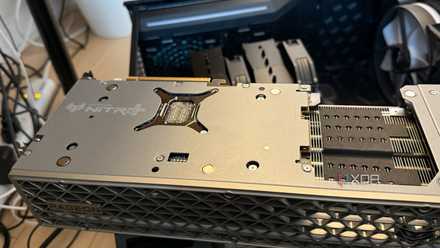
SAPPHIRE PULSE Radeon RX 9070 XT
3 ways shrinkflation is making Nvidia GPUs worse every year
Nvidia is silently making its GPUs worse with every generation
Spending more in the short term will save you regret in the long term
I'd recommend 16GB of VRAM even if it's outside your budget
GPUs with 1440p and 4K performance that also offer 16GB of VRAM aren't pocket-friendly right now, but I'd still implore you to buy one if you can stretch your budget. 8GB or 12GB of VRAM won't last you long if you wish to enjoy the latest games at 1440p or 4K for the next few years. You can save money with an "affordable" graphics card right now, but you'll regret the purchase when you're forced to upgrade sooner than you'd like to. You'll probably end up spending more than you would have had you bought a 16GB VRAM GPU in the beginning. If I exclude 60-class cards from both Nvidia and AMD, you're left with options like the RX 9070, RX 9070 XT, and RTX 5070 Ti, none of which are available at MSRP in this market. Even the cheapest of them, the RX 9070, is selling for over $630 right now.
However, there is another trick that you can pull to get more performance as well as more VRAM for about the same amount of money. The previous-gen RX 7900 XTX can be had for $650 on eBay, a monster of a GPU that is not only 20% faster than the RX 9070, but also has 24GB of VRAM. That's what I call the ideal amount of VRAM on a high-end GPU. The RX 7900 XTX has raw performance similar to that of the RTX 5070 Ti and RTX 4080, and it can also do well in ray tracing in most titles. It's only around 10% slower than the RTX 5080, a GPU that isn't available for under $1,300. Used graphics cards are much-needed in the current hardware market, as many of them offer tremendous performance for the price.

For the first time in 20 years, I'm ready to buy a used GPU
Pre-owned graphics cards are the only logical choice in this market
Buying a 16GB VRAM GPU is an investment
A GPU with 16GB of VRAM will cost you more than one with 8GB or 12GB VRAM, but it will last you way longer. AAA titles with ray tracing effects will continue to demand more VRAM, especially at higher resolutions. If you're buying a GPU today, those are the resolutions you're aiming for. Spending around $650-$750 on a 16GB VRAM GPU will ensure you not only get powerful performance but also a large framebuffer, so you can avoid a premature GPU upgrade down the line.