
Video game consoles have come a long way, and one of the biggest changes over the years has been how they store and deliver games. From simple circuit boards to high-capacity discs and now digital downloads, the way we access games has shaped the industry just as much as the games themselves. Each new format has unlocked new possibilities—bigger worlds, better graphics, faster load times—and, in some cases, even changed the way we play.
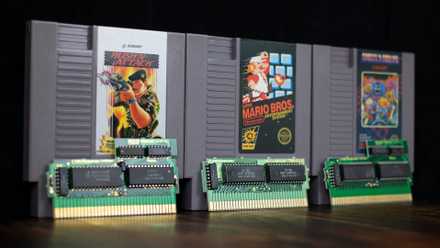
But game media isn’t just about technology. It’s about how we, as players, experience games. Some formats, like classic ROM cartridges, hold a special place in gaming history—just look at the Nintendo Entertainment System (NES), which is nearly 40 years old, and still one of the most popular retro consoles today. Others, like Blu-ray discs, still hang on in an era increasingly dominated by digital downloads. As we look at each console generation, we’ll see how technology, business decisions, and player preferences have shaped the evolution of game media—from the hardwired systems of the ‘70s to the cloud-based future ahead.

6 rare retro add-ons from the 90s underground gaming scene
Whether for preservation, enhancement, or just plain fun, these devices left a lasting mark on gaming history
9 1st generation (1972-1980)
Hardwired circuit boards and built-in games
The earliest game consoles didn’t have removable media—everything was built directly into the hardware. Systems like the Magnavox Odyssey (1972) and early Pong machines were more like electronic toys than the consoles we know today. If you wanted to play a different game, you weren’t swapping out a cartridge or disc; the system itself had to be designed to include it.
One of the Odyssey’s most unique features was its external game cards, which might look like early cartridges but worked completely differently. Instead of storing game data, these cards acted like circuit jumpers—changing the way the console processed inputs and displayed graphics. The Odyssey’s graphics, if you could call them that, were just dots and lines, so it relied on plastic screen overlays—transparent sheets you stuck to your TV screen to provide some kind of visual context for the game.
Modern multi-game cards for the Odyssey have a series of DIP switches to change which pins are being jumped, so all Odyssey games can be included on a single PCB game card. It was a crude setup by today’s standards, but it was a start. These limitations made it clear that something more flexible was needed, paving the way for the first true removable game media in the next generation.
8 2nd generation (1976-1992)
The rise of ROM cartridges
The second generation of consoles introduced something that would change gaming forever: removable game cartridges. Instead of being stuck with a handful of built-in games, players could expand their libraries by swapping out cartridges—making consoles more versatile and giving developers a way to keep releasing new titles long after a system launched.
The first console to introduce this concept was the Fairchild Channel F (1976), but it was the Atari 2600 (1977) that made it mainstream. With over 500 games released over more than a decade, the 2600 proved that a console’s success wasn’t just about hardware—it was about the strength of its game library.
Early ROM cartridges, however, were fairly simple. They stored game data on read-only memory (ROM) chips, but they had no extra processing power, no additional memory, and no way to save progress. That meant developers had to work within tight storage limits, and players often relied on long passwords to continue their games later. As games became more ambitious, these limitations became more apparent, leading to the more advanced cartridges of the next generation—ones that could enhance graphics, expand memory, and even store saved games.
7 3rd generation (1983-2003)
Refined cartridges and expanded memory
The third generation of consoles took cartridge technology to the next level. Systems like the Nintendo Entertainment System (NES) and Sega Master System introduced larger-capacity cartridges, allowing for more detailed graphics, better sound, and longer, more complex games.
One of the biggest innovations was the addition of memory management chips, like the NES’s MMC (Memory Management Controller) chips. These allowed for smoother scrolling backgrounds, more on-screen sprites, and larger, more immersive game worlds. Games were no longer limited to simple, single-screen levels—players could now explore expansive environments with fluid motion.
Another major improvement was battery-backed save data. Before this, players had to rely on password systems to resume progress, but now games like The Legend of Zelda let players save directly to the cartridge. This opened the door for longer, more story-driven games, setting the stage for future RPGs and adventure titles.
While cartridges were evolving, they still had limitations—storage capacity was improving, but it was nowhere near what later disc-based formats would offer. However, these advancements kept cartridges at the heart of gaming throughout the 8-bit and 16-bit eras, ensuring that consoles remained powerful enough to keep up with developers’ ambitions.
6 4th generation (1987-2004)
Larger cartridges and early CD-ROM experiments
The 16-bit era pushed cartridge technology to its limits. With more memory and specialized hardware inside the carts, games on the Super Nintendo Entertainment System (SNES) and Sega Genesis delivered larger worlds, better animations, and even basic 3D effects.
One of the biggest advancements came from specialized chips inside the cartridges. The SNES’s Super FX chip, for example, powered the polygonal 3D graphics in Star Fox, while Sega’s SVP chip made Virtua Racing possible on the Genesis. These weren’t just storage devices anymore—cartridges were actively boosting the capabilities of the consoles themselves.
Some companies, however, started experimenting with CD-ROMs as an alternative. Sega and NEC released CD add-ons, like the Sega CD and TurboGrafx-CD, offering full-motion video, CD-quality music, and voice acting—things cartridges struggled to handle. Meanwhile, Neo Geo cartridges pushed the format to the extreme, with arcade-level graphics and massive storage capacities, though at a premium price.
One of the most notable CD experiments never made it to market: the Nintendo Play Station, a collaboration between Nintendo and Sony that was meant to bring CD-ROM support to the SNES.
However, the partnership fell apart, and Nintendo backed out of the deal. Sony took what it had learned and developed its own console—the PlayStation, which would soon redefine the industry. Despite these early CD-ROM attempts, cartridges remained the dominant format throughout the 16-bit era. But with growing concerns over cost and storage limitations, the industry was on the verge of a major transition.

The only unlicensed SNES game ever commercially released
Super Noah’s Ark 3D’s release was perfectly timed—a first-person shooter where you didn’t shoot anyone.
5 5th generation (1993-2006)
The shift to optical discs
The 5th generation marked one of the biggest turning points in gaming history: the shift from cartridges to CD-ROMs. With significantly more storage space and lower production costs, discs allowed for pre-rendered cutscenes, orchestrated soundtracks, and higher-resolution textures—features that redefined what games could be.
Leading the charge were Sony’s PlayStation (1994) and Sega’s Saturn (1994), both fully embracing CD-ROM technology. The PlayStation, in particular, benefited from Sony’s experience with disc-based media, offering developers cheaper, higher-capacity game storage compared to expensive cartridges. Two of my favorite games from this generation, Final Fantasy VII and Metal Gear Solid, took full advantage of this—delivering cinematic experiences that wouldn’t have been possible on cartridges.
Meanwhile, Nintendo went against the trend with the Nintendo 64 (1996), opting to stick with cartridges instead of CDs. This decision had its benefits—cartridges had faster load times and were more durable than discs. However, they also had severe storage limitations and were more expensive to manufacture. These constraints frustrated third-party developers, most notably SquareSoft, who had been a longtime Nintendo partner. The next entry in its biggest franchise, Final Fantasy VII, was originally planned for the N64—but due to the storage limitations of cartridges, SquareSoft abandoned Nintendo and released it exclusively on the PlayStation instead. Other developers followed suit, leading to a major shift in third-party support away from Nintendo.
By the end of the generation, it was clear that CDs were the future. The PlayStation dominated the market, selling over 100 million units, while the N64, despite strong first-party titles, struggled to compete. Nintendo’s reluctance to embrace discs would influence the company’s strategy in the following generation, but the industry as a whole had already moved on.
4 6th generation (1998-2013)
DVD-ROMs take center stage
The 6th generation saw DVDs replace CDs as the primary game format, offering more storage for larger worlds, better cinematics, and more complex gameplay. The PlayStation 2 (2000) led the charge, doubling as a DVD player, which made it a must-have entertainment device and helped it become the best-selling console of all time. Microsoft entered the market with the Xbox (2001), also using DVDs, and introduced an internal hard drive, eliminating the need for memory cards and paving the way for digital gaming.
Meanwhile, Nintendo opted for proprietary miniDVD-like discs on the GameCube (2001), limiting storage and discouraging some third-party developers. Sega’s Dreamcast (1998) used GD-ROMs and pioneered online gaming, but the overwhelming success of the PS2 and its DVD capabilities forced Sega to exit the console business. By the end of this generation, DVDs were the industry standard, and consoles had evolved into full-fledged multimedia devices.
3 7th generation (2005-2017)
The era of Blu-ray and digital downloads
The 7th generation marked the arrival of high-definition gaming, with consoles moving beyond standard-definition (480p) to HD resolutions like 720p and 1080p. Sony’s PlayStation 3 (2006) introduced Blu-ray discs, which provided more storage for detailed textures, high-definition cinematics, and larger game worlds. Microsoft’s Xbox 360 (2005) stuck with DVDs but embraced online downloads through Xbox Live, pioneering full-game digital purchases and downloadable content (DLC).
Nintendo took a different approach with the Wii (2006), continuing to use standard DVD-like discs and limiting resolution to 480p, but prioritizing motion controls over graphical power. Meanwhile, digital distribution services like PlayStation Network, Xbox Live Marketplace, and Steam made game downloads more common, setting the stage for the digital-first future of gaming.
2 8th generation (2012-present)
Blu-ray dominates, digital expands
The 8th generation solidified the gaming industry’s shift toward digital distribution and subscription services. While the PlayStation 4 (2013) and Xbox One (2013) continued using Blu-ray discs, digital downloads became more popular, and always-online games like Destiny and The Division required internet connectivity to play. Game subscription services like Xbox Game Pass and PlayStation Now emerged, offering Netflix-style game libraries and reshaping how players accessed games.
Meanwhile, Nintendo took a different path with the Wii U (2012), which introduced a second-screen GamePad but struggled to gain traction. Its successor, the Switch (2017), refined Nintendo’s approach with a hybrid design, allowing it to be played both on a TV and as a handheld device. Instead of Blu-ray, it used proprietary game cards, prioritizing portability. Sony and Microsoft also introduced mid-generation hardware upgrades—the PS4 Pro (2016) and Xbox One X (2017)—bringing 4K gaming and blurring the lines between console generations.
1 9th generation (2020-present)
Digital-first gaming and ultra-high-capacity media
The 9th generation further pushed gaming toward a digital-first future, with some consoles even ditching disc drives entirely. The PlayStation 5 (2020) and Xbox Series X (2020) still support physical Blu-ray discs, but digital-only models like the PS5 Digital Edition and Xbox Series S highlight the industry’s shift toward downloads and cloud-based gaming. With games reaching 100GB+ in size, ultra-high-capacity SSDs replaced traditional hard drives, dramatically improving load times.
Meanwhile, cloud gaming services like Xbox Cloud Gaming, PlayStation Plus Premium, and NVIDIA GeForce Now offer streaming-based access to games, reducing the need for high-end hardware. While physical media is still around, digital distribution and game streaming are shaping the future of how players access and experience games.
Console meets cartridge: Breaking down the architecture of the NES’s unique design
The NES architecture can be divided into three key groups: CPU-related components, PPU-related components, and cartridge-specific components
The future of video game media
As digital distribution takes over, physical media is becoming less common, and true game ownership is more uncertain. With publishers controlling digital storefronts, games can be delisted, altered, or lost, making preservation more challenging. Cloud gaming and digital-only consoles offer convenience, but they also raise questions about long-term access and what it really means to own a game.
Still, physical media isn’t gone yet. Companies like retro-bit and Analogue continue to develop modern hardware that plays classic games, keeping older titles accessible long after their original consoles have disappeared. Some game genres and experiences have already faded over time, but efforts to preserve gaming’s past ensure they’re not completely lost. Whether the future is fully digital or a mix of both, gaming has always adapted—and no matter how it’s played, it’s here to stay.