
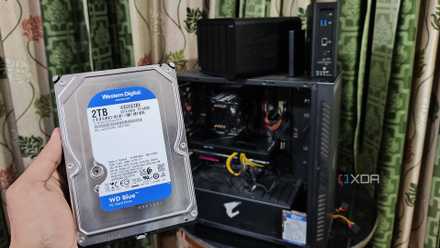
Although my motherboard features plenty of SATA and NVMe ports, I’m at an impasse when it comes to upgrading my storage. The NVMe slots house my boot and gaming drives, and I’ve placed a couple of SATA SSDs in RAID storage for my media and coding files. Since my Internet speed is painfully slow, I keep some less-played titles, ISO files, and emulation ROMs inside two hard drives.
Unfortunately, I seem to have hit the maximum limit on the number of storage drives I can slot into my chassis. Hard drives, in particular, need to be mounted properly, so I can’t just keep a couple of HDDs hanging off my desk. External storage is a useful solution, but with all the accessories and peripherals I use, I only have one spare USB port – that is, after using a PCIe-to-USB adapter to extend the number of connections available to my PC.
But what I do have are some spare NAS units and a high-speed 10 GbE network switch. While network drives are good and all, I can’t really use them to store my game library because they introduce micro-stutter in-game, with certain titles crashing out of the blue when I try running them off an SMB share. That’s where iSCSI drops in, and it’s the reason why I don’t need to upgrade my PC’s storage anytime soon.
4 quirky and fun ways I repurpose my old NAS
That old NAS still has some life left in it!
What’s iSCSI, anyway?
It’s the most accessible block storage protocol out there
In technical jargon, the Internet Small Computer Systems Interface or iSCSI (with a small “i,” mind you) is a network protocol that provides block-level access to your network drives. This makes it a lot different than file storage protocols like SMB or NFS, which are typically used for sharing files with multiple devices rather than hardcore I/O operations.
In simple terms, an iSCSI share will appear as a local drive rather than a network drive, and your PC will treat it as a physical volume. As such, you’ve got all the rights to format the drive and modify its partitions, operations that can typically only be carried out via the server in the case of file storage protocols.
Of course, this means only your PC (or rather the user who has initialized the iSCSI share) can access the contents of the drive, making it terrible when you want to share files with multiple devices. But more on that later…
A 2.5G connection is enough for gaming
Latency is a non-issue even in fast-paced titles
Going back to my storage issue, my NAS provides extra storage for my photo-editing tasks, coding projects, and other non-demanding workloads. Plus, it has enough drive bays for me to accommodate more storage devices, and since I keep everything tucked in a different room, I don’t have to worry about constant HDD vibrations.
But no matter how you slice it, gaming on a network drive sounds preposterous. Well, SMB couldn’t make the cut for my gaming escapades because of random stutters and sudden crashes. Despite the ridiculous premise, an iSCSI-mounted drive is more than enough to run fast-paced titles that require precise input.

I tried storing all of my Steam games on a NAS - here's how it went
The experience wasn't all that bad thanks to the amazing iSCSI protocol
To my surprise, even HDD-powered iSCSI shares have no latency issues whatsoever. Sure, loading times were a lot higher on an iSCSI share than a conventional hard drive, though the SSD speeds weren’t terrible by any means – and that’s just 2.5G speeds!
A 10GbE connection lets my iSCSI SSDs spread their wings
Perfect for my all-SSD NAS units
Folks following my articles will know that I recently upgraded to a PCIe NIC. While it helped solve the random network disconnection issues on my on-board Ethernet adapter, its 10 GbE speeds were a fantastic upgrade for my NAS experiments – especially for my iSCSI shares.
You see, the 2.5G connection restricted my SSD speeds to 250 MB/s, which is more than enough for modern HDDs (provided they aren’t in a high-level RAID configuration, of course). NVMe drives are a different story, with even a PCIe Gen 3 drive capable of hitting 3000MB/s – which is pretty high for a mere 2.5G iSCSI share.
Although a single NVMe drive can choke a 10 GbE connection with ease, 1200 MB/s is still a noticeable improvement over my 2.5G Ethernet adapter. The 10GbE connection reduces the boot times and fast travel times (in open-world games that support this feature) considerably when I use my NVMe drives as the iSCSI targets.
It’s not a viable project for everyone
Despite my positive experience with using iSCSI-mounted shares to expand my PC’s storage, I have to admit that it’s not the perfect replacement for conventional storage. Nor is it the ideal option for all NAS users. The biggest drawback of an iSCSI share is that I can’t share it with the other devices in my network, and as you can infer from the speed statistics, my NVMe drives won’t be able to attain blazing-fast speeds even with a 10 Gigabit connection.
Unlike me, if you’ve got spare NVMe slots (or even vacant PCIe cards, for that matter), it’s always a good idea to plug an SSD into them rather than rely on an iSCSI share. Then there’s the fact that I need my NAS rig operational whenever I want to play games. Since I run my storage server 24/7 anyway, storing excess games, 4K videos, and other heavy files on a couple of drives doesn’t add too much to my energy bills.