
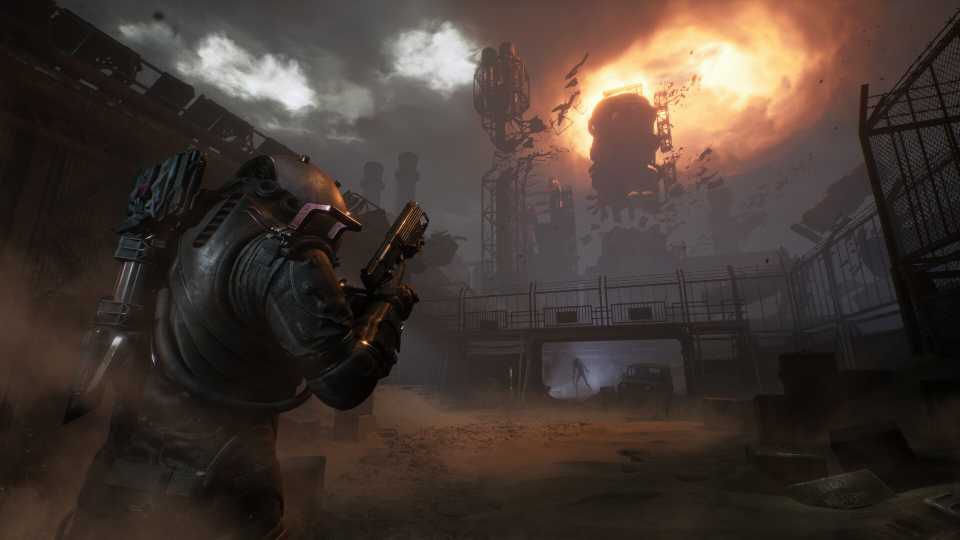
Five hours into Cronos: The New Dawn, I witnessed two characters wearing heavy, steel spacesuits, conversing with each other under the remains of a dilapidated and crumbling '80s Communist town. The area was teeming with organic biomass and mechanical tendrils and wires, all while the two discussed the fate of the universe, the plight of the human condition, and cats — how they knock things off tables, how they pretend to be unavailable yet crave attention, and how they are almost purr-fect.
That was perhaps the first moment in the game where I cracked a smile, after five straight hours of unrelenting tension and fear, and my deathly grip on the controller loosened for the first time that night. Cronos: The New Dawn is the new AAA survival-horror game in town, and I had been excited about it for a while now, considering it comes from Bloober Team, the creators of the fantastic Silent Hill 2 remake that did everything right and gave me one of the scariest gaming experiences I remember playing recently.
Cronos: The New Dawn was purchased by our team for review after release. The game was tested and reviewed on PC.
Cronos: The New Dawn
-
👁 Placeholder Image
OpenCritic Reviews - Top Critic Avg: 78/100 Critics Rec: 77%

- Released
- September 5, 2025
- ESRB
- Mature 17+ / Intense Violence, Blood and Gore, Strong Language
- Developer(s)
- Bloober Team
- Publisher(s)
- Bloober Team





WHERE TO PLAY


- Engine
- Unreal Engine 5
- Genre(s)
- Survival Horror, Science Fiction, Action
- Atmosphere drenched in tension and fear
- Incredible visual design of '80s Polish town
- Immensely nerve-wracking boss fights
- Combat feels unoriginal and derivative
- Incredibly linear gameplay with a mildly-padded narrative
Cronos: The New Dawn price and availability
Bloober Team's Cronos: The New Dawn is available to play on PC, Xbox Series X|S, PlayStation 5, Nintendo Switch 2, Linux, and macOS. The game is not enhanced for PS5 Pro. It is available in two editions:
- Standard Edition ($60): The base game.
- Deluxe Edition ($70): The base game, digital artbook, original soundtrack, and additional resources in-game.
Things are getting 'Stranger'
New Dawn is a fantastic setting for a survival-horror game
Cronos: The New Dawn awakens you in an '80s Polish town called New Dawn. The entire city is crumbling, floating, and engulfed in darkness and something sinister. The best way to describe this would be to perhaps liken it to being in The Upside Down. At first, this comparison came to me rather bizarrely, but the synth soundtrack, the setting, the constant time manipulation and jumping between the 80s and the present, along with everything grotesque I saw, all of it felt like this could very well have been a spin-off of the Netflix series. Now, I'm going to stop talking about the show, since I don't want it to sound like I'm saying there's nothing original about the setting.
The game is incredibly atmospheric, and it constantly felt like I was in the Upside Down.
Cronos: The New Dawn's setting of a destroyed '80s Polish town is entirely impressive, it's incredibly atmospheric, and the comparison to The Upside Down is to give you a sense of just how well done the visual team's efforts have been. The entire city of New Dawn being a communist haven also adds to the whole comparison, but hey, even if you're one of the two people left in the world who haven't watched Stranger Things, the setting is going to be just as intriguing and visually impactful.
Exploration in the game is pretty straightforward. It's never just corridors or buildings and rooms, though. After all, the game is set in a fictional Polish town that was one of the biggest communities in the world, which means you do get to traverse through plenty of open areas. However, they're more open visually than they are physically. The only detours Cronos: The New Dawn offers are extremely deliberate and charted out, which makes the game heavily linear. Not that I have any complaints at all about that. It's terribly linear, and that makes things fun.
The New Dawn's setting and narrative are unique
An immensely thrilling mystery that keeps you guessing
Right off the bat, the game pulls you in with an incredibly intriguing setting, where you don't exactly know what's going on, but everything you hear and see is just so immensely curious that you can't help but go on. Of course, there's tension in the air since it's a survival horror game, but it's also palpable from the very start. You don't really know what's going on here just yet, and even though you do know what it is you're supposed to be doing, every step is measured simply because you don't have all the variables yet.
You're 'a traveler' whose sole aim is to follow in the steps of their predecessor, and that's how the game starts. It barely tells you anything else, except for what you piece together from environmental and contextual clues. New Dawn keeps you on your toes with new mechanics and weapons, but even in your first few hours of interacting with 'time anomalies' and 'oddities' or weapons named 'Hammer' that can transform into shotguns, you don't quite know what's going on. That's the part I love the most — nothing has to make sense right off the bat, and the atmosphere makes sure you never lose interest.
The gameplay will keep you engaged throughout
It just brings nothing new to the table
The gameplay is nothing you haven't seen before, although that can really be said for any major AAA game worth its salt in the past decades, except when you come across something like my GOTY 2025 candidate. In New Dawn, as The Traveler, you're going to be exploring a crumbling city that was established in the '80s, and who knows how much time has passed, especially with time manipulation and travel thrown into the mix?
Walking through tight, claustrophobic corridors as you go towards your targets, you'll encounter grotesque, once-human monstrosities called Orphans. Your weapons are always going to be able to deal with them, but your body won't, which is why you need to constantly stay on the move and avoid damage while dishing out as much as you can. Par for the course, right?
Exploration is very Resident Evil-esque, although almost every game today follows a similar gameplay loop.
Exploration here is largely linear, too. For example, in the third hour of the game, you start encountering doors that are chained up in bright red chains — the universal sign that you need bolt-cutters. So, the next few letters you encounter along the way will, of course, talk about the nearby hardware store and how to go there, with progression in the main story stalling while you get the keys to the store to acquire said cutters. It's very Resident Evil-esque, although at this point, almost every game such as this one follows a similar gameplay loop.
Inventory management in New Dawn is a key mechanic. Do I waste an inventory slot by keeping the cutters with me in case I run into a locked door with resources behind it, or do I leave them in my stash, and only come running all the way back if I come across some chains? That's the part that also becomes an impediment to the smooth flow of the gameplay loop — I'd enter a safe zone, get all my duck in a row vis-à-vis resources and inventory management, and then leave, only to have to return just five minutes later because I came across a door requiring bolt cutters.
Sure, the game makes sure that you never have to backtrack too much, but it still could've been implemented better. I see its faults, but largely speaking, I still don't have too many complaints because such moments were few and far between, much like the safe zones in the game.
Cronos: The New Dawn's combat is incredibly tense
The stress of each combat encounter keeps you on the edge at all times
The phrase "every bullet counts" or "every resource matters" has been thrown around excessively for a lot of survival horror games over the past, and yet, I can't remember any game that is as zealous about it as Cronos: The New Dawn. Heck, I ran out of bullets in my first encounter because I missed one single shot, and had to resort to melee attacks and stomping, both of which got me fatally damaged. And you know what? I loved it. This was a glaring red banner from the game about how I couldn't afford any missed shots, and it just so happened to throw that banner straight in my face instead of just letting me read it.
Plus, I always found myself gambling with either my health or my ammo, which was clever design on the game's part. If I get out of the way to dodge an attack and reposition myself, I would risk an enemy getting the time to merge with a fallen Orphan, thus becoming stronger and requiring more ammo. If I don't, it stays weak, but also gets its tendrils on my spacesuit.
The incredibly tense and nerve-wracking boss fights were the highlight of the game for me.
The highlight of the game, for me, were the boss fights and the mini-boss fights. They come out of nowhere, and boy do they get your heart racing. The bosses are the toughest, and I am not exaggerating a single bit when I say you'll have to use every resource at your disposal as well as in the environment, all while struggling to keep your heart rate calm.
The game didn't actually present too many opportunities for this, but there were times when you could use your time-manipulation abilities to restructure and bring back explosive barrels to use them repeatedly at enemies. Sadly, that's the only novelty I felt during combat situations.
The combat suffers from a lack of novelty
The good, the bad, the Dead Space
Still, that's quite literally all there is to the combat. When I say it's nothing you haven't seen before, I mean it. The weapon you use can transform themselves a-la the Service Weapon from 2019's Control. The enemies that shamble towards you feel like re-skinned Necromorphs from Dead Space. The tram station, hospital, and apartment complex locations, among the others you'd explore, are not unique in setting, but certainly impactful in atmosphere.
The combat itself, while enjoyable, is simply... unoriginal. The one unique mechanic Bloober Team tries in Cronos: The New Dawn, is how one enemy can absorb a fallen one, turning stronger and requiring more ammo and time to take down. However, it falls miserably short of being 'new enough'. Outside of one weapon and a few enemies to shoot at, there's nothing new going on here that sets the game's combat apart from a sea of other survival horror titles, especially when compared to the game it's trying to succeed spiritually — Dead Space. Where we had kinesis and stasis effects to add to the combat, either by slowing down some Necromorphs to keep them at bay, or ripping off their own limbs to attack them with, The New Dawn presents no novel combat mechanics that it can call its own.
The 'novel' element here is that you must make sure to burn Orphan corpses, lest the next one merges with them to become more powerful. This mechanic becomes even more of a threat if an Orphan merges with an armored or venomous enemy, absorbing its abilities. Sadly, it doesn't really work. I barely ever burnt an Orphan corpse, instead just choosing to make well-placed shots to stop the merging process in its tracks. It isn't a threat at all, and since the game doesn't have any difficulty settings, there's never a chance for it to become one, either.
The game excels at fear and tension
My fingerprints are probably dug into the controller at this point
The moment-to-moment exploration in Cronos does manage to be very tense throughout. The cramped corridors, small rooms, and biomass-ridden basements and hallways all come together to keep you on edge. Everything your flashlight doesn't illuminate is almost always drowned in pitch-black darkness, ramping up your fear of the unknown. I also made the mistake of playing the first 6 hours in the middle of the night, which only made matters worse, making me miss shots out of sheer terror more often than I'd like to admit.
Combat is where tensions are highest in Cronos: The New Dawn.
Combat is where tensions are highest in Cronos: The New Dawn, and, well, that's the way it should be. The game always finds a way to throw you into tight, claustrophobic spaces with orphans, and while you'd think that tighter spaces would make aiming easier, it was just the opposite. You're constantly having to move around since the game doesn't give you a block or dodge button, owing to the lumbering suit of armor The Traveler wears.
With that in mind, you must always be on your feet, which makes aiming tough, and charging up a shot even tougher, presenting a risk-reward system for every single bullet that escapes your weapon. As an orphan prepares to lunge at you, do you charge up your shot for extra oomph, or do you use two bullets instead of one to keep them away?
There are plenty of moments even in the early hours when you'll find yourself in tough spots with more than just a couple of enemies. It's the usual affair — you're going towards a door that suddenly locks, and then a wave of enemies swarms you, so you have to get rid of them before being able to progress. With this, then stress ramps up immensely, and I must admit to dying a bunch of times.
Sometimes, after one missed shot too many, I simply chose to give up and die so I could try again with fewer shots, and that's where the game shined most. It marries the tension of combat with that of the grotesque, along with the stress of inventory management. It's peak Dead Space, and I couldn't believe my luck that I was able to play the fantastic Dead Space remake while also being able to experience a similarly polished and well-developed game just two years later.
The plot is intriguing, but nothing to write home about
I kept wondering what's going to happen next, but where the story goes isn't all that incredible
The game's plot follows you, The Traveler, as you work for an abstract, mysterious organization known as The Collective. Your job is to hop through time rifts and meet individuals of significance, and your role, as well as that of The Collective, in the goings-on of the city of New Dawn is revealed layer by layer. The narrative takes its time to slowly unveil all elements, but it makes sure you're invested throughout with just the right amount of knowledge-drip at key moments.
This is where the Dead Space comparisons make the most sense, too. You're exploring this whole community, and you're slowly seeing, through context clues and tapes and letters, what it was that became the catalyst for the dreadful things that began happening here, all those years ago. It's like intruding on this community's personal tragedies, and yet, being compelled to power through to know more about what happened. The time manipulation in the game is what makes things so different and intriguing at the same time. There's never a moment when you're not trying to fill in the next piece of the puzzle in your head, even before you have it in the game.
Overall, Cronos's plot is intriguing, yes, but if you're not someone who likes to have their stories presented through slow, deliberate breadcrumbs, then it might not be for you. It's also padded up significantly with long fetch quests like turning on generators or finding bolt-cutters across a city, all of which come together to make for an impressive but not unforgettable experience.
-
👁 Placeholder Image
OpenCritic Reviews - Top Critic Avg: 78/100 Critics Rec: 77%
- Released
- September 5, 2025
- ESRB
- Mature 17+ / Intense Violence, Blood and Gore, Strong Language
- Developer(s)
- Bloober Team
- Publisher(s)
- Bloober Team
WHERE TO PLAY
- Engine
- Unreal Engine 5
- Genre(s)
- Survival Horror, Science Fiction, Action
Verdict: Should you buy Cronos: The New Dawn?
It's a title I couldn't put down once I started, but I would recommend waiting for a sale to try this one out.
We've got some rather significant AAA titles releasing this month and in the next quarter, with major games like Dying Light: The Beast, Silent Hill F, and Borderlands 4 coming out in September itself. Alongside those, Cronos: The New Dawn's $60 price tag does look just a bit too demanding, especially if you've rationed out your purchases till the end of the year.
Still, with its clear Dead Space roots, impressive tension-building and atmosphere, and a genuinely engaging narrative, The New Dawn does present itself to be a rather remarkable title in the survival-horror space, and I have no doubt that perhaps a DLC or even a sequel, could turn this into one of the biggest franchises in this genre, as time goes on. For a first outing with an original new IP, Cronos: The New Dawn is genuinely a great game, even if it falls just a tiny bit short of going head-to-head with the likes of a full-blown Dead Space or Resident Evil game. Still, I have no doubt that this is a game that has come the closest to being a new-age Dead Space, and for that, Bloober Team deserves flowers.
In the end, the game's slick visual language and tense combat do present a title you won't be able to put down at all, but I can't help but recommend waiting for a sale to try this one out. The holidays are right around the corner, and we may very well see the $60 price go down a bit come Halloween, which would be the perfect time to purchase Cronos on sale.