
GPU manufacturers are always looking for ways to push the limits of performance. Every square nanometer matters, and as GPUs continue to get more complex, so do the technologies that work along with them. DLSS, or Deep Learning Super Sampling, is one such technology that Nvidia introduced in 2018, along with the launch of the RTX 20 series. In the present day, DLSS has become such a huge selling point for Nvidia's GPUs, to the point where I actually think it has become their primary weakness, and here's why.
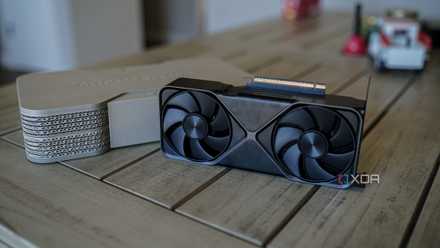
The Nvidia RTX 5070 is even more disappointing than I expected
Nvidia's RTX 5070 is gunning for the 1440p crown, but it fails to stand out from the half dozen other options already available around $550.
DLSS lengthens life of hardware
A great thing for the frugal PC consumer
To give you a quick and dirty rundown of how DLSS works, it's an upscaling technology that allows your GPU to render everything at a lower resolution than what ends up being displayed. The low-resolution render is put through an upscaler that uses AI to fill the gap between it and a higher-resolution image. DLSS has gone through sweeping changes during its development, with each version often working in a completely different way than the previous one. Initially, DLSS had to be trained on specific games in order to work with them, but now the technology works on many games, irrespective of training data.
Initially, DLSS was only supported by a couple of games and was released to very minimal acclaim. It created far too many artifacts and didn't come with enough of a performance benefit to be worth using. But as Nvidia developed the technology further, the performance gains increased, and with it, less visual fidelity was sacrificed. As of January 2025, Nvidia claims that over 80% of gamers turn DLSS on. It's unknown exactly how this data should be interpreted, but it's impressive on the surface.
With some thought, it does make sense. The most popular GPUs are in the mid-range; the 3060s and 4060s of the world are not only the most ubiquitous, they're also the ones that benefit the most from DLSS. Why not turn it on if it adds significant improvement without sacrificing much visual fidelity? Without DLSS, I really don't believe cards like the 3060 and 4060 would remain in PCs for as long as they have. Many 20 series owners upgraded to the 30 series because the generational uplift was great, but since then, if DLSS allows gamers to squeeze some more life out of their cards, why would they upgrade?

5 real reasons why no one buys AMD GPUs
AMD has remained the better value option for years, so why doesn't it get more love from consumers?
RTX 40 series owners have little reason to upgrade
Most of the bells and whistles of DLSS came before the 50 series
With each DLSS release also came additional features, one of which being Frame Generation. While it doesn't have anything to do with supersampling or upscaling, it still falls under the DLSS umbrella, and requires an RTX 40 series GPU to run. Frame Generation does what it says on the tin: it generates entire frames using AI that are then inserted between real frames, in theory giving better performance.
With the release of the RTX 50 series, NVIDIA introduced DLSS Multi-Frame Generation (MFG) to a rather mixed response. Frame Generation was available on RTX 40 series GPUs, but was limited to one extra frame generated per "real" frame. Exclusive to the RTX 50 series, MFG allows for up to 4X frame generation, which would mean when using the "Performance" DLSS setting with MFG enabled, at 4K resolution, three extra frames would be generated from one 1080p frame. This sounds like a significant performance increase for little additional overhead, but the truth is, MFG only works well when the base framerate is high enough. Otherwise, the latency felt during gameplay is accentuated too heavily to be worth having it on.
MFG was the technology that Nvidia was pushing heavily with the RTX 50 series. The GPUs themselves have been a mess, but if this technology was supposed to be the main selling point beyond pure gen-to-gen performance gains, then RTX 40 (and even 30 owners, to an extent) have no reason to upgrade. Most gamers are happily playing their favorite titles at 1080p, turning on DLSS 3.5 when they need to.
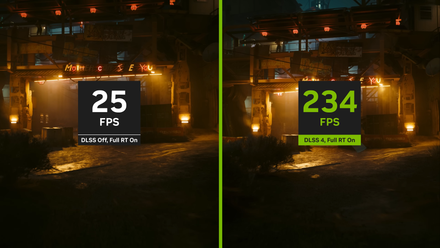
Nvidia's DLSS 4 multi frame generation works best when it doesn't make sense to use it
If you want to use Nvidia's new multi frame generation, keep in mind that there are very specific times where it can actually make a difference.
Is AI rendering the new normal?
Maybe MFG really is the future
Nvidia could very well be right when they talk about pure raster as "brute force rendering." Technologies like DLSS and MFG could very well be the future if they find a way around the latency issues. MFG is locked to the 50 series, although it can technically be run on 40 series hardware. Nothing is stopping Nvidia from making proprietary features baked into the hardware that enable more AI-based rendering tech. They've done this before with ray tracing; GTX cards simply aren't capable of running any kind of ray tracing whatsoever, so I wouldn't put it past Nvidia to take this a step further. At that point, it might not just be strong-arm tactics, it might actually be worth it to buy a new RTX GPU. Consumers will also feel that sense of brand loyalty as well if their Nvidia GPU lasts them a long time.

7 ways Nvidia's DLSS 4 is making the future of gaming happen today
DLSS 4 shows upscaling is the future of gaming.
AMD is catching up quickly
RT performance took a leap forward with RDNA 4
The reality of the GPU situation is beginning to look a bit different, though. MFG really wasn't the slam dunk NVIDIA thought it was going to be, and the other DLSS features that are actually popular with gamers are available on older cards. So long as games don't suddenly require loads of horsepower to run at reasonable settings, there are going to be a lot of gamers either sticking with their current RTX 40 and 30 series cards, or even buying AMD.
Not only have we seen significant improvement in ray tracing with RDNA 4, but FidelityFX Super Resolution (FSR) is beginning to make big strides. FSR is AMD's equivalent technology to DLSS. FSR 2 had no chance against DLSS 3.5 and 4, but now, FSR 3 looks to fall somewhere between the two in image quality and performance. Upscaling is no longer a clear win for the Green Team, and that might just be enough for some consumers to give the Red Team a try.
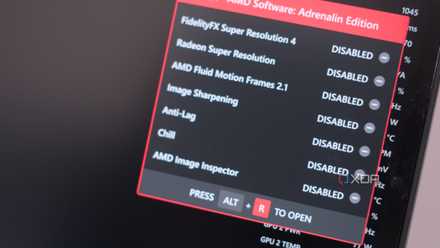
5 settings to change to get the most out of your AMD RDNA 4 GPU
Ready to unlock the full potential of your new AMD GPU?
DLSS 3.5 is part of why the RTX 50 series flopped
Simply put, the performance and image quality of DLSS without MFG is still more than enough for most consumers. Enthusiasts absolutely saw straight through Nvidia's marketing, but even for the casual consumer it seemed too good to be true. Obviously, most people will still upgrade eventually anyway, but as of right now, Nvidia has a technology in DLSS that makes new releases look bad, not only in the way that Nvidia chooses to market them, but also because GPUs seem to last longer than they ever have before.