
For the longest time in PC gaming, visual fidelity and raw performance existed on opposite ends of the spectrum. You either compromise on image quality to maintain high frame rates or endure a rather sluggish experience to enjoy the latest graphical bells and whistles, which is a compromise RTX 20-series owners are painfully familiar with.
Nvidia's new transformer technology seeks to subvert this expectation, promising an uplift in both fidelity and performance through the proprietary DLSS 4.5, which is available even for much older GPU architectures. This promise naturally carries some heavy expectations, and curious to know how well Team Green will deliver on this promise, I dusted off my RTX 2070 Super to benchmark some of the most popular titles amongst gamers.
A look inside the 'test bench'
What's under the hood?
To put DLSS 4.5 to the ultimate test, I'm using a setup that reflects the reality of many modern gaming rigs rather than a dedicated gaming rig. At the heart of this system is an RTX 2070 Super with 8GB of VRAM, paired with a Ryzen 5 3600 processor. The output is handled by a standard 1080p display, keeping the resolution grounded in the most common gaming experience today.
This configuration is intentionally dated to see how the new transformer model responds to older, more modest hardware, more reflective of the broader market. According to the latest December 2025 Steam Hardware Survey, roughly 32.6% of gamers are running 8GB of VRAM, and the vast majority continue to use 1080p as their primary resolution. With a low enough baseline, it's fairly easy to establish whether these software advancements offer a genuine advantage to the average user, or if they're best suited for cutting-edge hardware.
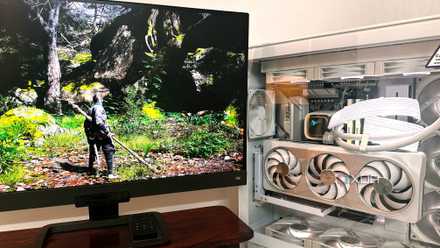
DLSS 4.5 is expensive, but it’s the best thing to happen to my aging RTX PC
The upside is remarkable, but the cost isn't equal for all.
Establishing the baseline of performance
DLSS 4.0 and 4.5 go head-to-head
The results for DLSS 4.0 (Preset K) revealed a performance profile that's largely consistent with expectations for this hardware tier. In Forza Horizon 5, the system achieved a decent 66 FPS at 1080p resolution, even while pushing the demanding "Extreme" preset. Meanwhile, Cyberpunk 2077 running on high settings returned a healthy 80.86 FPS average. This confirms that, while no longer flagship silicon, the 2070 Super remains a capable performer at this resolution.
The choice of testing titles was intentional, as the two focus on titles that represent opposing ends of the optimization spectrum. Cyberpunk 2077 remains the de facto "gold standard" for hardware benchmarking as it is one of the most graphically demanding and highly scalable titles of the decade. Forza Horizon 5, by contrast, represents the pinnacle of optimization in racing games, as despite featuring diverse terrain and dynamic weather effects that push rasterization capabilities, it remains remarkably friendly to older hardware. The stunning visuals also make it easy to demarcate any changes to image quality or graphical fidelity.
|
Title |
Graphics Preset |
DLSS Scaling |
Model Preset |
Average FPS |
|---|---|---|---|---|
|
Forza Horizon 5 |
Extreme |
Performance |
K |
66.0 |
|
Cyberpunk 2077 |
High |
Performance |
K |
80.86 |
Model K represents the first-generation Transformer (DLSS 4.0), while Model M refers to the second-generation model (DLSS 4.5).
How well does the 2070 Super handle DLSS 4.5?
"Expect disappointment, and never be disappointed."
Despite initial architectural concerns, the implementation of Model Preset M (which corresponds to DLSS 4.5 Performance) on the 2070 Super tells a surprising story. Because the GPU lacks native FP8 acceleration, it was expected that the second-gen Transformer (roughly 5x more compute-intensive) would introduce a ginormous performance overhead to the old Turing card. This is also consistent with Nvidia's updated DLSS Programming Guide.
While testing, however, Preset M subverted these expectations to a large extent by delivering an efficient performance across the board. The image quality is undeniably richer, offering a level of 'vividness' and stability that makes an aged GPU behave like a high-end card. As a matter of fact, the graphics were virtually indistinguishable from more recent hardware like the RTX 4070 Ti Super, which is enough evidence that the new Transformer model can be implemented and integrated with remarkable efficiency and offer improvements in fidelity despite the age of the hardware. The "Turing tax" amounted to an average of 9.8%. However, much of this impact was likely mitigated by ray-tracing features being disabled, which reduces the burden on CUDA cores.
|
Title |
DLSS Preset |
Average FPS (K) |
Average FPS (M) |
Δ Performance |
|---|---|---|---|---|
|
Forza Horizon 5 |
Performance |
66.0 |
58 |
-12.2% |
|
Cyberpunk 2077 |
Performance |
80.86 |
75.5 |
-7.4% |
Nvidia may have been cautious in their estimates, keeping in mind a multitude of factors such as silicon variance, thermal environments, ray-tracing capabilities and other performance delta averages, but if the results of this test are to be considered, DLSS 4.5 seems like a genuine, late-stage gift for aging hardware.
It's a very pleasant surprise for those on older hardware
Testing DLSS 4.5 on the RTX 2070 Super has been a revelation that, in a way, defies official warnings. Nvidia's own statement was clear — because the 20-series cards lack the architectural advancements to leverage the best out of the new Transformer technology, a "heavier performance impact" was to be expected, potentially making the older DLSS 4.0 the optimal choice for users on 20 and 30-series GPUs.
In the tests, however, only a negligible tax of 9-10% was observed, which, in perspective, seems like a small price to pay for an unequivocally high-end visual experience for those who don't care much about ray-tracing or path-tracing features. Model M is a significant leap from its predecessors in delivering image stability and richness that makes the "old architecture" tax on older hardware almost justifiable. As expected, Nvidia may have been cautious in their estimates, keeping in mind a multitude of factors such as silicon variance, thermal environments, ray-tracing capabilities and other performance delta averages, but if the results of these tests are to be considered, DLSS 4.5 seems like a genuine, late-stage gift for aging hardware.