
Chasing the latest and greatest performance in videogames and the most advanced graphics features used to be what everyone wanted to do with their PC. Each new generation of GPUs introduced some huge leaps in performance, or completely new capabilities like ray tracing and AI upscaling that completely changed the game (literally). I'll admit I'm not much of a PC hardware guy when it comes to my purchases, but I did enjoy following these developments and seeing what each generation brought.
Today, though — and for the last couple of years — that excitement has been dwindling when it comes to desktop PCs. Instead, the exciting graphics developments these days are all focused on integrated GPUs, which I'd argue are far more interesting today than the big desktop cards. Let me explain why.
Unrealistic prices and diminishing returns
All leading to the RTX 50 series launch
For years now, and especially since 2020, GPU prices had already been on a seemingly never-ending upswing on the back of supply issues and increasingly high demand due to cryptocurrency mining and then AI. This had already made it unrealistic for the vast majority of gamers to truly care about the latest developments in GPU tech since they were always going to be out of their reach. The GeForce RTX 4090 launched for an insane $1,599 price tag, and even then, finding one at MSRP was unlikely at best.
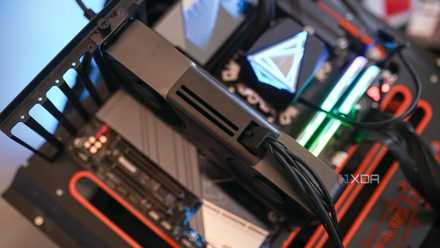
To make matters worse, these GPUs are using more and more power, and often becoming bigger while offering relatively small performance gains when it comes to rasterization. The big selling point of Nvidia's newer GPUs has been frame generation, and now multi-frame generation with the RTX 50 series, but this kind of performance boost only takes you so far when there are other things to consider, like latency and visual artifacts that can appear by using this tech.
It all culminated in the RTX 50 series launch which, on top of facing the same familiar problems users have been dealing with, came with hardware and software faults, with reports of driver instability and cables getting far too hot. It was one of the most unexciting Nvidia launches I've ever followed. AMD did deliver some exciting stuff with the Radeon RX 9070, but it's not trying to compete with Nvidia's flagship models.
Unfinished PC hardware is here to stay, just like broken PC games
Manufacturers aren't done launching broken PC components
Apple started a revolution
Integrated GPUs needed a serious boost
The increased interest in integrated GPUs felt like it got more serious starting around 2020, and it's hard not to look at Apple as something of a catalyst for this change. When the Cupertino giant announced its shift away from Intel processors and towards its in-house Apple Silicon, the performance uplift was basically universal, but there was one area that was clearly more noticeable — the GPU performance.
Compared to equivalent Windows PCs at the time, the Apple M1 delivered a massive upgrade in graphics performance, which may not have meant much for gaming in the long run, but it clearly showed that Intel and AMD needed to stay on their toes to offer a product that could offer a comparable experience on the Windows side. Even if no one is gaming on a Mac, that added GPU power is very useful for things like photo and video editing, and Intel still needed to compete there.
After this, Apple, Intel, and AMD all started putting a lot more work into graphics prowess. While Intel already delivered a big GPU upgrade in 2020 with Tiger Lake, it happened again with Meteor Lake in late 2023 and then again in 2024 with Lunar Lake — two huge graphics performance bumps in a row. AMD delivered a big performance improvement with the Radeon 6000 series on laptops in 2022, and kept improving on that with the Ryzen 7040 lineup and most recently with the Ryzen AI 300 series. All the while, Apple also kept delivering big GPU upgrades with each generation of Apple Silicon, especially the M3 and M4 models. Plus, Qualcomm entered the race with the very competent Snapdragon X Elite that brought the threat of Arm even closer to Intel and AMD's home turf.
Gaming on a thin and light laptop would have been an absolutely ludicrous idea a few years ago, but these days, any premium laptop can at the very least run basically any game you throw at it with some tweaked settings. Of course, not at max settings, but these developments have made gaming possible for a wider audience than ever without sacrificing portability, and that's very exciting to see.
Big integrated GPUs are becoming a thing, too
Unified memory on large chips can have advantages
Apple did something else that I believe is also very interesting for integrated GPUs, which was pushing the idea of increasingly larger GPUs in a unified form factor. Until Apple Silicon, most integrated GPUs were small portions of an already small chip, but Apple needed more powerful GPUs for creators, so the Apple M1 Max and M1 Ultra (and their respective follow-ups) are very large chips with equally big GPUs, which Apple touted as competitors to big desktop GPUs, offering similar performance for a much lower power cost (albeit with a much smaller power ceiling as well, meaning desktop GPUs can still be much faster).
I didn't think this would really start a trend, but lo and behold, AMD just recently joined the fray with the Ryzen AI Max series, which is following the exact same philosophy. These are big chips with a lot of CPU cores, and big GPU options available that AMD claims can offer equivalent performance to many mid-range discrete GPUs, all in a more efficient package. And just like Apple, these chips have a unified memory structure, with RAM being built onto the processor itself and going up to massive quantities like 128GB.
Even if this kind of chip clearly isn't for everyone, it does allow for more compact form factors to offer the experiences people want. Even Framework, a company known for upgradeability and repairability, opted to offer its newest Framework Desktop with one of these unified chips instead of using a discrete CPU and GPU, because that allows the processor to be used in more interesting ways, providing much larger amounts of memory to the GPU on demand without a speed sacrifice, all while also fitting in a smaller package than having these two separate components.
Gaming handhelds are all the rage
Thank you, Steam Deck
I'm not trying to sound like an Apple fanboy here, so of course I have to credit what's probably the biggest driving force behind better integrated graphics, and that's gaming handhelds. The Nintendo Switch showed that handheld gaming devices that can connect to a bigger screen still have a very passionate and large audience, and a few years later, the Steam Deck showed that this can truly be done for the PC space, too. PC gaming handhelds existed before that, but they were a niche only catered to by small unknown companies, and Valve propelled the form factor to stardom.
A lot of the same points that apply to laptops apply here. Outside of dedicated handheld consoles from the likes of Nintendo, playing your games portably simply wasn't feasible before the Steam Deck for most people. There were no processors capable of delivering a good experience running modern PC games in this form factor, and that's why no one cared. The Steam Deck made it possible to take absolutely huge demanding games like Elden Ring on the go and actually have a good experience with it.
And with more eyes on this market, people started wanting better and better experiences on these devices, so the market for more powerful handhelds started to develop, with newer chips from Intel and AMD consistently battling it out to enable a better experience. Intel Lunar Lake and AMD's Ryzen AI 300 series chips are absolute best ways to play your games on the go right now, and it's no doubt because of this market.

Should you buy a PC, laptop, or handheld to get your gaming fix in 2024?
It’s a tricky choice, but once you narrow down your needs, the right device will become clear.
The best gaming device is the one you have
Desktop GPUs are obviously faster, but does that matter?
You may read what I've been saying and say that desktop GPUs like the Nvidia GeForce RTX 5090 or the AMD Radeon RX 9070 XT are still far more capable and and produce infinitely better-looking visuals, and that's obviously true. Things like ray tracing will still bring a lot of these handheld devices to their knees, and most of the time, they need technologies like Intel's XeSS or AMD FSR to offer a pleasant frame rate. But that is also partly why integrated GPU developments are so much more exciting now.
Each new generational development on the desktop these days brings features that have less and less of an impact on gamers' experiences. Sure, these games look better and run smoother, but it's not like they looked bad or necessarily ran poorly with the previous generation of GPUs.
It's a different story with handhelds because we're witnessing the transition from an era where PC gaming could only be done on a big desktop PC or a bulky laptop that ruins your back if you carry it in a backpack, to an era where these games can be played in the palm of your hand, even without paying for some unreliable cloud service.
It's making gaming accessible to a lot more people and in a lot more places. You don't have to be confined to a desk with a big gaming rig anymore. And with each new generation, the little improvements we get have a much more noticeable impact on how playable and pleasant these gaming experiences are. We're rediscovering a lot of the things that are already more than standardized on the desktop, but this new context where you're able to enjoy those experiences anywhere comfortably makes things exciting all over again.
How long can gaming handhelds carry this excitement?
It's crystal clear to me that integrated graphics are more exciting than discrete GPUs at this moment, but the law of diminishing returns is inescapable, and ultimately, it's going to come for these small form factors, too. Processors are already using incredibly small nodes and shrinking further is getting more costly, so it's going to be hard to squeeze more performance out of a gaming handheld, too.
For now, though, it's good to live in this moment where handheld gaming is more prevalent than ever thanks to the huge developments that have been happening with integrated GPUs. We'll have to see if it keeps up for the next few years.