
By all accounts, 2024 was a lackluster year for PC hardware, especially for graphics cards. Next-gen GPUs that were originally slated to launch in the last few months of the year got pushed to 2025, and the RTX 40 series Super refresh failed to achieve anything of note. In contrast, 2025 could turn out to be much more interesting than people think.
Despite my apprehensions about Nvidia's RTX 5000 series, I'm excited about the desktop GPU market, thanks to Team Blue and Team Red. With several developments finally taking concrete shape, we can expect Intel and AMD to duke it out as Nvidia plays its own separate game. AMD has course-corrected with its RX 9000 series (not a typo), while Intel's Battlemage has the potential to be the dark horse of 2025's gaming GPUs.

3 reasons I'm scared my RTX 5000 dream might go up in smoke
I'm convinced I want to switch from the RTX 3080 to the RTX 5080, but Nvidia will not make it easy
Nvidia has left AMD and Intel in unfamiliar territory
Intel vs. AMD is no longer about CPUs alone
For a multitude of reasons, right or wrong, Nvidia rules the GPU market with an iron fist. Almost every discussion about GPUs and graphics software involves benchmarking AMD with the latest trend set by Nvidia. Team Green managed to convince the majority of gamers that ray tracing is important, cornering market share and selling overpriced GPUs every generation. AMD, on the other hand, was left playing second fiddle.
"AMD vs. Intel" was always about CPUs — they never found themselves competing in the GPU space until now. AMD has exited the high-end desktop GPU market as far as RDNA 4 is concerned. The company finally stopped playing catch-up with Nvidia, deciding to focus on mid-range and budget GPUs with its RX 9000 series cards (they're skipping the 8000 nomenclature). However, Team Red probably didn't expect Intel's second-gen Arc Battlemage GPUs to offer any real competition.
Intel's Battlemage series launched with a bang in the form of the Arc B580, striking the perfect balance between performance, price, and software reliability. This trifecta places Team Blue in a much better position than anyone hoped for. Sure, Intel's Alchemist series was mostly fine for budget buyers, but this time around, the company isn't planning to stop there. It has signaled to AMD that the mid-range segment in 2025 isn't going to be uncontested either.
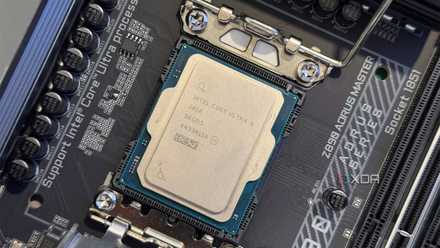
Intel will be stronger than ever in 2025 - here's why
Despite its somewhat disastrous 2024, there's reason to believe Intel will be back with a vengeance next year
Intel's Battlemage is battle-tested
Not an afterthought anymore
It's not just the fact that Intel is doubling down on its desktop GPU resurgence, but the way they're doing it. The second-gen Battlemage GPUs aren't just a customary iteration of the company's Alchemist architecture but a genuine step forward in the right direction. Intel took the lessons from Alchemist to heart, returned to the drawing board, and returned with a definitive answer to all its previous shortcomings.
The Battlemage architecture boasts more caching, improved shaders, and support for XeSS Frame Generation (XeSS-FG) and XeSS Super Resolution (XeSS-SR). While Intel's claim of 24% faster performance over the Arc A750 might not sound earth-shattering, it's the overall package that has gotten the Arc B580 rave reviews. At just $250, the first Battlemage GPU out of the gate handily beats the $300 RTX 4060.
With 12GB of VRAM and stellar ray tracing performance compared to the competition, the Arc B580 promises great things for the upcoming Battlemage GPUs. After securing its spot as the best-value card in the budget segment, Intel might be gunning for AMD's current and forthcoming mid-range cards. It will be interesting to see AMD's answer to Intel's extremely promising showing.

10 games that don't need an Nvidia GPU to look amazing
You don't always need an Nvidia RTX graphics card to enjoy the most visually impressive games
Intel might keep AMD in check
No one wants to see another RX 7600
We like to dunk on Nvidia for their scummy tactics and "luxury" GPUs, but AMD isn't innocent, either. During the recent GPU crisis, when consumers were prepared to buy anything, AMD launched worthless graphics cards like the RX 6500 XT, having a pathetic 64-bit memory bus and 4GB of VRAM. Over a year later, the company came out with the RX 7600, built on an older manufacturing process and slower than the RX 6650 XT.
AMD should have provided more value with its recent offering instead of following in Nvidia's footsteps and raising prices for what were widely perceived as inferior products. Intel's success with Battlemage will, hopefully, force AMD not to resort to launching sub-par GPUs in a competition-free market. With Nvidia focusing mostly on the high-end market, we need Intel to occupy the vacuum AMD might otherwise find itself in.
In a delicious twist, consumers will find themselves tossing up AMD GPUs not with Nvidia offerings but rather with Intel's latest GPUs. The new "Nvidia or AMD" might instead become Intel or AMD as the average gamer drops any hopes of buying a worthwhile Nvidia GPU and settles on a mid-range product. How much of a dent Intel can make in AMD's market share remains to be seen.

Nvidia might run the market, but AMD does this one thing better
As a long-time user of Nvidia GPUs, this drives me crazy!
More competition is always good for consumers
Nvidia might be beating AMD consistently in the GPU space, with AMD doing the same thing to Intel, of late, in the CPU space, but we shouldn't celebrate these things too much. A lack of competition never turns out well for the consumer. We all need Intel's desktop GPU business to succeed, including the company. Otherwise, AMD will start doing to the mid-range segment what Nvidia has done to the high-end.
The more gamers are accepting of Intel's Battlemage GPUs, the better it will be for the market as a whole. AMD will try to offer better value to sway people away from any compelling Intel offerings, which might also push Nvidia to improve, however little, its eventual mid-range and budget GPUs.