
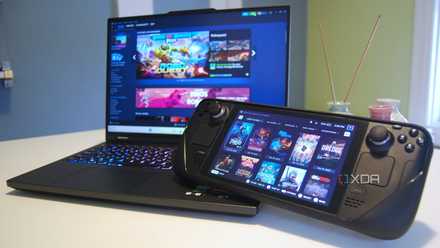
You've probably heard a lot about Linux gaming in recent years, and it's for good reason. The Steam Deck made it very obvious that gaming on Linux is no longer a pipe dream, and you can often have just as good of an experience than you would on Windows. Sometimes, it may even be better.
It's gotten to the point where there's a single app that keeps me from removing my Windows partition from my laptop, and it's not even related to gaming. As far as playing games goes, unless you're heavily invested in competitive multiplayer games that require kernel-level anti-cheat, Linux is already fantastic.

Here's why no one can shut up about Linux gaming
A gaming revolution is on the horizon, but one major hurdle remains.
Gaming on Linux isn't a problem anymore
All the games I care about work fine
I've done my fair share of experiments with Linux gaming, and I've always come out positively impressed. Back in 2024, I turned a Windows-based gaming handheld into a Steam Deck by installing Bazzite, and it turned out to perform even better than it did on Windows. It ran games like Forza Horizon 5, Shadow of the Tomb Raider, and Apex Legends with great performance, and even emulation worked well.
In the time since then, I've tried gaming on Linux with other machines and distros. Most recenly, I tried gaming on SteamOS on another tablet I had lying around, and performance was solid in games like Control, Hellblade, and Elden Ring. Valve's Proton and the Wine project it's based on have made huge strides since their early beginnings, and performance is often just as good if not better than on Windows. And if a game has a native Linux port, then it's even better, as is the case with the aforementioned Shadow of the Raider.
It's not just me, either. Last year, we tested a gaming handheld with official SteamOS and Windows releases, and the performance differences were drastically in favor of SteamOS, which is just Linux. It's generally agreed upon that Linux just performs better for gaming, when games are supported.
Linux is slowly taking over my life as a PC gamer
It's been happening right under my nose.
Of course, there are exceptions, most notably with games that require kernel-level anti-cheat due to their highly competitive nature. If you're into one of those games, then of course, Linux won't be for you, but I play primarily single-player games, so this isn't a restriction that really affects me. Some games may run worse on Linux due to the compatibility layer, but they're often still playable.
What's holding me back
Video editing is harder on Linux
What's actually holding me back from fully removing Windows from my system is video editing software, and oddly enough, it's not even because my preferred app doesn't support it. I use DaVinci Resolve for all my edits on Windows or Mac, and this app also has a Linux version.
The problem is this version of the app seems to be strictly aimed at professionals that have the powerful hardware required for complex edits. Most of the work I do in Resolve involves a primary video clip with a couple of extra tracks as needed, but it's rarely packed with effects and adjustments that need a lot of rendering power. So all my work is usually done on integrated graphics, and Resolve on Linux doesn't support this setup. You need a discrete AMD or Nvidia GPU, or the app simply won't run.
Now, depending on your level of comfort experimenting, you can find alternatives like Kdenlive, a relatively popular video editing tool that does run on hardware without a discrete GPU. However, I've found this program to be torturous to use, and I would rather continue to use Resolve, so I have to keep my Windows partition around.
Of course, if I absolutely wanted to focus on video editing, I'd buy more powerful hardware and at that point, I wouldn't have to worry anymore. I'm confident the app would run just fine if I had a discrete GPU. But as it stands, I still have to stick with Windows for whenever I need to do some video edits.

I replaced Adobe Premiere with DaVinci Resolve, and I'm not missing out on anything
Resolve is everything Premiere wishes it was
Linux is so close
Most of my other apps are here
It's truly a shame that I can't fully move to Linux yet because, aside from Resolve, I can use everything I care about on it already. Since I mostly work in our CMS, I can do all my writing in a web browser. And because Vivaldi is a fantastic web browser, it also gives me an email client built right in, so that's another major aspect taken care of. If I receive documents, I can open them in OnlyOffice, and I can also use this app to create the spreadsheets I need for my weekly reports.
For my communications, I use Beeper to bridge all my messaging services together, and thankfully, Beeper has an AppImage file available that lets me run the app just fine on any modern Linux distro. I can even use Android apps, and they work even better than they do on emulators for Windows.
And even for the purposes of content creation, Linux has served me well. I don't use my main laptop to record game footage (mostly to conserve space), but the laptop I use for it runs CachyOS, too. And on my main laptop, where I sometimes need to edit photos, the Affinity on Linux project has given me everything I need to make the edits I want. It's still a Windows app, but it works great through Wine with only minor graphical glitches.

Affinity's new free app may get me to ditch Photoshop for good
So much power for so little cost
I can't wait to ditch Windows completely
Seeing the progress that's been made with gaming on Linux, along with the wide range of apps and their quality, has convinced me that as soon as I can get DaVinci Resolve running on my laptop, or a PC with a discrete GPU, I'll be more than happy to make the switch completely. I have no desire to use Windows anymore, and I'm very happy that Proton has made such strides to make gaming more accessible for Linux users.
Hopefully it keeps growing in popularity and Blackmagic Design will improve the Linux version of Resolve available on more kinds of PCs. And of course, I hope to see even more apps come over so everyone can stop being hostage to Windows.
DaVinci Resolve
DaVinci Resolve is a fantastic video editing tool that comes with a free version available on all major desktop platforms.