
I'm going to do my best to separate the art from the artist on this one. Nvidia engaged in some underhanded tactics with the RTX 5060, blocking off access to a review driver even when reviewers had cards in hand, only to be caught cherry-picking media outlets to give the driver to, given that they published glorified marketing material for Nvidia under the guise of a "preview." But shady tactics aside, the RTX 5060 is a graphics card that a lot of PC gamers are going to be interested in buying. It's a GPU that demands a proper assessment.
Much to my surprise, the fiasco surrounding the launch of the RTX 5060 didn't color my impression of the card. It just put a point on a narrative the card wrote on its own; Nvidia is apathetic toward PC gaming. Yes, it's a $3 trillion company on the back of AI. Yes, CEO Jensen Huang has more value in his pinky finger than Nvidia's entire gaming business. And, yes, Nvidia dominates PC gaming so much that AMD and Intel graphics cards barely register. None of that has changed in the past two years.
What has changed is the competition. AMD refocused on midrange offerings, Intel got its driver issues under control, and the developers found ways to circumvent or provide alternatives to DLSS. At the moment, the RTX 5060 carves out a decent spot in the market given that you can actually find it at MSRP. A generation or two down the road, however, I'm not sure if this is the graphics card you're going to want in your PC.
Asus GeForce RTX 5060 8GB
- Memory Clock Speed
- 1750MHz
- Architecture
- Blackwell
- Process
- TSMC 4N
- Shader Units
- 3840
We've finally reached a breaking point in Nvidia's Blackwell generation, and it's the RTX 5060.
- MFG enables visuals that otherwise wouldn't be possible
- Widely available at or around MSRP
- Only requires a single 8-pin cable
- Runs into serious issues above 1080p
- MFG can't overcome VRAM limitations
- Stiff competiton around the same price from AMD and Intel
Nvidia GeForce RTX 5060 pricing and availability
I'm usually writing a review in the weeks leading up to release, which isn't the case for the RTX 5060. Thankfully, that gives me more insight into where prices have landed now that the card is out and available to purchase. Unlike most GPUs released in the past year, the RTX 5060 is available for list price. On Newegg, I clocked six models available for sale at or around MSRP ($300 to $340), and another half dozen premium models that range from $350 to $410. It's so shocking to see a new GPU in stock for list price that I can imagine a lot of folks looking to upgrade will pick up the RTX 5060 knowing full-well that it isn't the best GPU. It's just the one you can buy at MSRP.
Unfortunately, GPUs at MSRP are still in short supply. The RTX 4060 is not only slower than the RTX 5060, but limited availability means the last-gen card is around $400. The RTX 4060 Ti climbs up to $500. From Nvidia's perspective, the RTX 5060 is an excellent buy. It's cheaper than last-gen options, offers faster raw performance regardless of how small that uplift is, and it unlocks DLSS Multi-Frame Generation (MFG) that can enable some seriously impressive smoothness that otherwise wouldn't be possible. Unfortunately for Nvidia, it isn't the only company that makes GPUs.
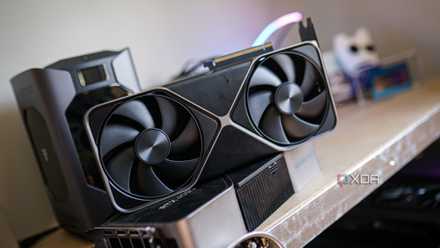
I have an RTX 50-series GPU, and I've barely touched DLSS 4
I've intentionally ignored quadrupling my frame rate, and for a good reason.
The one card that really kills the credibility of the RTX 5060 is Intel's Arc B580. This card should cost $250, and its performance falls in-line with that price, but it unlocks a much more capable 12GB frame buffer. You'll spend at least $320 on the Arc B580 right now, but even at that price, I'd still recommend Intel's GPU. That's what really turned me off of the RTX 5060. I'd much rather spend $70 over MSRP on the Arc B580 than spend MSRP for the RTX 5060, simply because Intel's GPU is better equipped to handle the demands of modern games, even if that means taking a slight backseat in some titles.
For AMD's part, it's gearing up to release the RX 9060 XT in a few days, with the 8GB model clocking in at $300 and the 16GB coming in at $350. Based on the numbers shared by AMD, and the stellar performance of the RX 9070 XT, there's a good chance it will offer much better performance than the RTX 5060. Nvidia still holds onto MFG, which is something that isn't available on these other cards, but even then, the RTX 5060 struggles to justify itself — more on that later.
Nvidia GeForce RTX 5060
- Shader Units
- 3840
- Ray Accelerators/Cores
- 30
- AI Accelerators/Cores
- 120
- Base Clock Speed
- 2280MHz
- Boost Clock Speed
- 2497MHz
- Memory Clock Speed
- 1750MHz
- Memory Capacity
- 8GB GDDR7
- Memory Bus
- 128-bit
- Memory Bandwidth
- 448GB/s
- Power Draw
- 145W
- Architecture
- Blackwell
- Process
- TSMC 4N
Disappointing performance, even by last-gen standards
It's basically an RTX 4060 Ti for $100 less
You don't need to push past the first chart above to see where the RTX 5060 runs into issues. At 1080p, the card is basically in lockstep with last-gen's RTX 4060 Ti, which was one of the most controversial GPUs Nvidia has released in the last several years. You're getting a large 29% jump over the RTX 4060, but no performance improvement compared to last-gen's RX 7700 XT from AMD — and these results factor in ray tracing. Compared to the Arc B580, the RTX 5060 ends up just shy of 14% faster, despite being 20% more expensive. Just looking at the 1080p results, the RTX 5060 falls in-line with the RTX 5070. It's not a bad GPU, but I had hoped for more.
Scaling up the resolution completely changes the narrative. Suddenly, the Arc B580 jumps up to match the RTX 5060, and the margins for the card narrow. 4K pushes that to the extreme, with Intel actually coming out ahead. The reason why is clear: 8GB of VRAM. It's not just a problem at 4K. Even at 1440p, the Arc B580 makes up a fairly large gap with the RTX 5060 simply because it has more VRAM. It's important to drive that point home. If you push above 1080p with the RTX 5060, the power of the GPU is limited simply because it doesn't have enough VRAM, and my results show that clearly.
Before getting into the individual results, here's a look at the test bench I used:
|
CPU |
AMD Ryzen 9 9950X |
|
Motherboard |
Gigabyte X870E Aorus Master |
|
Cooler |
MSI MEG CoreLiquid S360 |
|
Memory |
2x16GB Corsair Vengeance DDR5-6000 |
|
Storage |
2TB Samsung 990 Pro |
|
PSU |
1,200W Gigabyte Aorus P1200 |
I don't usually beat the drum on 8GB graphics cards too hard because, frankly, they're totally fine for a massive portion of PC gamers. It became clear just how much the tide is shifting during the course of my review, however. I normally include Forza Motorsport in my GPU reviews, but I cut it here. On my first run at 1080p, the RTX 5060 managed 83 fps. On the next, it dropped to 66 fps, and after that, it went down to 53 fps and then only 51 fps. That communicates an experience gamers with 8GB graphics cards know all-too-well, where performance will degrade over time as the frame buffer fills.
|
RTX 5060 |
RTX 4060 |
Arc B580 |
|
|---|---|---|---|
|
Assassin's Creed Mirage (Ultra High) |
|
|
|
|
Cyberpunk 2077 (Ultra) |
|
|
|
|
Cyberpunk 2077 (Ultra RT) |
|
|
|
|
Black Myth: Wukong (Cinematic/DLSS@68%) |
|
|
|
|
Dying Light 2 (High Quality) |
|
|
|
|
Dying Light 2 (High Quality RT) |
|
|
|
|
Returnal (Epic) |
|
|
|
|
Returnal (Epic RT) |
|
|
|
|
Horizon Zero Dawn Remastered (Very High) |
|
|
|
It wasn't just in Forza Motorsport, either. If you look at my Returnal results, you'll notice how much closer the Arc B580 and RTX 5060 are. Scene-to-scene, the frame rate would jump up and down, sometimes cutting performance in half for short periods of time as the GPU ran out of frame buffer. It's hard to defend 8GB graphics cards when two games from 2023 show obvious problems, even when looking at just 1080p and 1440p.
You don't need more than 8GB for the most popular PC games, including Counter-Strike 2, DOTA 2, Apex Legends, Rust, and Helldivers 2, all of which consistently top the charts as the most-played games on Steam. But you also don't need an RTX 5060 to play these games, and you certainly don't need MFG to play them. With middling performance improvements over the Arc B580, I'm struggling to find a situation where the RTX 5060 makes sense. It doesn't give you a clear upgrade path to a 1440p monitor, and it certainly doesn't change the narrative about Nvidia's value this generation with competitors like the Arc B580 and upcoming RX 9060 XT.
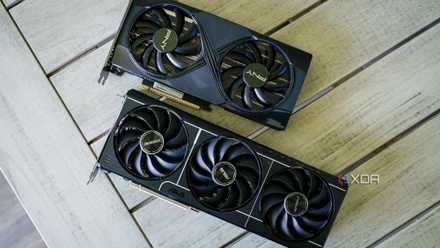
Consumers make their voices heard as the 5060 Ti 8GB model fails to sell
It just doesn't cut it.
DLSS 4 is great, but it isn't a catch-all
Great to get ahead, not to catch up
The savior of the RTX 5060, which has been the savior of all sub-$500 Nvidia cards over the last two generations, is DLSS. The RTX 5060 not only benefits from the new transformer model, which is available to all RTX GPUs, but also MFG with up to 4X frame generation in supported games. And by the numbers, MFG is a bit of magic. Triple-digit frame rates in the most demanding games available today, some of which have full-on path tracing, is nothing to sneeze at. Within the 1080p boundary drawn by the RTX 5060, you're getting a truly excellent gaming experience in these titles thanks to MFG.
There's an unfortunate irony that this is an 8GB graphics card that leans on MFG to manage its impressive feats. On one hand, it's a mainstream, workhorse GPU. It's for those gamers who just want to play the most popular games with high settings and even higher frame rates, and you don't need more than 8GB for that. And on the other, it's this shortcut to some premium gaming experience by generating frames instead of rendering them. That balance works at 1080p, but with MFG calling for more frame buffer alone, the two ideas are at odds with each other outside that 1080p boundary.
|
1080p Results |
DLSS Settings |
|
|---|---|---|
|
Oblivion Remastered (Ultra/Hardware RT) |
105.8 fps |
2X + Balanced |
|
Doom: The Dark Ages (Ultra Nightmare) |
150.9 fps |
2X + Balanced |
|
Black Myth: Wukong (Cinematic PT) |
119 fps |
4X + Performance |
|
Cyberpunk 2077 (PT) |
179.3 fps |
4X + Balanced |
You get a great experience at 1080p, but the numbers you see above really show the ceiling for what the RTX 5060 with MFG is capable of, and even then, the numbers don't tell the full story. Take Black Myth: Wukong as a prime example. We're running at 50% render resolution (720p) for a 1080p output, and three out of every four frames are generated, not rendered. You're essentially playing at 30 fps, just with the visual smoothness of 120 fps, and that disconnect between the visual experience and the amount of input lag you feel really doesn't work for a difficult game like this.
Moreover, you don't have a lot of runway to scale up the experience on the RTX 5060. You'd hope that MFG and the constantly improving DLSS Super Resolution would allow this 1080p graphics card to scale up to 1440p, but that 8GB frame buffer gets in the way. In an ideal world, features like DLSS and FSR either give your GPU more life after an upgrade is in order, or they enable visual quality that otherwise wouldn't be possible. With an 8GB frame buffer that's already stressed above 1080p, and a reliance on MFG that only increases VRAM usage, the RTX 5060 isn't a card that can grow alongside your rig.
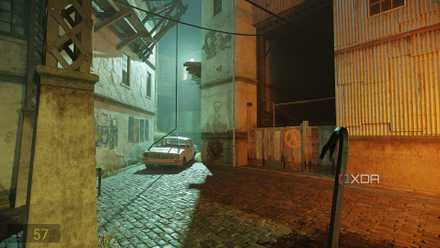
Half-Life 2 RTX is the future of PC gaming, for better or worse
A beautiful remaster with big performance overhead.
Should you buy the Nvidia GeForce RTX 5060?
You should buy the Nvidia GeForce RTX 5060 if:
- You play at 1080p and don't plan to upgrade soon.
- You're willing to dial back settings in VRAM-hungry games.
- You have a GPU from RTX 30-series or RX 6000 series, or older.
You should NOT buy the Nvidia GeForce RTX 5060 if:
- You have or plan to buy a monitor above 1080p.
- You're sensitive to input lag in games that necessitate MFG.
- You don't plan on upgrading in the next couple of generations.
You could do worse than the RTX 5060 right now, largely due to the tight control of last-gen supply. You could also do a lot better. The Arc B580, despite not always matching the RTX 5060, has a lot more life with its 12GB frame buffer, and the upcoming RX 9060 XT looks to be about 15% faster, at least based on AMD's numbers. We'll have to see how prices shake out with AMD's GPU, however.
The best argument for the RTX 5060 is if you just need a solid, modern GPU, and you plan on upgrading in the next couple of generations. What's disappointing more than anything about the RTX 5060 is how low its shelf life is due to the 8GB frame buffer, which is a shame because features like MFG should give GPUs life well after they've aged out of relevance.
Asus GeForce RTX 5060 8GB
- Memory Clock Speed
- 1750MHz
- Architecture
- Blackwell
- Process
- TSMC 4N
- Shader Units
- 3840
We've finally reached a breaking point in Nvidia's Blackwell generation, and it's the RTX 5060.