
When PCIe 5.0 Gen 5 SSDs started coming out in 2023, I was genuinely excited by their theoretical bandwidth claims, just like most of you guys. As someone who jumped straight from an old SATA drive to the Corsair MP600 PCIe 4.0 NVMe drive, I've already experienced what a real storage leap feels like. When Windows boot times reduce by five seconds, you notice it immediately. And when games take a few seconds less to load, you genuinely feel like the upgrade was worth your hard-earned money.
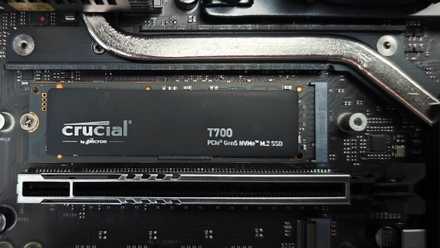
So when Gen 5 drives started advertising speeds well beyond 10,000MB/s, I expected a similar real-world improvement, especially considering the Crucial T710 I bought claims read speeds of up to 14,900MB/s. What should've translated into a noticeably snappier system ended up feeling almost identical to my experience with a Gen 4 drive. That's when I realized that doubling theoretical bandwidth doesn't necessarily mean doubling the performance you can actually feel in daily use.

3 things I've learned about Gen 5 SSD's with Crucial's new P510
I've spent the last month using Crucial's latest Gen 5 SSD, and this is what I've learned about this cutting edge storage.
Gen 4 was already more than fast enough
Gen 5's bandwidth stopped being impressive when my PC didn't feel any faster
The Corsair MP600 I purchased in 2020 never really struggled to boot Windows or load games quickly. Even though a sequential read speed of 4950MB/s isn't anywhere close to Gen 5's standards, it still was enough to make my PC feel instant in daily use. None of the open-world AAA titles that I played kept me waiting long enough to even think about storage performance. At no point did I feel like my SSD was the weak link in my system, but that 14,900MB/s bandwidth claim made it seem like I was missing out on something.
I got my reality check when I switched to the Crucial T710, though. Sure, it feels nice to see those numbers in CrystalDiskMark shoot up dramatically compared to my old drive. But when I actually use my PC the way I normally do, I can't even tell the difference. Even large file transfers, which are supposed to highlight the benefit of higher sequential throughput, aren't something I do often enough to justify a threefold jump in peak bandwidth. And that's when you know that daily workloads, including gaming, simply don't push modern Gen 4 drives anywhere near their limits.
The only difference I noticed was how hot it ran
Those speeds come at the cost of higher power draw and heat
After upgrading to the Crucial T710, I actually had to start paying attention to SSD temperatures. My old MP600 definitely ran warm, but not enough for me to keep monitoring it in HWiNFO while gaming or transferring large files. The Gen 5 drive was different, idling about 7-10C higher in the same case with the same airflow configuration. Sure, it may have run cooler if I had used the included heatsink instead of the motherboard's integrated one, but that only reinforces my point. An SSD upgrade shouldn't require more aggressive cooling just to stay comfortable under normal use.
That extra heat is the direct result of the higher power draw needed to sustain those sequential speeds. We’re still dealing with the same compact M.2 form factor, so pushing more bandwidth means cramming more energy into the same tiny space. And for what? My boot times didn't improve, and my favorite games didn't load any faster. During large file transfers, I was more focused on how much hotter it was running than how fast the progress bar was moving. When the most noticeable change under normal use is temperature, that's a problem.
I'm not the target audience for Gen 5
They make sense for creators and professionals, not for how I use my PC
I'm not saying Gen 5 drives are pointless because they absolutely do make sense for some people. That's why they exist in the first place. If you're someone who works with massive 4K or 8K RAW files, constantly exporting large projects, or moving hundreds of gigabytes of data every single day, shaving seconds off sustained transfers can add up quickly. For professionals whose time directly translates to money, sequential throughput of over 10,000MB/s isn't just a spec sheet flex.
But that's simply not how I use my PC. I spend most of my time browsing the web, writing articles for XDA, and gaming. None of those tasks come close to saturating even peak Gen 4 speeds. Even large game installs rely heavily on decompression and processing, not just raw sequential reads. For my usage, that extra bandwidth is mostly theoretical headroom I could benefit from in the future rather than performance I can actually feel today.
Right now, all I have are bragging rights
It's definitely nice knowing my storage can push nearly 15,000MB/s on paper. The CrystalDiskMark screenshots look impressive, and there's a certain satisfaction in seeing those numbers scale so dramatically over my old Gen 4 drive. But once I go back to using my PC normally, it's almost like upgrading from last year's iPhone to the latest one. The upgrade didn't change how my PC feels in any way because my old MP600 was already more than enough for almost anything I threw at it. Sometimes, fast enough is actually enough, and I learned that the hard way.
PCIe 5.0 storage solved a problem almost nobody had
Gen5 SSDs are technical marvels, but most consumers just don't need one yet