
Nintendo is one of the most recognizable names in gaming, responsible for some of the most beloved consoles of all time, from the original NES to the Switch. However, while systems like the Game Boy and Super Nintendo are staples of gaming history, the company has also released lesser-known hardware — some through partnerships, others as regional exclusives—that have slipped under the radar. In some parts of the world, Nintendo isn’t even the name most associated with its own systems, as many players grew up with hardware clones or locally branded versions instead of the originals.
We often think of gaming history through the lens of where we grew up, but hardware can look very different depending on the region. Just as the NES and Famicom had distinct designs for the North American and Japanese markets, Nintendo has produced other unique systems tailored to specific regions — sometimes out of necessity, other times through creative collaborations. Some of these consoles pushed technical boundaries, while others were shaped by licensing restrictions or bold design experiments that set them apart from mainstream releases.
Nintendo’s history is full of fascinating offshoots that reveal a side of the company that many players have never experienced.

Inside the rare Nintendo PlayStation prototype: History, restoration, and technical breakdown
The discovery, restoration, and legacy of the rare Nintendo PlayStation prototype—and how it helped spark the console wars of the 1990s
5 Twin Famicom
Sharp’s all-in-one take on the Famicom and Disk System
Released in 1986 under an official license from Nintendo, the Twin Famicom combined the Famicom’s game cartridge slot with a built-in Famicom Disk System (FDS). This sub-console add-on allowed games to be stored on proprietary rewritable floppy disks. The Sharp Corporation made three models of the Twin Famicom — launching with a black version and a red version and then releasing a black version with green highlights the following year.
At the time, this was a major innovation — floppy disks were cheap and introduced save functionality, something most cartridge games lacked until battery-backed saves were introduced. They also offered larger storage space for bigger games like The Legend of Zelda and Metroid, which were originally released on the FDS and only later re-released when cartridge technology advanced.
One of the most interesting aspects of the Disk System wasn’t just the hardware but how games were distributed. Instead of always buying new titles at retail, players in Japan could visit Disk Writer kiosks in stores and rewrite their existing disks with new games for a lower price. This early form of reusable game media made gaming more affordable and served as a precursor to modern digital distribution. While Nintendo never officially introduced this system outside Japan, bootleg disk-copying services appeared in other parts of Asia, offering a similar experience through unlicensed means.
Sharp had a history of collaborating with Nintendo on hardware. The Twin Famicom reflected that approach, combining two systems into one. But it wasn’t their first attempt — or their last. Sharp also produced televisions with built-in Nintendo consoles, beginning with a Famicom TV in the early '80s and later revisiting the concept with the Super Famicom in the '90s.

9 generations of video game console media: from Magnavox PCBs to modern Blu-rays
The evolution of video game media across nine console generations, from circuit boards to Blu-rays and digital downloads.
4 Sharp C1 & SF-1 TVs
Nintendo consoles built directly into televisions
Sharp and Nintendo's long-running partnership led to several unique hardware collaborations, including television sets with built-in Famicom consoles. As early as 1983, Sharp released the C1 TV, a television made for gaming with a fully integrated game system. Nearly a decade later, Sharp revisited the concept with the SF-1, a Super Famicom built into a 14-inch or 21-inch television.
Integrating the Famicom and Super Famicom directly into a TV reduced the need for extra cables and separate power adapters, creating a cleaner setup than a traditional console. They also featured higher-quality visuals than most consumer CRTs, offering sharper colors and a clearer image — similar to how modern gaming monitors prioritize display quality over standard TVs. The SF-1 even had built-in stereo speakers with a physical volume control dial, an uncommon feature for a gaming setup at the time.
Despite these advantages, the SF-1 never became a mainstream success. Its high price — comparable to buying both a high-end TV and a console separately — made it a niche product, and Sharp’s limited marketing didn't help. In addition, because it was built as a television first, the SF-1 lacked some of the expansion options offered by a console counterpart, making it less attractive for those who wanted accessory support.
Sharp’s Nintendo-branded TVs not only showcased innovative design in Japan but also set the stage for how licensing deals and regional restrictions would later shape Nintendo’s global presence. This contrast would soon become apparent in markets like South Korea.
3 The Comboy series
When Hyundai sold Nintendo consoles
In the 1980s and ’90s, Nintendo couldn’t officially sell its consoles in South Korea due to a government ban on Japanese cultural imports — a policy that remained in place until 1998. To circumvent this, Nintendo partnered with Hyundai Electronics, a major South Korean company with deep roots in consumer tech, to distribute its hardware under a different name: Comboy.
While Hyundai is best known internationally for its cars, it was also one of South Korea’s largest electronics manufacturers at the time, producing TVs, VCRs, and home appliances. Distributing game consoles was a natural extension of that business. Through its partnership with Nintendo, Hyundai rebranded the Famicom as the Hyundai Comboy, the Super Famicom as the Super Comboy, and later released both a Comboy 64 (based on the Nintendo 64) and a Hyundai-branded Game Boy. Aside from minor regional differences and the Hyundai name on the box and hardware, these systems were functionally the same as their Japanese or American counterparts.
For many South Korean players growing up during that time, Comboy was Nintendo, even if they knew the systems were originally made in Japan.
Because of restrictions like these, Nintendo had to take different approaches worldwide. In Brazil, high import taxes led to the rise of the Phantom System, a locally made NES clone that looked more like a Sega console. In Russia, the unlicensed Dendy became the region’s de facto NES. But South Korea’s case was unique — it was one of the few regions where official Nintendo consoles were sold with another major corporation’s name taking center stage, making Hyundai the brand most players associated with these systems.
After the import restrictions were lifted, the Comboy branding quietly disappeared. However, for a generation of Korean gamers, it left a lasting impression — and today, these rebranded systems are a rare and interesting part of Nintendo’s global history.
2 iQue Player
Nintendo’s workaround for China’s console ban
While kids in the U.S. were dealing with overblown warnings from parents and politicians about games like Mortal Kombat, kids in China had it worse: a full government ban on home video game consoles. Enacted in 2000, the ban was intended to curb what officials saw as the harmful effects of gaming on children — everything from addiction and poor academic performance to exposure to foreign culture.
Rather than exit the market entirely, Nintendo designed a workaround. In 2003, it launched the iQue Player, a compact, controller-shaped device that played Nintendo 64 games without a traditional console setup. Developed through a joint venture with Chinese scientist Dr. Wei Yen, the iQue Player kept all the processing hardware inside the controller and plugged directly into a TV, helping it avoid being classified as a console under Chinese law.
That's right — Nintendo essentially got around China's ban on video game consoles by calling their system a controller instead.
By the time the iQue Player launched, the rest of the world had already moved on to the GameCube. But for Chinese players, this was their first chance to play N64-era titles. Instead of using cartridges or discs, the iQue Player relied on internal flash memory. Games were downloaded at physical iQue kiosks located in malls and game shops — the idea echoed Japan’s Famicom Disk Writer kiosks from the ’80s.
The system debuted with localized versions of Super Mario 64, The Legend of Zelda: Ocarina of Time, and other N64 titles. While it never became a huge commercial success, it introduced many Chinese players to Nintendo’s characters and franchises for the first time, establishing a small but important foothold in the region. The iQue wasn’t a glimpse into Nintendo’s digital future — it was a region-specific workaround built on aging hardware and clever design choices.
While the iQue was designed to meet regulatory limits, the next console on this list came from a completely different goal: transforming the GameCube into a high-end entertainment system for Japanese homes.
1 Panasonic Q
A GameCube with DVD playback
Of the major consoles that defined the sixth generation — PlayStation 2, Xbox, and GameCube — Nintendo was the only one that couldn’t play DVDs. The Dreamcast also lacked DVD support and used its own proprietary GD-ROM format, similar in concept to the GameCube’s mini-DVDs. It was discontinued very early into the sixth generation, and most don't consider it a major player. After all, Dreamcast's failure caused Sega to withdraw from the console business.
The GameCube’s mini-DVD format, called the GameCube Game Disc, was co-developed with Matsushita, the parent company of Panasonic, as a way to reduce piracy and control manufacturing costs. As part of that agreement, Panasonic was granted a license to develop its own GameCube-compatible hardware. The result was the Panasonic Q, released exclusively in Japan in 2001 — the same year as the standard GameCube.
Functionally, it played all the same games but added DVD playback, a feature Nintendo had intentionally left out of the main console. Panasonic reworked the design with a faux brushed-metal case, mirrored front panel, and blue LCD and bundled it with a full-featured DVD remote. A Game Boy Player add-on was also sold separately.
Although officially licensed, this GameCube's design didn't have Nintendo's input—it was entirely Panasonic’s product, and that may help explain one of its core problems. The box referred to the system as the SL-GC10-S DVD/Game Player, with minimal Nintendo branding. The system itself only had a tiny badge, a Nintendo GameCube logo about the size of the Dolby logo, or a power button.
Unless you were already familiar with the Panasonic Q being a GameCube, there was little reason to recognize it as a Nintendo console at all.
The Q also came with a premium price tag — roughly the cost of a GameCube and a mid-range DVD player combined. And while some might appreciate its appearance, I think it’s ugly as hell. You can judge for yourself from the photos, but the mirrored faceplate and glowing display make it look more like a cheap bookshelf stereo system than a game console. Discontinued in 2003 and never released outside Japan, the Panasonic Q remains one of the more unusual corners of Nintendo’s hardware history — an officially licensed console that barely looked like one, made by a company better known for TVs and stereos than video games.
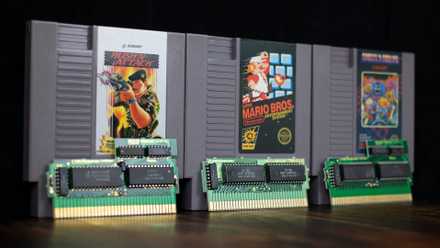
Console meets cartridge: Breaking down the architecture of the NES’s unique design
The NES architecture can be divided into three key groups: CPU-related components, PPU-related components, and cartridge-specific components
Nintendo’s history is full of hidden gems
It’s easy to assume everyone grew up with the same consoles we did — the same hardware, the same plastic shells, the same start-up sounds. But retro gaming was never that simple. Depending on where you live, your version of a “Nintendo” console might have had a different name, a different logo, or maybe didn’t come from Nintendo at all.
That doesn’t even get into the add-ons, cheat devices, or game copiers that let players bypass limitations like region locks or game preservation. Some of those same tools are part of how we’re still able to play games that never left their country of origin, had limited runs, or were almost lost entirely. There are entire libraries of obscure systems and stories out there — many of them forgotten, misremembered, or sitting boxed up in someone’s garage. That’s part of what makes retro gaming so fun to me — no matter how much you think you know, there’s always something weirder, more obscure, or more specific to a single corner of the world just waiting to be found.