
PCI Express 5.0 has dethroned many worthy contenders in hardware technology to become the most redundant modern feature in early 2026. It's got all the classic marketing sells, like the promise of "future-proofing", headline-grabbing throughput figures, and the mesmerizing allure of doubled bandwidth over PCIe 4.0—all while remaining functionally unnecessary across almost every real-world use case.
So why should you care as a consumer? The short answer is that you probably shouldn't, at least not until the rest of the hardware ecosystem plays catch-up. PCIe 5.0 has solved a bandwidth problem that quite simply didn't exist for most consumers, while simultaneously adding to the economic cost. Here's why you should avoid subscribing to the mesmerizing spell of ultra-fast bandwidth just yet.
The bus is not the bottleneck for your GPU
Bandwidth is vanity, benchmarks are sanity
The primary justification for the technology as per most manufacturers, was the arrival of PCIe 5.0 supported GPUs, like the RTX 50-series and Radeon RX 9000 family. So, categorically, one would argue that the extra bandwidth and the related performance uplifts taken together is what would appeal to them.
When you resort to that argument, things get a little more interesting. The last two years of benchmarking has exposed the fact that the bus is not the bottleneck for the GPU. As a matter of fact, the previous iterations of GPUs hadn't even saturated the bandwidth of PCIe Gen 4 before the arrival of Gen 5 to the consumer market in 2019.
In February 2025, GamerNexus tested the Blackwell flagship RTX 5090 across PCIe 5.0 x16, PCIe 4.0 x16 and PCIe 3.0 x16 coupled with the Ryzen 7 9800X3D on the bench. The independent reviewer reported that the maximum performance delta between Gen 5 and Gen 3 landed within the 1–4% range, with most scenarios showing absolutely no meaningful difference at all. When the fastest consumer GPU ever made (coupled with the best gaming CPU on the market) still fails to meaningfully benefit from PCIe 5.0 bandwidth, it becomes an "upgrade" that's almost impossible to justify... unless, of course, you're 'future-proofing' your build.
Your storage isn't going to feel any faster either
Unless you're always moving huge files
When it comes to SSDs, there are two kinds of speed. The first is sequential, which is the big number on the box that commands the bigger price. Then there's the second kind, which shapes how 'fast' your system feels like. Depending on your workflow, you get to experience both, but for the vast majority of users, the latter, known as "Random I/O" is the one that matters more.
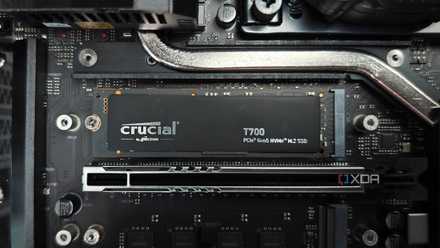
PCIe Gen 5 NVMe drives excel at delivering lightning-fast sequential speeds, which means that large file transfers occur faster. If your daily workflow routinely involves moving 100GB 8K RAW video files between drives, Gen 5 SSDs are a godsend. But for everyone else, like gamers, office workers and power users, the experience is one of diminishing returns.
This is because performance across desktop storage, especially when it comes to Random I/O speeds, has mostly plateaued. Sequential speeds over the years have skyrocketed from 7,000 MB/s to 14,800 MB/s, while random performance has (quite reasonably) hit the brick wall. To put this performance variance in perspective, I tested three generations of NVMe SSDs across different systems and compared their in-game loading time while running Forza Horizon 5. As is evident, the difference was minimal.
|
Storage Generation |
Loading Time (Forza Horizon 5) |
Average Retail Price (2026 Est.) |
|---|---|---|
|
PCIe Gen 3 NVMe |
38.2 seconds |
$55-$75 |
|
PCIe Gen 4 NVMe |
36.8 seconds |
$85–$120 |
|
PCIe Gen 5 NVMe |
34.8 seconds |
$185–$230 |
The benchmark results are indicative and are influenced by multiple factors, such as the SSD controller, NAND type, and drive health. Even when all other factors are identical, the CPU, memory configuration and background system activity can still impact the results.
My next storage upgrade won't be a Gen 5 NVMe, I'm getting this instead
User experience matters more than benchmarks
There are other problems that need solving
Are we innovating in the wrong direction?
Perhaps the fundamental issue with PCIe 5.0 concerns its pricing and usability. By early 2026, it has become quite clear that the standard arrived on the market long before the desktop ecosystem and its users needed it. Manufacturers do what they've always done, which is to chase spec-sheet victories, while the user experience for consumers (besides a very small segment) remains unchanged. It's a classic case of engineering theatrics, where performance ceilings reach the orbit while the performance floor remains mostly stagnated.
At the heart of this well-intended, but misplaced solution lies a poorly understood problem. PCIe Gen 5 isn't solving a tangible problem for most consumers, and is therefore not integrating well into the broader hardware ecosystem. What we're essentially witnessing is an enterprise intended for AI and data science, which most of the hardware industry seems to be aligning for anyway. The rise in DDR5 prices, routine GPU shortages, the exit of major PC hardware manufacturers from the consumer market all seem to point in one direction, and it's not oriented towards retail customers like you or me.
What we're essentially witnessing is an enterprise solution intended for AI and data science, which most of the hardware industry seems to be aligning for anyway.

Future-proofing my PC is the one mistake I'll never make
Nothing can protect your PC from performance leaps and unpredictable market forces
You won't regret missing this bus
It seems that we've reached a point where innovation is being increasingly redirected towards a specific industry, and this innovation only happens to coincidentally have a few intersecting advantages for retail consumers. If not, PCIe 5.0 is just too early, expensive, and mostly misaligned for most desktop use-cases, which almost sounds ridiculous to say since the technology has been out for over 7 years now.
For the ones who care about future-proofing, I say, it is indeed possible to pay the toll for the high-speed lane on the highway, but it is not wise to do so when your car cruises far, far below the speed limit. You won't experience it, and you'll arrive at your destination all the same.