
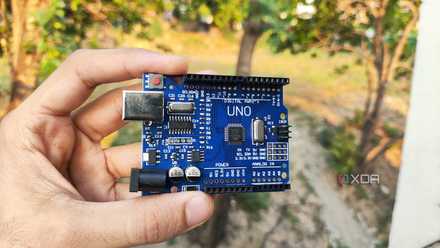
An Arduino is a microcontroller — a single board designed to control something and perform a specific task. Unlike a Raspberry Pi, you won't find anything resembling an operating system here; instead, the Arduino uses simplified controls and works off "sketches," or programs you write within the Arduino software itself. Don't worry, the coding is simple enough to understand even without prior experience.
An Arduino is a much better choice than a Raspberry Pi for tasks that require real-time input and responses. While a Pi can be used for more complex tasks (such as designing a whole-network ad blocker or an emulator for classic games), the Arduino is better suited for directly controlling hardware. That makes it ideal for applications like robotics or controlling smart blinds that react to light.
With me so far? Here is a list of projects that you can do with an Arduino that are fun, relatively easy, and incredibly convenient.
5 Improve your home security
Know when someone knocks — or worse
Arduino is able to interpret signals from a variety of sensors. By placing a unit equipped with an ADXL345, an accelerometer for detecting motion, or a Piezo sensor on a door, it can notify you when someone knocks or tries to kick in the door. Linking the Arduino to another device, such as a speaker, will allow you to set up a chime that will trigger if the door is rattled. If your security system works with third-party accessories, you can link your Arduino alarm to that system and let it serve as a trigger.
4 Create a robot with a green thumb
Never forget to water your plants again
Keeping plants around the house has been linked to multiple health benefits, but it can be hard to know when to water each one — especially if they all need to be watered on different schedules. With an Arduino, you can build a system that will automatically water your plants when needed. That means no more over-watering or letting that Monstera get a little too crispy. All it requires is a moisture sensor, a water pump, and some sort of container to hold a reserve. When the soil gets too dry, the moisture sensor will signal the pump that it's time to re-hydrate.
A beginner's guide to programming an Arduino board
Want to build your next DIY project using an Arduino board? Here's an easy guide to help you get started with the popular microcontroller family.
3 Build a zone of truth
It's your own homemade lie detector
There are sensors sensitive enough to pick up minute changes in your skin, and you can link these to an Arduino to build a lie detector at home. Whether you want to learn how to bluff better in poker or you're recreating a scene from your favorite procedural, this project is relatively easy to do and a lot less complicated than you might expect. The actual day-to-day application of this is somewhat limited, but it's a fun hobby build.
2 Automate your laundry
Arduino can fold like a pro
Do you enjoy folding laundry? For some people, it's something of a meditative, Zen-like experience. For others, it's one of the most irritating household chores. The good news is that with an Arduino, you can build a robot that handles it for you. This one is a little more complicated than just connecting sensors, but still very easy for the average person to do. Using foam board and packing tape as "hinges," you can design a robot that will fold your shirts perfectly each time. All you have to do is lay your clothes flat on the boards.
1 Build your own biometric security system
Scan your fingerprint to gain access
Smart locks are helpful, but if their batteries die, you might find yourself locked out. They're also on the pricier side, but you can build your own secure access with an Arduino. Just be warned: this one is a bit more complicated than the others on this list. You'll need the sensor module R305 to read your fingerprint and a list of other connectors to link the circuit to your lock. It essentially creates a magnet that only moves when your fingerprint is pressed against it. It takes some work, but it's still more than doable with a bit of time and patience.

What are counterfeit and clone Arduino boards (and how to identify them)
With the Arduino ecosystem rife with clones and fake boards, here's what you need to know before you make your next purchase
Your imagination is the limit
There are hundreds of different Arduino builds on the internet, but if you have the know-how, you can create gadgets no one else has ever made. Think about something you wish your current electronics could do. Chances are, you can solve at least part of the issue with an Arduino and a bit of creativity.