
Whether you’re into robotics or plan to build projects centered around embedded systems, heavy circuitry, and sensors, an Arduino is the best purchase you can make. With a huge repertoire of boards in its family tree, you can spend hours picking out the perfect Arduino microcontroller for your DIY project.
But if you’re keen-eyed, you may have already noticed that the price of the Arduino series is all over the place. In fact, it’s common to see huge price differences between two identical boards that bear the same name. That’s because a significant number of the Arduino microcontrollers available online are clones developed by third-party manufacturers, and there are a handful of differences between them and the real deal. So, we’ve put together everything you need to know about the Arduino clones, including how to identify them.
A beginner's guide to programming an Arduino board
Want to build your next DIY project using an Arduino board? Here's an easy guide to help you get started with the popular microcontroller family.
Are Arduino clones legal?
The word open-source is thrown around a lot in the DIY project landscape and while the software aspects of most devices, including SBCs like the Raspberry Pi, are open-source, the hardware itself is not. The key word here is “most,” as the Arduino family has an open-source hardware license. This means you’re free to copy, modify, and even add additional functionalities to an Arduino microcontroller – so long as you don’t use the same branding and logo as the company.
The end result is that you’ll find a host of clones on the market, and while counterfeit boards that don’t abide by Arduino’s trademark rules are illegal, the clones that follow the regulations, are perfectly legal. But that doesn’t mean all clones have the same features as their original counterparts.
Are third-party boards inferior to genuine Arduino boards?
If you have a genuine Arduino board, then you can rest assured that the device was built with high-quality components and underwent a thorough screening process before it made its way to you. However, the quality control of clones can vary dramatically depending on the manufacturer. While the more reputed brands use decent-quality parts in their models, others, especially the companies that manufacture counterfeit Arduino microcontrollers, can use inferior components and skimp out on conducting proper quality checkups to maximize their profits.
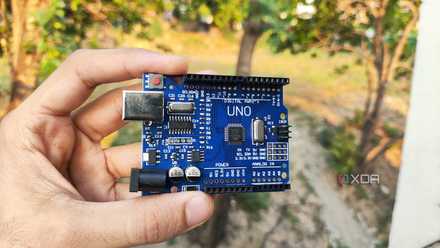
Another difference between the fake and real Arduino boards is the component used for serial communication. The genuine Arduino devices are equipped with another 16u2 microcontroller, which makes them compatible with a wide range of PCs. On the other hand, clone boards typically utilize the CH340G chip to connect to your system via the USB port. This makes using fake boards slightly more complex to set up, as you’ll need to find and install the necessary drivers on your system to make full use of the boards.
All that said, some third-party manufacturers instead go the extra mile to improve upon the functionality of the original Arduino microcontrollers, and may feature extra sockets and more interfaces than their genuine counterparts.
How to identify clone and counterfeit Arduino boards
Thankfully, there are plenty of subtle differences that set the genuine Arduino models apart from the third-party replicas.
Logo
Despite seeming rather unassuming at first glance, the branding on your Arduino board is a key indicator of the authenticity of the microcontroller. A real board will have the Registered ® mark next to Arduino. A clone, on the other hand, will leave out the word “Arduino,” while a counterfeit board may have it written in a weird font with the Trademark (™) symbol right next to it.
Model name and packaging
Moreover, a genuine board will have the model name inside a bold rectangle, while replica Arduino devices tend to have it surrounded by dotted circles and in some cases, may even ditch the white block/dotted lines altogether.
The boxes that the Arduino boards ship can also clue you in on whether they're fake or genuine. A legit Arduino will have a colored diagram of the board alongside its specifications on the rear side. Third parties don’t put so much effort into the packaging and usually ship them out in anti-static bags or cheap-looking boxes.
Color
The microcontrollers manufactured by Arduino have their own distinct colors, with the more popular boards rocking a teal hue while the older boards bear a light blue profile. Clones usually come with their own distinct color schemes, and may even have some designs or illustrations that set them apart. As for counterfeits, most manufacturers stick to dark blue colors.
Driver support
When setting up your Arduino with your PC, you’ll need to install the official IDE provided by the company. When you plug in a legit microcontroller into your PC, the IDE will give out the proper board name when you choose the Get board info under the Tools header.
But since knock-offs usually include an inexpensive CH340G chip, the IDE will display the Unknown board message if you don’t install the drivers for the counterfeit device.
LEDs
While the genuine Arduino boards have featured different colored LEDs over the years, you can easily tell them apart from the imitation boards. The older boards came with green LEDs and used to switch to yellow during certain operations, with the newer models featuring RGB LEDs instead. However, the fake boards only come with red-colored LEDs.
Budget-friendly clones or original Arduino: Which one should you choose?
If you’re a newcomer looking to sink your teeth into the world of microcontrollers, it’s better to grab an original Arduino board. This way, you won’t have any issues when programming it on your PC.

Arduino vs Raspberry Pi: Which board should you buy for your next DIY project?
Don't be fooled by their appearance — there's a world of difference between the tiny Arduino and Raspberry Pi boards!
While counterfeit boards are a different story because of their legal issues, tinkerers who are well-versed in the art of building DIY projects can also opt for clone boards to save some money. Sure, the build quality won’t be the best, but you can grab more than a few imitation boards for the price of one legit Arduino.
Arduino Uno REV3
The most popular microcontroller in the Arduino family, the Arduino Uno is a versatile device that can serve as the backbone of complex DIY projects.