
Ray tracing is often hailed as the apex of gaming graphics, cited as the reason behind peak immersion and realism. Nvidia brought real-time ray tracing to consumer GPUs in 2018 and pushed the technology to newer heights over the years, with AMD and Intel catching up. However, the performance penalty linked to ray tracing hasn't seen any drastic improvements. You still need high-end GPUs to enjoy ray-traced titles at playable framerates. Upscaling and frame generation can help, but they come with their own problems.
Ray tracing enhances immersion, but only in a few titles. Plus, we've seen multiple games that managed to look breathtaking without any ray tracing. Overall, ray tracing still doesn't seem worth it in the majority of titles, and most gamers seem to agree.

3 reasons why I turned off RTX features despite having a high-end RTX GPU
Performance matters more than fancy lighting
We're four generations in, but the ray tracing tax remains high
It hits both your performance and wallet
Any new technology takes time to mature. The same was said about ray tracing when it arrived on Nvidia's RTX 20 series GPUs seven years ago. At the time, it had few takers, considering the prohibitive pricing of high-end SKUs and hardly any games supporting the latest graphical innovation. The early adopters had to swallow a massive performance penalty after enabling ray tracing — #RTXOn quickly became synonymous with FPS sinks. Gamers hoped things would improve with next-generation GPUs, but all that happened as Nvidia came out with the RTX 30 and RTX 40 series GPUs was that ray-traced titles kept getting more demanding. And GPUs couldn't catch up.
Today, the RTX 50, RX 90, and Arc Battlemage series can all do ray tracing (at various levels), but the performance hit is still there. It hasn't gone down to the degree that you can confidently turn ray tracing on without worrying about the FPS. Most gamers care more about gaming performance than enhanced lighting, reflections, and shadows, especially those playing competitive titles. Even fans of single-player games will tone down RT settings if it becomes a bottleneck for 60+ or 100+ FPS performance.
Then, there's the very real problem of affordability. Ray tracing is technically supported on even the RTX 5050, which costs around $250. However, it's pretty clear that you need at least a mid-range GPU to be able to handle the ray tracing tax and still enjoy the eye candy. This translates to having at least an RTX 4070 Super or RX 9070 for decent 1440p ray-traced gaming, and even then, you can't expect to dial everything up to 11.

Is ray tracing even worth it in 2025?
Ray tracing is over 6 years old now, but it's still pointless for the majority of gamers
You need to make heavy compromises just to get a playable FPS
Upscaling and frame generation are no longer optional
The FPS hit isn't the only thing you need to deal with when you enable ray tracing. Modern ray-traced titles are so heavy on most GPUs that upscaling and frame generation are no longer optional settings. Ray tracing goes hand in hand with DLSS, FSR, and XeSS, depending on your GPU brand. And while upscaling has come a long way, it still suffers from visual downsides compared to native rendering, especially in fast-paced titles and around objects like fences and foliage. You can notice shimmering and a lack of smoothness in these objects, especially at 1440p and 1080p.
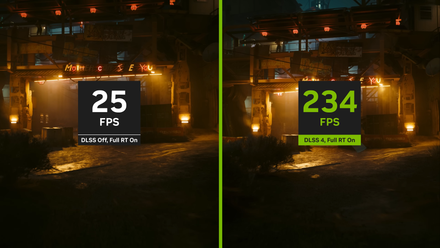
Frame generation is the new weapon in your GPU's performance-enhancing toolkit. It adds AI-generated frames between real ones to drastically boost framerates, even up to 4x. The problem is that you can still feel the real responsiveness of the game linked to the base framerate. AI-generated frames might push the FPS might counter up, but the added latency will make the experience suffer. And most people can actually feel it. Nvidia's RTX 50 series could only muster marginal gains over the RTX 40 lineup, with frame generation picking up the slack.
You might be able to skip crutches like upscaling and frame generation if you turn ray tracing off, but then you could just buy a budget GPU. What's the point of spending $500–$1000 on a GPU and still having to put up with visual downsides just to enable ray tracing?
Multi-frame generation does make a difference, but in one particular area
Nvidia's fake frames aren't completely useless
Ray tracing looks stunning only in a handful of titles
Games can look great even without ray tracing
Even after all this, the number of games that look drastically better with ray tracing can be counted on your fingers. Older titles, such as Control, Metro Exodus Enhanced Edition, Cyberpunk 2077, and Watch Dogs: Legion are what you might recall when someone mentions ray-traced games. Newer games like Alan Wake 2, Black Myth: Wukong, and Avatar: Frontiers of Pandora are also great examples of ray tracing done right. Each of these titles makes it worth the hassle to turn ray tracing on. The game world looks significantly better, adding to the immersion and improving your experience.
That said, as a PC gamer, you aren't just playing these titles all the time, right? Maybe you're spending several hours every week on titles like Counter-Strike 2, Apex Legends, and Dota 2. Maybe you like to free roam in Forza Horizon 5 or soar the skies in Microsoft Flight Simulator. Ray tracing won't matter much to you if you're playing games across genres and generations. Besides, ray tracing isn't a must for a game to look visually impressive. Titles like Dead Space (2023), Ghost of Tsushima, and Red Dead Redemption are but a few examples of big-budget titles that look stunning without major ray-traced effects.
Today, we're seeing many new games skip hardware-based ray tracing altogether. For instance, Battlefield 6, Dying Light: The Beast, and Death Stranding 2 launched in 2025 and proved that developers can craft immersive and breathtaking worlds without ruining game optimization with ray tracing.

The only 10 games that can justify the ray tracing tax
Ray tracing comes with heavy financial and performance overheads. Here are the only titles that make it all worth it.
When will ray tracing come to the masses?
It's high time graphics cards and big-budget games talked to each other and decided that ray tracing can't expect everyone to have an RTX 5080 or RTX 5090. If ray tracing needs to become commonplace across rigs of all tiers, it needs to be optimized to run on mid-range and budget hardware. Unless next-gen GPUs feature drastic innovations in performance, or game developers somehow bring down hardware requirements, ray tracing will remain a rich man's game.