
Backups are one of those jobs that look solved right up until they fail at the worst possible moment. For a long time, my Proxmox backup strategy was technically functional, but it demanded too much attention to deserve any real trust. I had jobs running, storage targets assigned, and enough moving pieces to convince myself I was covered. What I didn't have was confidence that restoring a VM or container would be as painless as the backup logs made it sound.
A backup plan that needs constant babysitting is not really finished, because it still depends on your mood, memory, and free time.
That distinction matters more in a home lab than people sometimes admit. A backup plan that needs constant babysitting is not really finished, because it still depends on your mood, memory, and free time. The moment life gets busy, the whole thing starts to drift. Proxmox Backup Server changed that for me by turning backups from a collection of tasks into a system I could stop actively managing.
A beginner's guide to Proxmox Backup Server
The perfect means to protect your virtual machines from unforeseen circumstances... and your experiments
The biggest win is how much cleaner everything feels
One backup destination replaced several awkward moving parts
Before I switched, my backup strategy had the usual patchwork quality that many home lab setups develop over time. Some backups lived on shared storage, some relied on manual habits, and some existed mostly because I had meant to refine them later. It wasn't impossible to manage, but it was messy enough that every small change made me second-guess whether I was improving things or just adding another layer. That's a bad feeling to have around the one part of your setup that is supposed to rescue you.
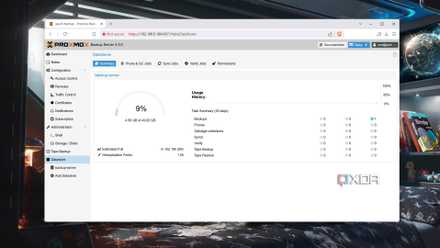
Proxmox Backup Server gave me a dedicated place and purpose for backups, and that alone made a huge difference. Instead of treating backups as a side effect of the hypervisor, I started treating them like infrastructure with its own logic and standards. Retention policies, scheduling, pruning, verification, and datastore management all felt like parts of the same machine instead of scattered settings across different workflows. Once that clicked, the whole setup became easier to understand at a glance.
It also helps that Proxmox Backup Server feels designed for the exact problem I was trying to solve. It is not a general-purpose storage trick dressed up as a backup plan. It's a backup platform built for Proxmox VE, and that focus shows in daily use. I spend less time improvising and more time trusting that the system is doing what it says it is doing.
Restores matter more than backups, and this tool gets that
Fast recovery changes how safe your lab really feels
Anyone can claim they have backups because backup jobs are completed overnight. That does not tell you much about whether your data is actually safe or whether recovery will be smooth when something breaks. The part that really matters is restoration, because that's the moment when all of your planning either pays off or falls apart. Proxmox Backup Server makes that side of the equation feel more central, and that is a big reason I have stuck with it.
Restoring from a backup should not feel like digging through a box of old cables, hoping the right one is still there. With Proxmox Backup Server, the process is sufficiently integrated that restoring a VM or container feels like a normal administrative task rather than a last-resort operation. I know where the backups are, I know what policies produced them, and I'm not wondering whether some half-forgotten workaround is about to become relevant again. That peace of mind is hard to overstate once you have lived through less polished backup arrangements.
There is also a mental benefit that comes from knowing your backups are not just sitting there as static insurance. Features like deduplication and verification make the platform feel active rather than passive. It is not simply a pile of archive files accumulating in a directory and daring you to trust them. It is a system that keeps backups organized, efficient, and meaningfully tied to recovery.
It is not the simplest option for every Proxmox user
Dedicated backup infrastructure can feel like extra overhead
To be fair, Proxmox Backup Server is not the lightest possible answer if your environment is tiny or your needs are modest. If you're only running a couple of disposable test VMs, adding another service may seem like unnecessary overhead. You need hardware or at least a place to host it, plus storage you are willing to dedicate to the task. For some people, that will feel like building a backup system for a problem they have not fully encountered yet.
There's also a learning curve, even if it is a reasonable one. The first time you move from simple scheduled backups to a more purpose-built platform, you have to think differently about datastores, retention, verification, and where this server fits into your overall topology. That is not a huge burden, but it is still more involved than pointing Proxmox at a network share and calling it a day. Some home lab users will look at that difference and decide that the simpler route is good enough.
Cost can be part of the hesitation, too, especially in a home lab where every extra node and drive competes with ten other project ideas. Backup hardware is never a glamorous purchase. It does not give you better benchmark numbers or a fun dashboard to show off to friends. It just sits there doing important work in the background, which is exactly why many people delay taking it seriously.
That extra effort is exactly why it works so well
Good backup systems should remove future work, not create it
The argument against Proxmox Backup Server usually makes sense on paper, but I think it underestimates the value of reducing long-term friction. Yes, it's another tool. Yes, it asks for some deliberate setup. But the whole point is that this effort happens upfront, so you stop paying a smaller tax forever after. I would much rather spend a little more time building a backup system once than keep nursing an improvised one for the next year.
That is really what changed for me. My old setup was cheaper in effort only if I ignored the constant low-grade maintenance it demanded. I had to remember how things were arranged, keep an eye on where jobs landed, and carry around a vague sense that I should probably revisit the whole thing soon. Proxmox Backup Server got rid of that background noise, and that alone made it worth adopting.
It also scales with me in a way that ad hoc backup strategies never really do. A home lab has a way of growing in uneven bursts, and backup plans built around convenience usually start to crack as soon as more VMs, more containers, or more critical services appear. Proxmox Backup Server gives me room to expand without having to redesign the entire protection story every time I add something important. That means I can keep thinking about my lab itself instead of the duct tape holding its safety net together.
Proxmox Backup Server does not need huge hardware, but that can give the wrong impression. The real sizing question is your datastore, because retention, backup frequency, and data churn will matter far more than the CPU needed to boot PBS. In other words, size the storage plan first, then pick the box.
|
Component |
Evaluation minimum |
Better target |
|---|---|---|
|
CPU |
64-bit x86, 2+ cores |
Modern 4-core AMD or Intel CPU |
|
RAM |
2GB |
4GiB minimum, plus 1GiB per TiB of storage |
|
OS drive |
More than 8GB |
32GiB or more |
|
Network |
1 NIC |
Faster and redundant networking if possible |
|
Backup storage |
Not really defined |
Size it around retention and churn, not just live data |
Why this kind of backup confidence is hard to give up
The best thing I can say about Proxmox Backup Server is that it made backups boring in the most useful way possible. I don't mean invisible in a reckless sense. I mean, predictable, organized, and stable enough that I no longer burn mental energy on them every week. In a home lab already filled with enough tinkering, that is a huge quality-of-life improvement.
I still care about backups, of course, but I do not have to constantly think about them anymore. That is the distinction that convinced me I had finally landed on the right approach. Proxmox Backup Server replaced a strategy that was always asking for attention with one that mostly stays out of my way while doing a better job. For something as important as recovery, that is exactly what I wanted.
Proxmox
Proxmox is an excellent way to manage virtualization in your home lab, but don't forget about backups.