
The PC market is undergoing rapid changes at the moment, and the memory industry is at the forefront of those changes. With insurmountable data center demands, increased wafer spending on HBM (high-bandwidth memory), and Micron pulling out of the consumer memory market, things aren't looking good for at least a while. Among all that, another emerging shift in the industry is the adoption of soldered RAM in desktop computers.
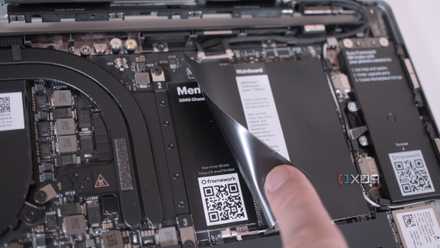
Soldered RAM might get more common, and that's a problem for consumers
Manufacturers aren't very fond of modularity, or retail customers
RAM soldering
And why laptops adopted it
Soldered RAM has plenty of advantages and is not the only performance component that comes "permanently" installed on select laptops (nothing but the storage is upgradable). The key advantage is compactness, as soldering eliminates the need for physical DIMM connectors like those on PC motherboards. This is obviously important for laptops, particularly for "ultrabooks" and premium thin laptops. It's what caused the drive in the early 2010s, when laptops were beginning to shed weight; otherwise, removable RAM was still quite standard in the 2000s and even the 2010s.
It also provides other advantages, such as better energy savings and performance (the latter due to potentially shorter trace paths, which can enable higher frequencies).
Soldered RAM in desktops
The advantages are there!
Mini and all-in-one PCs have begun adopting soldered RAM over the past few years, generally for the same reason as laptops. This is LPPDR (low-power DDR) RAM, the same as laptops. They operate at lower voltages and support more advanced power states for lower power draw. With that, they face sustainability challenges, so they can't be used on DIMM slots. Due to their lower operating voltage, electrical signals are weaker and more susceptible to noise over longer trace paths (i.e., that of DIMM RAM). The additional capacitance and impedance discontinuities with DIMMs would contribute further. This is countered by placing the memory closer to the CPU, which is practical only when it's soldered to the motherboard.
Also, even though soldered memory isn't "inherently faster" on its own, the system design enabled by soldered LPDDR can offer higher effective memory bandwidth, especially for integrated GPUs and AI accelerators. APUs and AI-focused CPUs sometimes require very wide, high-speed LPDDR memory buses that can only be practically implemented with soldered LPDDR memory. Framework's Desktop, which uses the AMD "Strix Halo" APU with LPDDR5x RAM, is an example of this. In graphics and AI workloads, the rate at which data can be moved between memory and compute units can otherwise be a performance bottleneck. When memory cannot feed data fast enough, the iGPUs remain underutilized. High memory bandwidth, therefore, helps keep integrated compute units busy and improves overall performance in GPU and machine-learning tasks. Also, even within laptops, soldered LPDDR RAM often supports higher maximum frequencies than lightweight DDR SO-DIMMs, enabling higher effective system bandwidth for these applications.
Framework Desktop
- CPU
- AMD Ryzen AI Max 300 Series
- Graphics
- Intergrated
The Framework Desktop lets you choose the parts you want, and build your own mini PC with no fuss.
- Motherboard
- Mini-ITX
- Operating System
- Windows 11, or install your own Linux distro
- Dimension
- 96.8 x 205.5 x 226.1mm
- Weight
- 3.1kg
- USB Ports
- 2 USB-C; 2 USB-A
Basically, the advantages of socketed RAM (capacity scaling and swapping) are exchanged for size, efficiency, and design simplicity. Apple's Mac Mini PCs have been demonstrating the trend of soldered RAM for a while now, as they integrate RAM into the SoC. This essentially locks in the memory and is central to the M-series architecture of unified memory, which ties the CPU, GPU, and NPU memory pools together.
Compact workstations are also beginning to adopt soldered memory or fixed memory configurations. High-end compact PCs (often "AI-focused" ones) are increasingly balancing performance with thermal and space constraints. The Beelink GTR9 AI MAX 395 PC, for example, supports up to 128GB of soldered LPDDR5X memory.
The point is: in these compact PCs with less available room for standard DIMM slots and memory traces, it just makes sense. LPDDR (low-power DDR) not only provides an integrated performance advantage but also helps with power efficiency, which is important in low-power or fanless PCs.

The practical advantages
…that manufacturers won't admit
Soldering RAM directly to the motherboard reduces the number of discrete parts OEMs must procure and manage (including the DIMM sockets and connectors). Fewer discrete parts and simpler boards can translate into lower component costs and assembly complexity. Also, integrating RAM directly into the board enables more automated assembly and cuts costs associated with additional connectors and slots. Even though the savings per unit may not be large, when multiplied across millions of units annually, this smaller bill of materials and streamlined assembly benefit OEM profit margins. Reducing slots and sockets also marginally reduces overall production costs by enabling simpler boards and fewer failure points during assembly.
Also, when RAM is soldered and non-upgradable, buyers have to choose and pay for their memory configuration at the point of purchase because they cannot add or replace memory later. This effectively locks revenue for higher-margin, higher-RAM configurations into the initial sale. In the current situation, the RAM crisis is actively impacting OEM pricing and profitability. So, OEMs can extract more revenue from customers who may otherwise upgrade memory by adding new sticks.
Soldered RAM is coming to town
Soldered RAM has many advantages, including potentially faster speeds and lower power consumption, which makes it suitable for low-power computers. For all-in-one PCs and desktops focused on compactness and little active cooling, it's an ideal choice. It's also important to Apple's Mac M-series architecture and can be better suited for AI PCs with NPUs, and those with iGPUs, too. Its limits are, namely, the lack of consumer control over customization and the potential to be forced to spend more upfront. Though it's unlikely that soldered RAM will transition into tower desktops, so the concern will only be limited to the mini PC market.