
I'm deep in the middle of planning my next home network upgrades, putting the knowledge I gained from the last upgrades not quite working out to good use. I made some mistakes, I'm sure they won't be the only ones, and I'm also sure that the next upgrades won't be the last. But while the hardware being used might change, there is one network feature I won't live without.
That's a collection of VLANs, but perhaps not for the reasons you are thinking. I know they're not a security replacement, or a place to banish IoT devices, or any of the usual tropes that get mentioned as the reasons for using Virtual LANs at home. I have one reason for using them, but that reason creates the framework for the rest of the software layer of my networks.
5 rules I use for sane VLAN design at home (without overcomplicating it)
These keep me sane as well...
I have a problem with organization
Scatterbrained everywhere except in my home lab
Every aspect of my life needs dedicated dashboards; otherwise, the carefully constructed house of cards that I operate in falls apart. When my home network was fairly simple and had about a dozen devices, I could manage it from a single list of MAC addresses. Those days are long gone, and my home network was a mess. Not just smart home devices, but my home lab, laptops being tested, and the private MAC rotation of smartphones were all contributing to daily headaches.
For me, VLANs are just another set of dashboards, a way to segment my network into manageable chunks, so I don't get overwhelmed or fall into decision paralysis. They sort my network-attached devices into labeled buckets, making it easier to recall what's on the network, if it should be there at all, and how the different devices might need to communicate with each other.
I'll upgrade my switches at some point for more ports, which will bring more headaches as I remember where everything is. I'll be heavily leaning on VLANs to keep me sane, and I want to do some micro-segmentation experiments with VLANs for individual devices, to see how easily Zero Trust can be achieved.

5 reasons you should replace your unmanaged switch with a managed one
You gain a ton of utility by using a managed switch in your home network.
VLANs are now key to my home network
Everything has a place, and now I know where to look for it
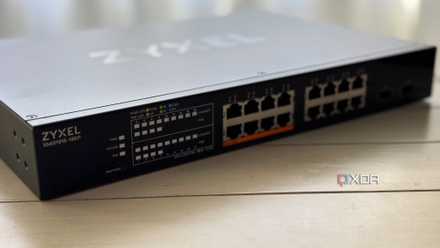
With the right mix of network appliances, I can apply VLANs to devices, VMs, and containers, and keep everything in some semblance of order. A managed switch was the first step, but it didn't solve all the issues. For that, I needed a few wireless access points that supported virtual SSIDs, so I could assign dedicated SSIDs to some VLANs, keeping them separated across the stack. That also ensured that any firewall rules I set were enforced centrally.
And that's it. An organized home network, where every device has its assigned section. You wouldn't throw all your kitchen gadgets and cooking utensils in one cupboard in your kitchen and expect it to be easy to cook in. I don't understand why anyone would want to keep all their network devices on the same network segment for the same reason. Not every device needs to talk to other devices, the internet, or be allowed to open ports. VLANs help me make sense of the chaos, and are a non-negotiable now for my setup.
And it makes troubleshooting (somewhat) easier
Troubleshooting network issues is never any fun, at all, and it's only made exponentially more difficult by the number of devices on your network. Dividing that number into smaller chunks makes any issues easier to work out, because it's either one of the devices on that VLAN segment, the firewall rules attached to that VLAN, or the ports that are allowed to pass that VLAN traffic. I don't have to guess whether it's a misbehaving IoT device sending more broadcast packets than it should, unless I'm troubleshooting the IoT VLAN.
It also makes setting up firewall rules easier, as I can apply them to entire VLANs, then drill down to make more specific rules for certain services or things like printers, if I only want some computers to be able to print.

This one VLAN setup protects everything on your network from everything else
Let's get some Zero Trust into the home lab
I wish I'd learned about VLANs earlier
I spent so many years struggling with troubleshooting every device on my network whenever there was an issue. If I'd had a managed switch to set up VLANs, I could have cut that time down drastically and only had to investigate the devices on the affected VLAN. Networking was never my favorite part of computing back then, and I probably actively avoided learning advanced techniques. But I'd consider VLANs to be a foundational feature now, and they're one of the first things I set up.