
The air cooling vs. liquid cooling debate isn't a simple one — different users prioritize different aspects and benefits when making the choice. Some would prefer the simplicity and acoustics of an air cooler, while others wouldn't compromise on the esthetics and higher performance of an all-in-one (AIO) liquid cooler. However, one thing that is becoming increasingly clear regardless is that it might be the end of the line for custom watercooling loops.
Custom loops were never intended to be adopted by the masses, typically relegated only to enthusiast builds where absolute performance and intense overclocking reigned supreme. In 2024, however, custom loops might be on their way out, fast becoming a relic of the past.

5 overkill PC building trends that aren't worth the trouble
PC building has seen many overkill trends over the years. These are the ones just not worth it anymore.
3 Custom loops demand more money, time, and skill
Be prepared for some intense DIY
For most users, cooling the CPU means installing an air cooler or a stock AIO liquid cooler, and they're probably blissfully unaware of the circus that custom watercooling can become. In contrast to a pre-built cooler that you simply attach to your CPU, a custom loop consists of tubes, waterblocks, reservoirs, and fittings that you need to assemble yourself. Needless to say, this requires considerably more skill than the overall competence needed for building a new PC.
Even among enthusiasts, many users are reverting to AIO liquid coolers after years of using a custom watercooling loop on their high-end rigs.
You'll need to ensure the right size and compatibility of every part of the loop, and spend a lot of time putting everything together. Finally, the cost of a custom loop can range from $400 to $700 and even more. Most people who build a custom loop cool their graphics cards as well, further adding to the cost of the open-loop setup.
Enthusiasts might shrug off the added financial investment and effort required for creating a custom loop, but the vast majority of the PC building community will naturally look elsewhere. Even among enthusiasts, many users are reverting to AIO liquid coolers after years of using a custom watercooling loop on their high-end rigs.

Watercooling your PC: What is it and should you do it?
When it comes to cooling computer components, water cooling is the most premium option, but it's not just for high-end systems.
2 The benefits aren't worth the hassle
Custom loops are cool, but at what cost?
The biggest reason to use a custom watercooling loop instead of an AIO or air cooler is to attain significantly lower thermals, especially for the CPU. While user reports vary, custom loops can deliver anywhere from 10–20℃ lower CPU temps compared to AIOs. That's a big difference when you're considering today's power-hungry processors, but does that instantly make custom loops worth it?
Delidding your CPU might have become slightly easier thanks to delidding kits, but the process will void the warranty of your CPU if you're doing it yourself.
You need to keep in mind that those massive gains usually only come with delidding the CPU i.e. removing the IHS from the CPU to establish direct contact between the waterblock and the die. Delidding your CPU might have become slightly easier thanks to delidding kits, but the process will void the warranty of your CPU if you're doing it yourself (Intel will, reportedly, still honor the warranty if delidding is done by some system integrators).
Besides, a custom loop needs way more maintenance than an AIO — you need to ensure there are no unintended leaks in the loop, plus drain the liquid now and then for cleaning purposes. Unless you need to squeeze every last ounce of performance from your CPU, you can skip a custom loop and pick a high-quality AIO instead. Undervolting your CPU can further help you attain lower CPU temperatures.
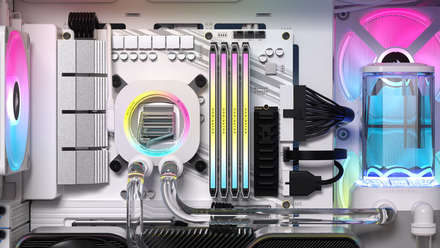
Water cooling your PC is a gimmick for most people
If you're an enthusiast who likes water cooling, just know that not everyone needs it.
1 AIOs are more powerful than ever
Watercooling (sans custom loops) is accessible to everyone
Even though air coolers can adequately handle the most extreme chips today, there are definite benefits to liquid cooling if you want to prevent your processor from being thermally limited. For a small premium over air coolers, you can access powerful liquid cooling thanks to high-end and even budget liquid AIO coolers. You can build a silent, cool, and visually impressive system using a quality AIO liquid cooler.
When you can tap into much of the performance of custom watercooling with an easy-to-install, hassle-free AIO cooler, there's little reason to opt for the former.
In such a market, it's hard to recommend a custom loop to anyone, even someone who has the extra budget and skills to make it happen. When you can tap into the performance benefits of custom watercooling with an easy-to-install, hassle-free AIO cooler, there's little reason to opt for the former. Even if esthetics are an important factor for you, AIO systems can satisfy that need.
The use cases for a custom loop are becoming increasingly scant as a result, and it's no wonder that they're rapidly disappearing, joining the ranks of overkill PC building trends that just aren't worth it for most users.

Air coolers can handle almost everything, so who are AIO coolers really for?
Air coolers aren't the useless cousins of AIOs anymore, so why are liquid coolers still relevant?
What will the future of PC cooling look like?
Both AIOs and air coolers will likely remain the best choices for PC builders considering all the factors involved, but manufacturers are hard at work bringing new technologies to market. From advanced AIOs using composite heat pipes to pump-less coolers and even embedded cooling, there's a lot to look forward to in the coming years.
The thermal output of high-end processors will likely only go up from here, so manufacturers need to keep up with high-end cooling systems. The technology that will come out on top will be the one that marries simplicity, safety, and performance in a single irresistible package.