
Correction (June 15, 2026): This article originally stated that Microsoft announced "WSL 3," with near-native GPU and NPU access, at Build 2026. Microsoft did not announce a "WSL 3." The actual WSL announcement was WSL containers, which comes in the form of built-in Linux container support in WSL (via a new wslc.exe CLI and developer API) that reduces reliance on tools like Docker Desktop. This article has been rewritten to reflect the official announcements, and we apologize for the error.
WSL has long been the saving grace of Linux developers that also need to run Windows daily, and it's partly responsible for keeping me on Windows in the first place. Underneath all of the AI announcements, Microsoft unveiled new containerization features within WSL at Build 2026, and it's a free upgrade that the entire Windows 11 base can eventually pull down, just as previous versions have been, but the added functionality removes the need to containerize using a third-party stack like Docker Desktop.
I tested dual-boot, WSL2, and VMs to run Linux apps on Windows, and only one was worth keeping
Dual-boot, VMs, and WSL2 walk into a Windows PC...
WSL giving Linux containers a native hold
The CLI and API live inside WSL👁 A photo of someone running the nvidia-smi command in WSL
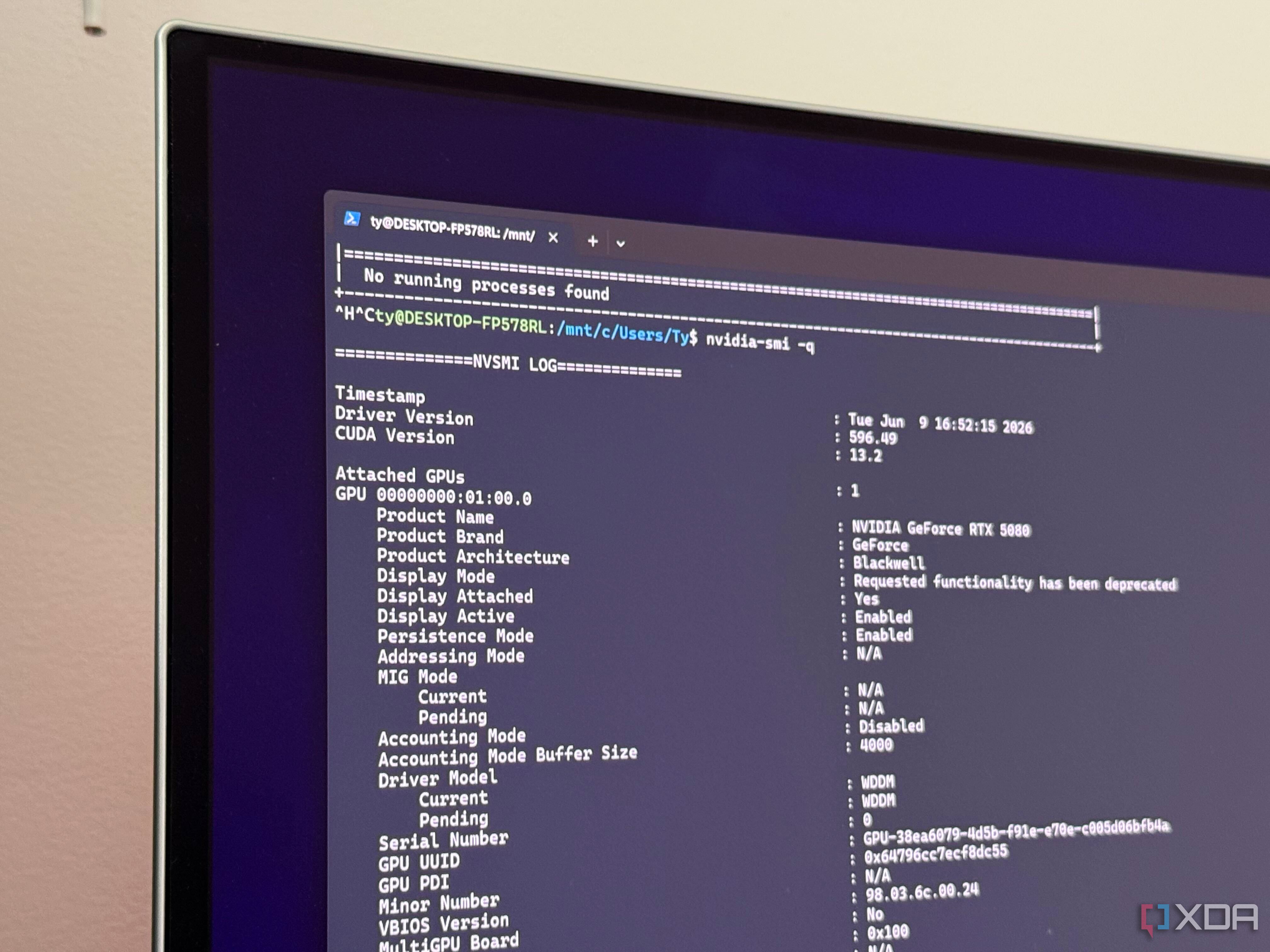
Microsoft is adding a built-in way to create, run, and interact with Linux containers directly on Windows, and it ships as part of WSL rather than as a separate product you bolt on. It's exposed in two ways: either through a new command-line library (wslc.exe) that lets you build, run, and deploy Linux containers at will from a terminal, and a developer API that lets native Windows apps spin up containers as part of local AI workloads, testing pipelines, or any Linux-based processing you might want to drive from your own code. It can also pass your GPU through to a container via the Container Device Interface, so you can pull a CUDA image and run a GPU-accelerated ML workload against your Windows GPU driver, which is just building on the same support WSL 2 has had for years.
Microsoft actually open-sourced WSL at Build 2025, and looking at the numbers, it's pulling in substantial community PRs, so it's no surprise they're continuing to fold Linux deeper into the fabric of developing on Windows. WSL already runs Linux on a lightweight managed VM, and this allows containers to ride on that existing plumbing instead of standing up a parallel stack.

I ditched Copilot on VS Code for this free extension, and it's miles ahead
It's completely self-hosted, too!
This is squarely aimed at the third-party container stack
Docker Desktop is in the crosshairs
Microsoft was unusually direct about the problem it's solving with this. Container workflows on Windows, it points out, usually depend on third-party tooling that adds setup overhead, licensing cost, and limited enterprise control. You don't have to squint to see Docker Desktop in that sentence at all. Its per-seat licensing for larger companies is a pretty hefty tax that a lot of teams just end up tolerating.
WSL containers folding in that capability directly into Windows hands IT professionals the controls they've been missing. Admins get access to proper policy-based enablement, visibility into which containers are running, which images can be pulled, and a direct say in how the containers interact with the host. All-in-all, it's less to babysit if you're in charge of a lot of hosts.
5 reasons I stopped dual-booting Windows and Linux on my PC
It's just not worth the hassle anymore.
It's still free and decoupled
This is delivered as a WSL update, not a Windows one
As someone who really dislikes having non-core Windows updates forced upon them, this is the part I appreciate the most: WSL containers will arrive as a regular update to WSL, not as something gated behind a major Windows release. WSL ships as a standalone app through the Microsoft Store, decoupled from Windows feature updates, so this should land without a giant OS upgrade hanging over it. And because the project is completely open-source, you can actually see it coming together rather than having to keep track of press releases.

I ran Linux for two years without actually understanding it, and WSL2 made that possible
WSL has come a long way.
I've got my eye on WSL
Microsoft says a public preview is coming "in the coming months," with no firm general-availability date. The CLI surface, the exact command syntax, and any system requirements can still shift before it ships, so I'd personally treat the specifics with a huge grain of salt. The underlying promise is there, though: Linux containerization available in a native Windows format is truly a game-changer for basically anyone who frequents Docker in Windows. WSL was already a saving grace for anyone who dual-booted for the sake of needing to reach for Linux tooling on a daily basis, but now that containerization is getting some love, there continues to be fewer reasons for a second OS install than there ever has been.