
A new graphics card is often a massive performance upgrade for a gaming PC, especially if it's generations removed from your existing one. If you're considering buying a new GPU right now, you should consider an alternative upgrade before finalizing your decision. A new gaming monitor can arguably be as impressive as a new graphics card, if not more. Considering how far gaming monitors have come in the last five years, you stand to gain a lot from a more advanced display. Switching from IPS to OLED, 1080p to 4K, or 144Hz to 360Hz can transform your gaming experience more than some extra frames. The prices of graphics cards are inflated right now, and new GPUs are probably not coming out till 2028. If your GPU is already capable of 1440p gaming, it's better to invest in a monitor upgrade before buying a new GPU.

I regret using this gaming monitor for years
I wasted three years with a 75Hz "gaming" monitor
High-end gaming monitors are finally getting affordable
It's the year for monitor upgrades
Before 2026, advanced gaming monitors were prohibitively expensive. Whether you were after OLED displays, 4K monitors, or high-refresh-rate panels, "affordable" wasn't a word most people associated with these features. You couldn't hope to get a decent OLED monitor from a reputable brand for under $800–$900, and 4K 160–180Hz monitors weren't available for under $600. Combining OLED, 4K, and a 240–360Hz refresh rate easily pushed the asking price beyond $1,000. Today, you can get a 4K 240Hz QD-OLED monitor from a brand like MSI for under $700. While that's still not what you'd call economical, it showcases a larger downward trend in gaming monitor pricing over the last few months. Most people aren't after such specced-out beasts anyway, so the $700 list price is way more than you need to spend for a significant upgrade over your current display.
Realistically, the minimum for a 27" 1440p 240Hz QD-OLED display has dropped to around $350 if you pick an AOC model. For just over $400, you can get the Samsung 27" Odyssey OLED G5 with a 1440p 180Hz QD-OLED panel. Even a year or two back, buying a modern OLED monitor for $400 was unthinkable. Newer technologies like tandem OLEDs are also coming to market at prices I never thought I'd see. Gigabyte's MO27Q28G, a 4th-gen tandem OLED display with a 1440p resolution and 280Hz refresh rate, is available for around $600. These monitors are some of the best iterations of OLED technology you can buy right now, and they don't exactly cost a bomb.
Even if you're not impressed by the true blacks and superior HDR of OLED displays, you have plenty of other affordable IPS options. Dual-mode displays with 4K 180Hz and 1080p 360Hz configurations have dropped below $300. If you're using a 1440p 144–165Hz display right now, you're already in the sweet spot in terms of the resolution and refresh rate, at least for single-player, story-driven titles. Switching to an OLED display still promises a huge upgrade over your existing experience, and it's arguably more immersive than a 4K 240Hz–360Hz monitor.
For 1080p users, who still form a majority according to the Steam Hardware Survey, jumping directly to a 4K display is now more affordable than ever. Provided your GPU can sustain playable framerates at 4K using upscaling and frame generation, you're looking at a new tier of gaming immersion. You could consider a new monitor and a used graphics card as a combined upgrade to account for the resolution jump if your existing GPU is a bit too old.
Your 4K monitor is more important than your RTX 4090
Your GPU's power is only potential, your monitor's quality is reality
A GPU upgrade will most likely not be as impressive
More FPS isn't everything
A new gaming monitor is one of the best upgrades you can make to your setup, and I'd even argue that it's better than spending way more on a high-end graphics card. Assuming your existing GPU is not more than two generations old, it's probably capable of decent 1440p gaming even in modern AAA titles. Buying a high-end graphics card, such as the RTX 5070 Ti or RX 9070 XT, for $600–$750 will give you a significant FPS boost, but it probably won't be a radical shift from what you're playing at already. Compared to the jump in image quality, HDR experience, and motion clarity you'll get from an OLED display, a new GPU is likely to feel like a minor upgrade.
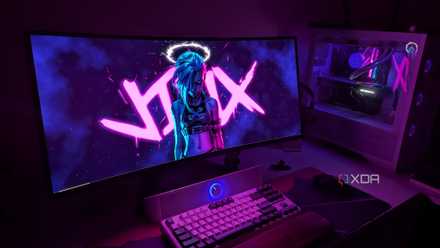
You also need to consider that you can further enhance immersion by getting a curved ultrawide display with an OLED panel, which is something I did six months ago. I got the Alienware AW3423DWF for around $600, and it's a pretty great deal for that price. The 1800R curve isn't too aggressive, but it's enough to offer a genuine upgrade over my flat IPS panel. The refresh rate jump for me wasn't significant, but going from a flat IPS to an ultrawide OLED was something I didn't know I needed. Besides, the near-instantaneous response time of the QD-OLED panel makes everything feel so much more responsive.
The fact that you need to spend nearly half the price of a new GPU on a new monitor (OLED or not) makes the comparison between the two upgrades more interesting. Most gamers still use 1080p or 1440p IPS displays, so the upgrade to an OLED display (1440p or 4K) will be huge.
Alienware QD-OLED AW3423DWF
This gaming monitor uses QD-OLED technology to reach a brightness up to 1,000 nits while having a smooth 165Hz refresh rate and ultra-fast response times of 0.1ms.
Why I switched to yet another 1440p gaming monitor instead of upgrading to 4K
An OLED display trumped 4K resolution or a 240Hz refresh rate for me
New graphics cards aren't coming out for years
In case you were hoping for better deals
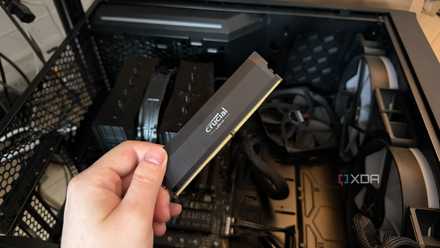
Even if you were to splurge on a new GPU right now, the market isn't in the best shape right now, and probably won't be for another two years. Unless you've been living under a rock, you know about the price hikes we've seen in the last six months. What started with unprecedented demand for DRAM led to skyrocketing prices for consumer RAM, SSDs, and graphics cards. VRAM has become one of the most expensive parts of a GPU, which is why Nvidia has reportedly stopped supplying memory with GPU dies to its AIB partners. High-end GPUs like the RTX 5090 and RTX 5080 are retailing at record prices, and even mid-range cards haven't been spared. AMD's relatively value cards like the RX 9070 XT are also inflated right now, and will remain so for the foreseeable future. A GPU upgrade just doesn't seem like a sensible choice in this market.
To add to the woes of PC gamers, neither Nvidia nor AMD is launching any new graphics cards this year, or even in 2027. Due to shifting priorities, GPU companies are focusing on data center GPUs for enterprises. You'll most likely have to wait till 2028 for next-generation GPUs. And there's no guarantee that this AI-induced crisis won't lead to higher price levels across the board. Even if we get new GPUs in 2028, they'll probably launch at higher price points than we've seen to date. Amid this doom and gloom, you can at least invest in a new gaming monitor using all the money you've saved for a GPU upgrade. It'll cost less and make a bigger difference to your gaming immersion.
I've lived through hardware shortages before — this one feels unprecedented
Prepare yourselves for a new normal in pricing and availability
It's high time you elevated your gaming display
Your gaming monitor is the device through which you experience your games. Upgrading to a modern display will probably be a more impactful upgrade than switching to a new GPU. The latter may provide you with an FPS boost, but the former will make your games look better, run smoother, and feel more immersive. Considering the prices of current-gen GPUs, and that no next-gen GPUs will arrive before 2028, it's the right time to invest in a new gaming monitor.