|
VOOZH | about |
|
VOOZH | about |
| Dogmatika | |||||||||||||
|---|---|---|---|---|---|---|---|---|---|---|---|---|---|
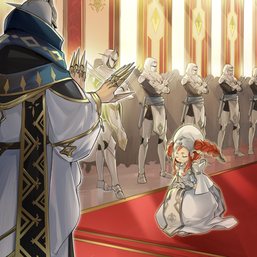
| 👁 "Dogmatika Maximus", "Ashiyan", and "White Relic" in the artwork of "Dogmatika Genesis" | |||||||||||||
| Japanese |
| ||||||||||||
| Simplified Chinese |
| ||||||||||||
| French |
| ||||||||||||
| German |
| ||||||||||||
| Italian |
| ||||||||||||
| Korean |
| ||||||||||||
| Portuguese |
| ||||||||||||
| Spanish |
| ||||||||||||
| |||||||||||||
| Lists | |||||||||||||
A great country existing in the 'Abyss', the "Dogmatika Nation".
A girl raised by the church from young age.
Controlling the power of miracles through the 'Stigmata' to annihilate the heretic.— The archetype's taglines in promotional material
"Dogmatika", known as "Dragma" (ドラグマ Doraguma) in the OCG, is an archetype of LIGHT Spellcaster monsters which debuted in Rise of the Duelist.
There are many who call it 'The Abyss', it is a continent isolated from the rest of the world. In the land of 'The Abyss', a huge different dimension called 'The Hole' appeared in times long lost from the traces of memory, which is well known to open its 'jaws' and swallow both people and regions whole. However, 'The Hole' is not just a disaster that swallows men, but in rare, almost miraculous, cases, it brings forth power that could be called 'Grace Beyond Human Understanding' to the world. One time, it was an unknown form of dark matter. Another, it brought forth what appeared to be a relic from a long lost civilization. And yet another, even a life form...
Located in the far north of 'The Abyss' is a political superpower, that has the church as the central political authority, lead by "Dogmatika Maximus" as the supreme leader and highest authority. Their army of crusaders, made up of followers of the "Dogmatika" faith, eradicate heathens and heretics, by devoutly following the path of "Dogmatika", by which they perform miracles via 'Stigmata', the mark of their faith.
The 'Stigmata' is a mark given to all members of the "Dogmatika" faith. The followers and agents of the faith receive this power of the divine through the holy relic "Dogmatika Nexus", administered by "Maximus Dogmatika", and this power is capable of creating mysterious miracles. Among them are those who are particularly powerful, who fight heretics that threaten the stability of the nation as soldiers of its crusading army.
A maiden raised by the church since childhood. With the 'Stigmata' shining brightly on her forehead, and her pure personality, people call her a saint along with "Fleurdelis".
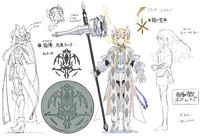
The knight commander of the crusaders, who, thanks to the 'Stigmata' on all four of her limbs, wields the three holy relics of the church, the Sword, the Shield, and the Armor, that can only be wielded by those with truly incredible power of miracles. She is the other saint who serves as the moral authority of the nation's people.[1]
The Japanese name for the archetype, "Dragma", is likely a portmanteau of the words "dragon" and "dogma", while the English one appears to be simply dog Latin of "dogmatic". As suggested by "Dogmatikaturgy", the former may also be a play on "drama", referencing the theater theme of "Despia". Most of the monsters' names reference the Christian religion.
The "Dogmatika" Ritual Monsters and Ritual Spells use the kanji 「」 (Kyōdō, literally "Wicked Way") under the "Dragma" reading in their Japanese names, unlike the rest of the "Dogmatika" monsters, which use 「」 (Kyōdō, "Dogmatism") instead. This reflects the latter half of The Fallen & The Virtuous, where the "Dogmatika" eventually revealed their true colors.
Most of the "Dogmatika" monsters have either "Despia" counterparts or "Swordsoul" counterparts, as in the latter half of The Fallen & The Virtuous, some of the characters turn against the rest of their people.
The "Dogmatika" archetype is thematically focused on countering Extra Deck monsters (referring to Fusion, Synchro, Xyz, Link Monsters). To this end, cards in this archetype commonly feature three shared conditions and effects:
The Level 4 "Dogmatika" monsters, "Ecclesia", "Adin", and "Theo", all share the following two effects:
Between these three, the individual effect of "Ecclesia" overshadows that of the other two, since she can search any "Dogmatika" card from the Deck to the hand when Normal or Special Summoned, at the cost of preventing the player from Special Summoning from the Extra Deck for the rest of the turn.
The Level 8 and 11 "Dogmatika" monsters have varying effects to Special Summon themselves and various individual effects.
Fitting with the archetype's restrictions against the Extra Deck, the archetype has several Main Deck Ritual boss monsters and Ritual support.
Other "Dogmatika" Spell and Trap cards and support provide more utility to the Deck, and further involves the archetypal mechanic of sending monsters from the Extra Deck to the GY. The most notable among these are "Nadir Servant" (the archetype's main searcher and recovery tool), "Dogmatika Punishment" (a Normal Trap that destroys opposing monsters by sending a monster with equal or greater ATK from the Extra Deck to the GY), "Quadogmatika Beast" (which Special Summon any monster from the user's GY or banishment by sending a monster from the Extra Deck or 1 "Dogmatika monster from the Deck whose ATK is equal or greater), and "The Fallen & The Virtuous" (which can destroy any face-up card or Special Summon a monster from either GY). Like "Dogmatika Ecclesia", using "Nadir Servant", "Dogmatika Punishment" or "Quadogmatika Beast" will also prevent the player from Special Summoning from the Extra Deck for the turn (though the restriction of "Punishment" and "Quadogmatika Beast" lingers until the end of the player's next turn). Other "Dogmatika" Spells/Traps including "Branded in Central Dogmatika", "Dogmatikacism" and "Dogmatika Nation" have secondary effects to send monsters from the Extra Deck to the GY and as such, they have more difficult requirements to trigger such effects when compared to the first group of cards. Meanwhile, "Dogmatika Encounter" either recovers or Special Summons a "Dogmatika" monster to the hand.
A pure "Dogmatika" Deck is broadly control-based, focusing on Summoning their boss Ritual Monsters and sending monsters from both player's Extra Decks to the GY, while preventing the opponent from Summoning some of their most important and/or powerful Extra Deck monsters. Extra Deck monsters with beneficial GY effects are thus invaluable for the Deck. "Titaniklad the Ash Dragon", "The Dragon that Devours the Dogma" and "Granguignol the Dusk Dragon" are the main choices to be sent from the Extra Deck to the GY by a "Dogmatika" Deck, as they can search or Special Summon "Dogmatika" cards from the Deck after they are sent to the GY. Meanwhile, "Despian Luluwalilith" can Special Summon any LIGHT Spellcaster whose ATK equals its DEF. All three choices are ideal for summoning "Dogmatika Ecclesia, the Virtuous" which in turn searches "Dogmatika Fleurdelis, the Knighted" for its monster negate during the opponent's turn. Other Extra Deck monsters with beneficial effects in the Graveyard include "Ecclesia and the Dark Dragon", "Elder Entity N'tss", "Herald of the Arc Light", "Wind Pegasus @Ignister", and "Fossil Warrior Skull Knight" for searching more cards or removing the opponent's cards from the field.
The archetype's supporting cards has some overlap with supporting "Fallen of Albaz" as well (namely "Titaniklad the Ash Dragon", "Dogmatika Encounter" and "Nadir Servant"), which can be situationally Special Summoned to fuse away the opponent's monsters. Besides "Titaniklad the Ash Dragon" and "The Dragon that Devours the Dogma", some Fusion Monsters that mention "Fallen of Albaz" also provide useful advantages for the "Dogmatika" strategy with their GY effects (such as "Albion the Branded Dragon" being able to set "The Fallen & The Virtuous" during the End Phase). However, the "Dogmatika" archetype's restrictions against Special Summoning from the Extra Deck makes "Albaz" and most of its associated cards a poor fit with it.
Due to the deck being able to easily send monsters from your Extra Deck to the Graveyard, and in most cases only stopping you from summoning from the Extra Deck on your turn, this can be used to setup for the Fusion Summon of "Cyberdark End Dragon", "Naturia Exterio", or "Dragon Master Magia" using cards like "Necro Fusion" during a subsequent turn, or "Synchro Summoning" "Jurrac Meteor" (which can clear the entire board) by the effect of "Jurrac Astero" during the opponent's turn.
"Invoked Shaddoll Dogmatika" is a hybrid of the "Dogmatika" archetype with the "Invoked" and "Shaddoll" archetypes, taking advantage of the "Dogmatika" archetype's ability to easily bin "Shaddoll" monsters from the Extra Deck directly to the GY to trigger the GY effects of "Shaddoll" Fusion Monsters.
Specifically, "Nadir Servant" and "Dogmatika Maximus" can send "El Shaddoll Apkallone" and "El Shaddoll Construct" directly from the Extra Deck to the GY, triggering their GY effects to search out and/or recover the "Shaddoll" Fusion Summon Trap Card "Shaddoll Schism", which would be used to Fusion Summon "El Shaddoll Winda" on the opponent's turn to floodgate the opponent. After completing this central combo of Fusion Summoning "Winda", the additional "Dogmatika" resources generated during the combo are used to make disruptions, through cards such as "Dogmatika Punishment" or " Dogmatika Fleurdelis, the Knighted". The "Invoked" component of the Deck meanwhile serves as a method to easily make Extra Deck monsters to enable the "Dogmatika" monsters' Special Summons.
This theme was one of those featured in the Yu-Gi-Oh! CARD GAME THE CHRONICLES video.