


























Categories
Also Featured In
Artemis II Flight Day 2: Orion Completes TLI Burn, Crew Begins Journey to the Moon

Editor’s Note: Blog updated to reflect update propellant burn quantities.
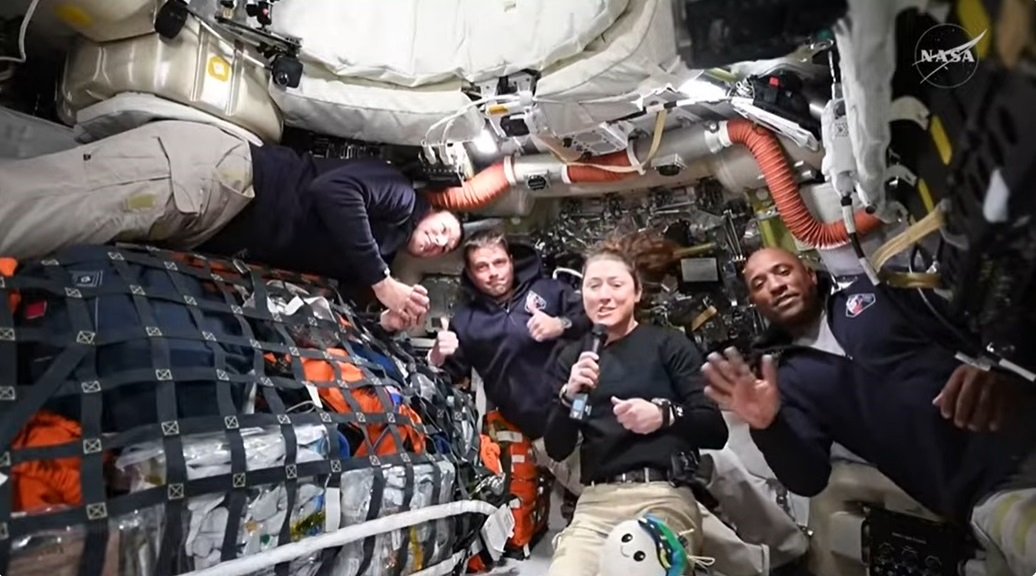
NASA’s Artemis II crew is on the way to the Moon.
After the mission management team polled “Go” Thursday, NASA’s Orion spacecraft fired its main engine for five minutes and 50 seconds beginning at 7:49 p.m. EDT, to successfully complete the translunar injection (TLI) burn, sending the crew in Orion out of Earth orbit and on a trajectory toward the Moon.
Orion’s main engine provides up to 6,700 pounds of thrust, enough to accelerate a car from 0 to 60 mph in about 2.7 seconds. At the time of the burn, Orion’s mass was 58,000 pounds and burned approximately 1,000 pounds of fuel during the firing.
Crew members also are spending time exercising on the spacecraft’s flywheel exercise device. During exercise, teams on the ground monitored the spacecraft’s air revitalization system, which maintains a breathable, comfortable cabin environment for the crew, and assessed how exercise impacts movement of the spacecraft.
The flywheel uses a simple cable‑based mechanism that supports both aerobic exercises like rowing and resistive movements such as squats and deadlifts. Operating much like a yo‑yo, the device provides resistance proportional to the force applied, allowing loads up to 400 pounds. This capability is especially important in deep space, where astronauts do not have access to the extensive exercise equipment aboard the International Space Station. On the station, crews rely on more than 4,000 pounds of exercise hardware spread across roughly 850 cubic feet. In contrast, Orion’s flywheel weighs just 30 pounds and is about the size of a carry‑on suitcase—meeting the strict mass and volume constraints of deep‑space missions while still supporting crew health and reentry readiness.
The crew members – NASA astronauts Reid Wiseman, Victor Glover, Christina Koch, and CSA (Canadian Space Agency) astronaut Jeremy Hansen – have successfully checked out the AVATAR scientific payload.
Engineers also determined that a brief loss of two-way communications between the ground and crew that occurred shortly after the crew reached orbit was due to a ground configuration issue involving the Tracking and Data Relay Satellite system. The issue was rectified quickly with no impact to mission operations.
Lunar Science Team Prepares for Flyby
After the TLI burn that sent Orion on its path to the Moon, the lunar science team began building a Lunar Targeting Plan, a guide to what the crew will look at on the Moon’s surface during its approximately six-hour observation on Monday, April 6.
The targeting plan will include documenting features that can help scientists understand how the Moon and solar system formed, such as craters, ancient lava flows, and cracks and ridges created as the Moon’s outer layer slowly shifted over time.
One feature that will be added to the plan is a solar eclipse, which will last for nearly an hour toward the end of the flyby window. During the eclipse, the Sun will be hidden from view as it moves behind the Moon from the perspective of Orion. The crew will see a mostly dark Moon at this time — an opportunity for them to look for flashes of light from meteoroids striking the Moon’s surface, dust lofting above the edge of the Moon, and deep space targets, including planets. While the Sun slides behind the Moon, the crew will observe the solar corona, the Sun’s outermost atmosphere, while it’s visible.
View the latest imagery from the Artemis II mission on our Artemis II Multimedia Resource Page. Please follow @NASAArtemis on X, Facebook, and Instagram for real-time updates. Live coverage of the mission is available on NASA’s YouTube channel.