VOOZH about

URL: https://apify.com/apify/facebook-posts-scraper

โ‡ฑ ๐Ÿ“ Facebook Posts Scraper ยท Apify


Pricing

from $2.00 / 1,000 posts

Go to Apify Store

Facebook Posts Scraper

Extract posts, videos, and engagement metrics from Facebook pages. Get text captions, reactions, video transcripts, images, external links, collaborators, and more from Facebook pages and profiles. Export ad data, schedule runs via API, and integrate with other tools or AI workflows.

Pricing

from $2.00 / 1,000 posts

Rating

4.6

(184)

Developer

๐Ÿ‘ Apify

Apify

Maintained by Apify

Actor stats

997

Bookmarked

81K

Total users

8.5K

Monthly active users

2.2 days

Issues response

11 minutes ago

Last modified

Categories

Share

What is Facebook Posts Scraper?

It's a simple but powerful Facebook post extractor that allows you to scrape posts from Facebook pages and profiles. To get that data, just insert the page or profile URL and click "Save & Start" button. With this post scraper tool, you can crawl Facebook posts and download all posts from Facebook page beyond the limitations of the Facebook API:

๐Ÿ—‚ Scrape multiple Facebook pages at once

๐Ÿ“ Extract key post data: text, URLs, timestamps, engagement metrics, and thumbnails

๐Ÿ‘ Get number of shares, likes, and comments for each Facebook post

๐ŸŽฅ Access video transcripts and media assets

๐Ÿ“… Filter posts by time frame (custom date ranges)

โšก Get 500 posts for free in less than 2 minutes

๐Ÿ”“ No limitations on requests or number of calls

๐Ÿ’พ Export Facebook data in JSON, CSV, Excel, or HTML

๐Ÿ”— Export via SDKs (Python & Node.js), use API Endpoints, webhooks, or integrate with apps & AI workflows

๐Ÿ” Explore 20+ other Facebook scraping tools

What Facebook posts data can I extract?

With this Facebook post API, you can download Facebook posts and extract comprehensive data from any public page or profile. Use this post scraper to analyze engagement patterns, track content performance, and monitor posting trends:

๐Ÿ“ Post text and caption๐Ÿ”— Post URL and page/profile URL
๐Ÿ• Timestamp and publish date๐Ÿ‘ Number of likes, reactions, and shares
๐Ÿ’ฌ Comments count and top comments๐Ÿ‘ฅ Author name and profile ID
๐Ÿ†” Post ID and Facebook ID๐Ÿ“Š Engagement metrics breakdown
๐Ÿ–ผ Media URLs and thumbnails๐ŸŽฅ Video URLs and transcripts
๐Ÿ”— External links in posts๐Ÿ“ฑ Page or profile details
๐Ÿ”ข Reaction breakdowns (like, love, haha, etc.)๐Ÿ“ข Number of Facebook shares per post
๐Ÿ“ฃ Whether the page runs ads๐Ÿ†” Page ID in Meta Ads Library
๐Ÿ”„ Whether post is shared from another page๐ŸŽฌ Whether the post is a video

How do I use Facebook Posts Scraper?

Facebook Posts Scraper was designed to be easy to start with even if you've never extracted data from the web before. Here's how you can use this Facebook post extractor to crawl Facebook posts:

  1. Create a free Apify account using your email.
  2. Open Facebook Posts Scraper.
  3. Add one or more Facebook page/profile URLs to scrape posts from.
  4. Choose optional filters: time frame (custom date range), include video transcripts, or number of posts to scrape.
  5. Click "Start" and wait for the data to be extracted.
  6. Download your data in JSON, XML, CSV, Excel, or HTML.

For a step-by-step guide on scraping Facebook posts, follow our Facebook Posts Scraper tutorial ๐Ÿ“.

โžก๏ธ Input

The input for Facebook Posts Scraper should be Facebook page or profile URLs such as https://www.facebook.com/pagename/. You can insert the URLs one by one, paste a prepared list, or set the input via API. You can also set optional filters like time frame (custom date range) to download Facebook posts from specific periods, enable video transcripts, or limit the number of posts.
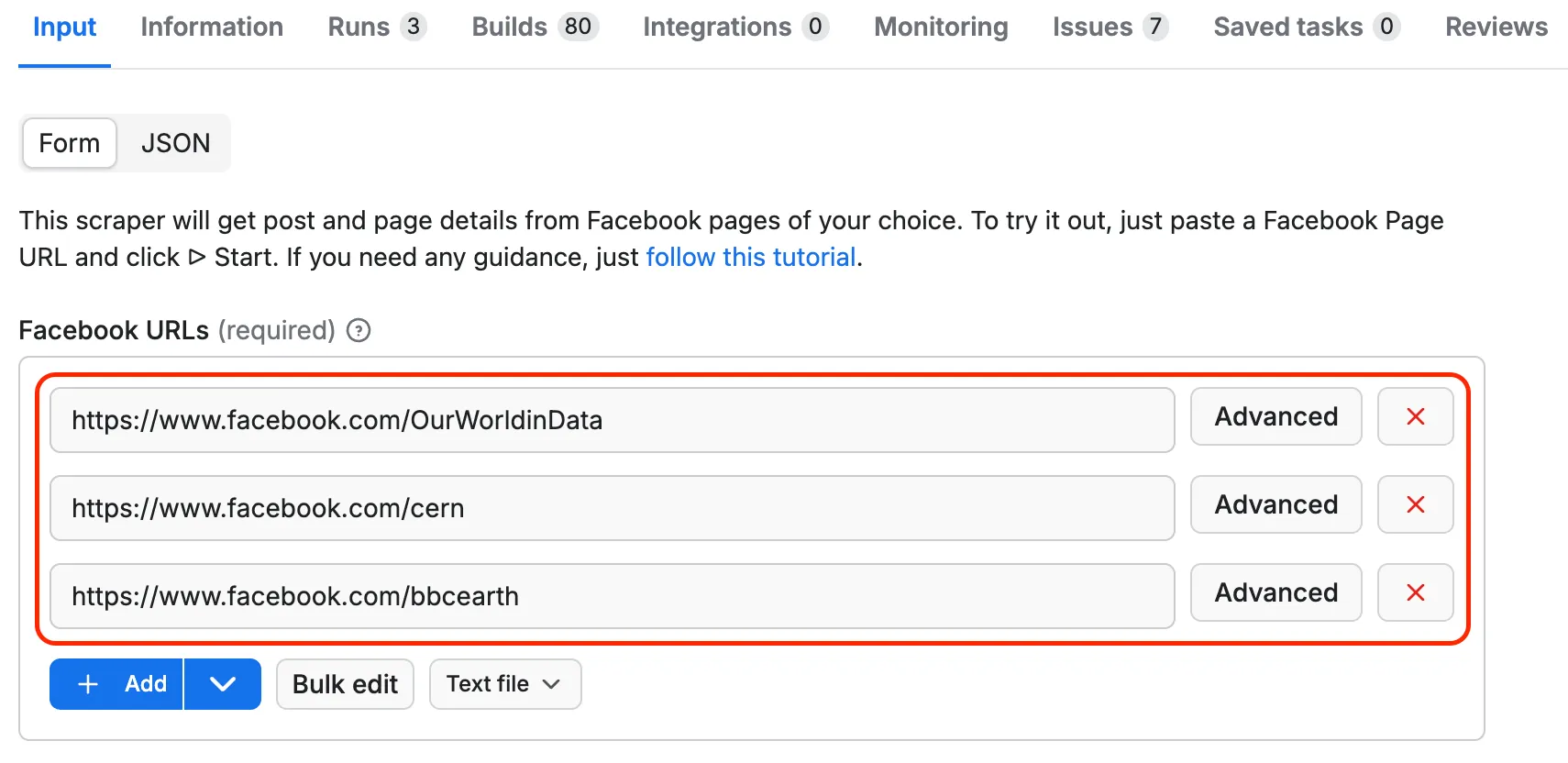
๐Ÿ‘ Facebook posts scraping input

Click on the input tab for a full explanation of an input example in JSON.

โฌ…๏ธ Output

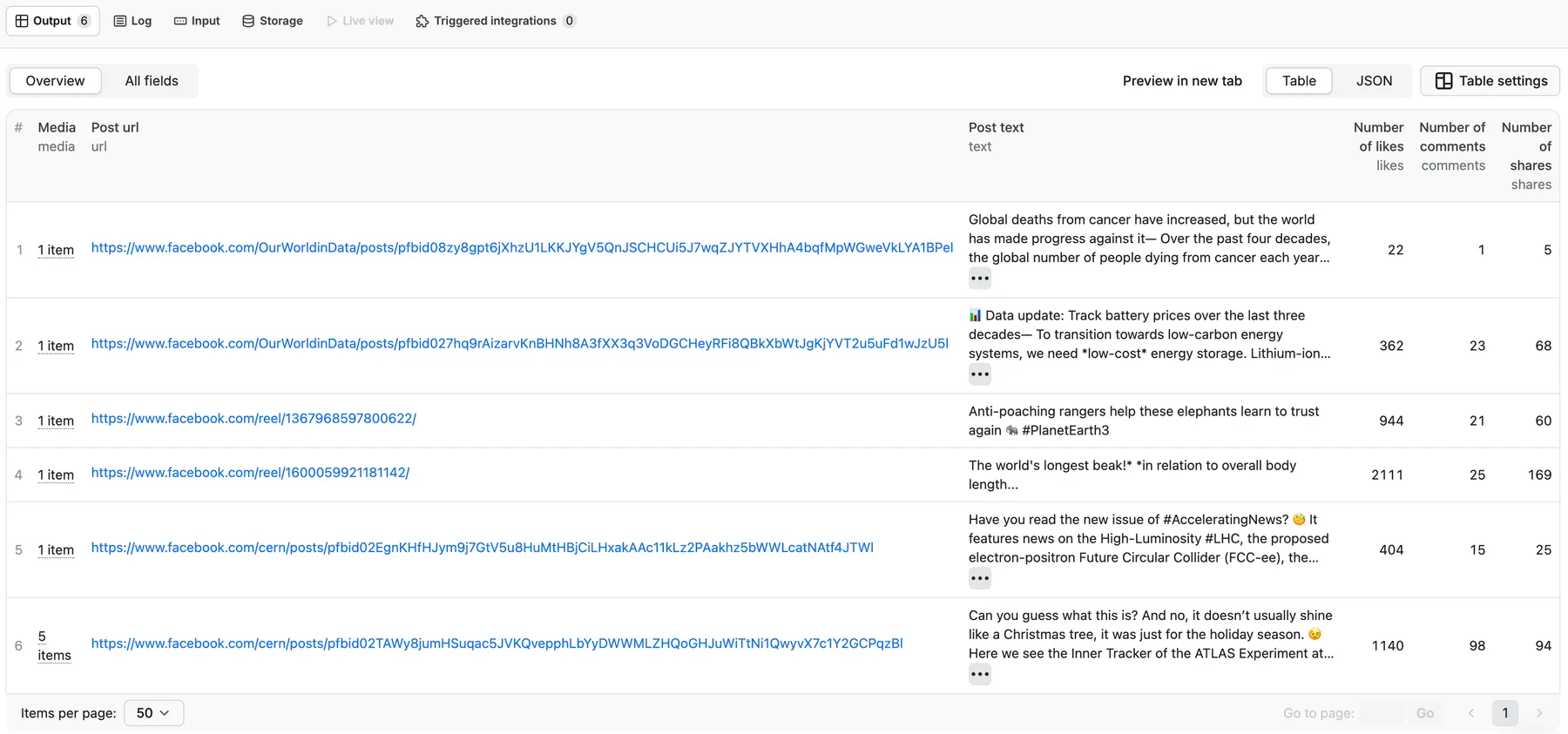
The results will be wrapped into a dataset which you can find in the Output tab. Here's an excerpt from the dataset you'd get when scraping Facebook posts:

๐Ÿ‘ Facebook posts scraping output

๐Ÿ“˜ Example of extracted Facebook post data

You can choose in which format to download your Facebook data: JSON, JSONL, Excel spreadsheet, HTML table, CSV, or XML. Here's what a typical post output looks like:

[
{
"facebookUrl":"https://www.facebook.com/cern",
"postId":"1315686150601111",
"pageName":"cern",
"url":"https://www.facebook.com/cern/posts/pfbid02tCuZQNXY4oegKgnTGU2pbxtZdrg9uZwuaSWdyZeaYuhb8hw8ZBZ51Go19Em86Uwvl",
"time":"2026-01-20T13:00:05.000Z",
"timestamp":1768914005,
"user":{
"id":"100064792144187",
"name":"CERN",
"profileUrl":"https://www.facebook.com/100064792144187",
"profilePic":"https://scontent-lga3-3.xx.fbcdn.net/v/t39.30808-1/348216459_1300189730851164_4698791499509539689_n.jpg?stp=cp0_dst-jpg_s50x50_tt6&_nc_cat=110&ccb=1-7&_nc_sid=2d3e12&_nc_ohc=Pj2Wg3o7ldwQ7kNvwGGPU3k&_nc_oc=AdnmAKKQ_2TQdVmfEq42BxQekAnn4xQbK__K1Ubul6MOYLHsqDraXyiOODvzedxgHR5vwR5V7ZcyS9aWAVxLWl3C&_nc_zt=24&_nc_ht=scontent-lga3-3.xx&_nc_gid=ypkFPlrkf_vAdug9n8GJ3A&oh=00_AfpFBtut5Iv6v0iQRPvSkPr_288dbS69vh9VJMeXUZ10Dw&oe=69755C03"
},
"collaborators":[],
"text":"What can you do with 380 million #Higgs bosons?\n\nWhat is the fate of the universe? Why is there more matter than #antimatter? What lurks beyond the #Standard Model? Valentina Cairo and Steven Lowette explore the physics reach of the High-Luminosity LHC (#HiLumiLHC) in the new issue of the #CERNCourier.\n\nRead more: https://cerncourier.com/a/what-can-you-do-with-380-million-higgs-bosons/",
"textReferences":[
{
"url":"https://l.facebook.com/l.php?u=https%3A%2F%2Fcerncourier.com%2Fa%2Fwhat-can-you-do-with-380-million-higgs-bosons%2F&h=AT1ryZGt8eZkjr8VtJvdF7O_ECl8TYUwlINEJeOpLm279O-2HQdm8K-7D3DWfVjUC51TaPwj5cEFs3_643kfe9GOO3GIdFwu5dpAzOZVghvf3X9taxjwOrhNvuVV-PiGoImW9axSWZvK5jRY0HVDBHNPGvLoBzrxwdZ1kzgke_XYMsmY&s=1",
"external_url":"https://cerncourier.com/a/what-can-you-do-with-380-million-higgs-bosons/",
"web_link":{
"__typename":"ExternalWebLink",
"url":"https://cerncourier.com/a/what-can-you-do-with-380-million-higgs-bosons/",
"fbclid":null,
"lynx_mode":"ASYNCLAZY"
},
"mobileUrl":"https://lm.facebook.com/l.php?u=https%3A%2F%2Fcerncourier.com%2Fa%2Fwhat-can-you-do-with-380-million-higgs-bosons%2F&h=AT3WZGDRRCD-VLBzxP7Fsf_Zjb1cS88KBZ2Gq4DWBZfVEKn4nPU5i4eS8DE14zBaY7SnAhVSKgXdmkyJS7QL5lyEMG5H3lCkeNOYsqh8t-HqvJyCau4Dv2J969HI0G44H160YV74sn5jKoxv30c6XOy2dMoApxcJcZtZsML-YiqAgthJ&s=1",
"id":"NjQyMTgzOTU5MjA4MTA3Omh0dHBzXGEvL2Nlcm5jb3VyaWVyLmNvbS9hL3doYXQtY2FuLXlvdS1kby13aXRoLTM4MC1taWxsaW9uLWhpZ2dzLWJvc29ucy86OkRlZmF1bHQ6OjoxMzE1Njg2MTUwNjAxMTEx"
},
{
"url":"https://www.facebook.com/hashtag/higgs?__eep__=6",
"mobileUrl":"https://m.facebook.com/hashtag/higgs",
"id":"277101575754961"
},
{
"url":"https://www.facebook.com/hashtag/antimatter?__eep__=6",
"mobileUrl":"https://m.facebook.com/hashtag/antimatter",
"id":"388710277894247"
},
{
"url":"https://www.facebook.com/hashtag/standard?__eep__=6",
"mobileUrl":"https://m.facebook.com/hashtag/standard",
"id":"218027618337364"
},
{
"url":"https://www.facebook.com/hashtag/hilumilhc?__eep__=6",
"mobileUrl":"https://m.facebook.com/hashtag/hilumilhc",
"id":"1404235909704964"
},
{
"url":"https://www.facebook.com/hashtag/cerncourier?__eep__=6",
"mobileUrl":"https://m.facebook.com/hashtag/cerncourier",
"id":"218164278307153"
}
],
"link":"https://cerncourier.com/a/what-can-you-do-with-380-million-higgs-bosons/",
"likes":146,
"comments":3,
"shares":27,
"topReactionsCount":4,
"media":[
{
"thumbnail":"https://scontent-lga3-3.xx.fbcdn.net/v/t39.30808-6/618970043_1315670090602717_8133399184917159433_n.jpg?stp=dst-jpg_s960x960_tt6&_nc_cat=1&ccb=1-7&_nc_sid=127cfc&_nc_ohc=T4WYOy4-rBwQ7kNvwE5nP9G&_nc_oc=AdkzQR48rCWiJpmKjbl9l8nfUvSEv23tImr9JzO_-y5mdq8R8Usmv0RmaO53tSClXcnmgFiygMHOEc6cjpHJ3cWO&_nc_zt=23&_nc_ht=scontent-lga3-3.xx&_nc_gid=ypkFPlrkf_vAdug9n8GJ3A&oh=00_Afq4rjFhoZmNdMyZZ9I3pmnEgtQl5mO5W8C21Yj2sQFrVQ&oe=69756C90",
"__typename":"Photo",
"__isMedia":"Photo",
"accent_color":"FF1A0534",
"photo_product_tags":[],
"photo_image":{
"uri":"https://scontent-lga3-3.xx.fbcdn.net/v/t39.30808-6/618970043_1315670090602717_8133399184917159433_n.jpg?stp=dst-jpg_s960x960_tt6&_nc_cat=1&ccb=1-7&_nc_sid=127cfc&_nc_ohc=T4WYOy4-rBwQ7kNvwE5nP9G&_nc_oc=AdkzQR48rCWiJpmKjbl9l8nfUvSEv23tImr9JzO_-y5mdq8R8Usmv0RmaO53tSClXcnmgFiygMHOEc6cjpHJ3cWO&_nc_zt=23&_nc_ht=scontent-lga3-3.xx&_nc_gid=ypkFPlrkf_vAdug9n8GJ3A&oh=00_Afq4rjFhoZmNdMyZZ9I3pmnEgtQl5mO5W8C21Yj2sQFrVQ&oe=69756C90",
"height":540,
"width":960
},
"url":"https://www.facebook.com/photo/?fbid=1315686073934452&set=a.636209511882115",
"id":"1315686073934452",
"feedback":{
"can_viewer_comment":false,
"id":"ZmVlZGJhY2s6MTMxNTY4NjE1MDYwMTExMQ=="
},
"ocrText":"May be an image of fireworks"
}
],
"feedbackId":"ZmVlZGJhY2s6MTMxNTY4NjE1MDYwMTExMQ==",
"reactionLikeCount":135,
"reactionLoveCount":8,
"reactionCareCount":2,
"reactionWowCount":1,
"topLevelUrl":"https://www.facebook.com/100064792144187/posts/1315686150601111",
"facebookId":"100064792144187",
"pageAdLibrary":{
"is_business_page_active":false,
"id":"169005736520113"
},
"inputUrl":"https://www.facebook.com/cern"
},
{
"facebookUrl":"https://www.facebook.com/OurWorldinData",
"postId":"1488978839895353",
"pageName":"OurWorldinData",
"url":"https://www.facebook.com/OurWorldinData/posts/pfbid0cgFatC8MEX6pPqnj6bPWS64bkptnQS5p8LivWR9PbJoJbeRg6fcFjqvf9d35e6iYl",
"time":"2026-01-20T11:17:58.000Z",
"timestamp":1768907878,
"user":{
"id":"100063497546604",
"name":"Our World in Data",
"profileUrl":"https://www.facebook.com/100063497546604",
"profilePic":"https://scontent.fwbw1-1.fna.fbcdn.net/v/t39.30808-1/476307086_1193465699446670_8804202441996587127_n.jpg?stp=cp0_dst-jpg_s50x50_tt6&_nc_cat=110&ccb=1-7&_nc_sid=2d3e12&_nc_ohc=ZGpr8DcwVY0Q7kNvwHzaC7d&_nc_oc=AdmGwCHVLWxxE6EnQCCzXLGzIeOeEXwOyd6hrfIWlRTXQ_7MtFNVmFsND5lm_Q3qFiQ&_nc_zt=24&_nc_ht=scontent.fwbw1-1.fna&_nc_gid=dg8rFwrg9E1em7VZFcstUw&oh=00_Afq3evsVu7EiclquNSCxjcw3ThSEzW2hJXemkOyEjZxNWg&oe=697574D3"
},
"collaborators":[],
"text":"Over 40,000 near-Earth asteroids have been detected since 1990โ€”\n\nSince the late 20th century, astronomers and space agencies have taken steps to monitor the threat of large asteroids passing near Earth.\n\nThey set up international efforts to find these objects early, track their paths, and learn more about what theyโ€™re made of, so weโ€™d have the best chance of spotting a real collision risk in time.\n\nAs the chart shows, more than 40,000 near-Earth asteroids have been discovered and tracked since 1990.\n\nNASA estimates that weโ€™ve already found over 90% of near-Earth objects larger than 1 kilometer. These are the most dangerous ones, because an impact at that size could cause global-scale damage.\n\n(This Data Insight was written by Edouard Mathieu and Pablo Rosado.)\n\nExplore more interactive charts on space exploration and satellites: https://ourworldindata.org/search?topics=Space+Exploration+%26+Satellites\n\nSubscribe to our newsletter to receive Data Insights directly in your inbox: https://ourworldindata.org/subscribe",
"textReferences":[
{
"url":"https://l.facebook.com/l.php?u=https%3A%2F%2Fourworldindata.org%2Fsearch%3Ftopics%3DSpace%2BExploration%2B%2526%2BSatellites&h=AT3NPxyNmqS2JQy-DvT58TqeSLMsmfDLMrV4PTA2IG3Z0CU34gFYT_XCyyl1WSYL5hnYhbJ8vSMkKTIGeQVySnTmPIBPFVlxRDGUe0k5asfIJ60xJp2P2d6BRLs-fjqU3TXnbeVHmUQKARp3Z6-ydQBH9XwkaMJ3&s=1",
"external_url":"https://ourworldindata.org/search?topics=Space+Exploration+%26+Satellites",
"web_link":{
"__typename":"ExternalWebLink",
"url":"https://ourworldindata.org/search?topics=Space+Exploration+%26+Satellites",
"fbclid":null,
"lynx_mode":"ASYNCLAZY"
},
"mobileUrl":"https://lm.facebook.com/l.php?u=https%3A%2F%2Fourworldindata.org%2Fsearch%3Ftopics%3DSpace%2BExploration%2B%2526%2BSatellites&h=AT1N99KYEUlxP8PCcf-3qvEYm7AeLu0SBDTjLZ8dB6LidS7TU2ZayjGvsafq1ZmRnJZsFdFQQRtcNCywo8BLq_u7QXj2Uw43Ki4baM81PjZtaNMHqucYdNIDv-zT9E5DolF5hM6QpIzuo0tpDaWmG11JHVJddp5l&s=1",
"id":"NjQyMTgzOTU5MjA4MTA3Omh0dHBzXGEvL291cndvcmxkaW5kYXRhLm9yZy9zZWFyY2g/dG9waWNzPVNwYWNlK0V4cGxvcmF0aW9uKyUyNitTYXRlbGxpdGVzOjpEZWZhdWx0Ojo6MTQ4ODk3ODgzOTg5NTM1Mw=="
},
{
"url":"https://l.facebook.com/l.php?u=https%3A%2F%2Fourworldindata.org%2Fsubscribe&h=AT3yksEresnHU9OBj2Y-BKIgvYxj8aPk43bTyu2iqKQt0Z854MWqeFqL01Cl2pmhtOf13gw92KmgON1_NIBvAeVlWCcxkekOYfQWIpz-AOqay_Vd0orw4u9JGHYn_cE-hzVLsCWBVBNqyLppudh81pZwPX2fVruy&s=1",
"external_url":"https://ourworldindata.org/subscribe",
"web_link":{
"__typename":"ExternalWebLink",
"url":"https://ourworldindata.org/subscribe",
"fbclid":null,
"lynx_mode":"ASYNCLAZY"
},
"mobileUrl":"https://lm.facebook.com/l.php?u=https%3A%2F%2Fourworldindata.org%2Fsubscribe&h=AT1VYhjtXkApq3moVuZ-5QEeqYHwsgf873PIVoxZxfPI8BddSoNKhcvOE-3B6QRyJ83i8lQJwlxZbKGQiVTXxE3GcOXvGMbb4U14rzf4llPtSXaiDllYul2YdQvVIrhQVirUCK36ROqN8Y7xsYyXzGZM5kj214tx&s=1",
"id":"NjQyMTgzOTU5MjA4MTA3Omh0dHBzXGEvL291cndvcmxkaW5kYXRhLm9yZy9zdWJzY3JpYmU6OkRlZmF1bHQ6OjoxNDg4OTc4ODM5ODk1MzUz"
}
],
"link":"https://ourworldindata.org/search?topics=Space+Exploration+%26+Satellites",
"likes":18,
"shares":3,
"topReactionsCount":2,
"media":[
{
"thumbnail":"https://scontent.fwbw1-1.fna.fbcdn.net/v/t39.30808-6/617842353_1488978829895354_7092179280408000991_n.jpg?stp=dst-jpg_p526x296_tt6&_nc_cat=110&ccb=1-7&_nc_sid=127cfc&_nc_ohc=3dhbP9jOwxIQ7kNvwF1Qzy6&_nc_oc=Adkc0EwoJPJVx-RKMGDlUZJAf_865JrqG1gVo6a3XiDQIG9IaW3QVZy_tqOaLHJKXuE&_nc_zt=23&_nc_ht=scontent.fwbw1-1.fna&_nc_gid=dg8rFwrg9E1em7VZFcstUw&oh=00_AfornpHQbUc5G5G6shAmqPTIIb2dJ7lb8Nn-Mrssv-LDXQ&oe=69754B62",
"__typename":"Photo",
"__isMedia":"Photo",
"accent_color":"FFFFFFFF",
"photo_product_tags":[],
"photo_image":{
"uri":"https://scontent.fwbw1-1.fna.fbcdn.net/v/t39.30808-6/617842353_1488978829895354_7092179280408000991_n.jpg?stp=dst-jpg_p526x296_tt6&_nc_cat=110&ccb=1-7&_nc_sid=127cfc&_nc_ohc=3dhbP9jOwxIQ7kNvwF1Qzy6&_nc_oc=Adkc0EwoJPJVx-RKMGDlUZJAf_865JrqG1gVo6a3XiDQIG9IaW3QVZy_tqOaLHJKXuE&_nc_zt=23&_nc_ht=scontent.fwbw1-1.fna&_nc_gid=dg8rFwrg9E1em7VZFcstUw&oh=00_AfornpHQbUc5G5G6shAmqPTIIb2dJ7lb8Nn-Mrssv-LDXQ&oe=69754B62",
"height":526,
"width":526
},
"url":"https://www.facebook.com/photo/?fbid=1488978826562021&set=a.542059731253940",
"id":"1488978826562021",
"feedback":{
"can_viewer_comment":false,
"id":"ZmVlZGJhY2s6MTQ4ODk3ODgzOTg5NTM1Mw=="
},
"ocrText":"Cumulative near-Earth asteroids discovered over time. Stacked area chart of cumulative discoveries from 1990 to 2025, showing three size categories: smaller than 140 meters; 140 meters to 1 kilometer; and larger than 1 kilometer. The y-axis runs from 0 to 40,000 cumulative asteroids. Discoveries rise slowly through the 1990s and 2000s, then accelerate sharply after about 2010 and especially after 2015. By 2025, roughly 40,000 near-Earth asteroids have been recorded, with the majority in the smaller-than-140-meters category, a substantial but smaller share in the 140 meters to 1 kilometer category, and a very small number larger than 1 kilometer. Data source: NASA Center for Near-Earth Object Studies (2026). License: CC BY."
}
],
"feedbackId":"ZmVlZGJhY2s6MTQ4ODk3ODgzOTg5NTM1Mw==",
"reactionLikeCount":17,
"reactionHahaCount":1,
"topLevelUrl":"https://www.facebook.com/100063497546604/posts/1488978839895353",
"facebookId":"100063497546604",
"pageAdLibrary":{
"is_business_page_active":false,
"id":"255848064618361"
},
"inputUrl":"https://www.facebook.com/OurWorldinData"
},
{
"facebookUrl":"https://www.facebook.com/bbcearth",
"postId":"1441693187314472",
"pageName":"bbcearth",
"url":"https://www.facebook.com/reel/895509256298494/",
"time":"2026-01-20T14:00:46.000Z",
"timestamp":1768917646,
"user":{
"id":"100044214140223",
"name":"BBC Earth",
"profileUrl":"https://www.facebook.com/100044214140223",
"profilePic":"https://scontent-mia3-3.xx.fbcdn.net/v/t39.30808-1/378863511_857719969045133_4486636644081495495_n.jpg?stp=c191.191.1666.1666a_cp0_dst-jpg_s50x50_tt6&_nc_cat=1&ccb=1-7&_nc_sid=2d3e12&_nc_ohc=38S9Wsz6IisQ7kNvwEHjsej&_nc_oc=Adl754iSLl3lFILNqorjKKl9bvdbaRk5ifAe4-18BjgWlvvA1fmkDvFfFfwumHo4XUk&_nc_zt=24&_nc_ht=scontent-mia3-3.xx&_nc_gid=91OrvVvEtP9Zr9FHWiKYMA&oh=00_Afq23KotN4dC2MI0MrFoQOmIYUMiT8oZ6iRWNHZD5oZH2Q&oe=69757D3D"
},
"collaborators":[],
"text":"Like many animals, panda bears take pains to mark their territory. They may even perform an handstand or two.",
"likes":147,
"comments":2,
"shares":3,
"topReactionsCount":5,
"viewsCount":309624,
"feedbackId":"ZmVlZGJhY2s6MTQ0MTY5MzE4NzMxNDQ3Mg==",
"reactionLikeCount":112,
"reactionLoveCount":29,
"reactionCareCount":3,
"reactionHahaCount":2,
"reactionWowCount":1,
"topLevelUrl":"https://www.facebook.com/100044214140223/posts/1441693187314472",
"facebookId":"100044214140223",
"pageAdLibrary":{
"is_business_page_active":false,
"id":"118883634811868"
},
"inputUrl":"https://www.facebook.com/bbcearth"
}
]

How much will scraping Facebook posts cost you?

Scraping data from Facebook posts costs approximately $5-8 for every 1,000 posts, or $0.005-0.008 per post. If you're on Apify Free plan, you will be able to scrape up to 500 posts before needing to upgrade.

For more frequent or extensive Facebook data scraping, consider upgrading to the $29/month Starter plan, which can get you up to 3,600-5,800 Facebook posts per month. For scalable scraping of Facebook posts, check out $199/month Scale or $999/month Business plan.

What is the best Facebook scraper?

You can use the dedicated scrapers below if you want to scrape specific Facebook data. Each of them is built particularly for the relevant Facebook scraping case be it groups, reviews, comments or search. If you need to scrape posts from Instagram instead, check out our Instagram Post Scraper.

๐Ÿ•ต๏ธโ€โ™€๏ธ Facebook Search Scraper๐Ÿ—“ Facebook Events Scraper๐Ÿšฉ Facebook Pages Scraper
๐Ÿ•น Facebook Games Scraper๐Ÿ‘€ Facebook Marketplace Scraper๐ŸŽž Facebook Reels Scraper
๐ŸŒŸ Facebook Reviews Scraper๐Ÿ‘ฅ Facebook Groups Scraper๐Ÿ“น Facebook Video Search Scraper
๐Ÿ’ฌ Facebook Comments Scraper๐Ÿ‘ Facebook Likes and Reactions Scraperโ„น๏ธ Facebook Page Contact Information
๐Ÿž Facebook Photos Scraper๐Ÿ”ฎ Brand Collaboration Scraper๐Ÿ‘ฅ Facebook Followers Following Scraper
๐Ÿ›๏ธ Facebook Ads Library Scraper๐Ÿ“ฑ Facebook Pages Info Scraper๐Ÿงฒ Social Media Leads Analyzer
๐Ÿ“ธ Instagram Post Scraper

โ“ FAQ

Can I export Facebook Posts data using API?

Yes, you can access the extracted Facebook data through the Apify API. You'll need an Apify account and your API token (available under Integrations settings in Console). Apify API is organized around RESTful HTTP endpoints that enable you to manage, schedule, and run Apify actors. The API also lets you access any datasets, monitor actor performance, fetch results, create and update versions, and more. To access the API using Node.js, use the apify-client NPM package. To access the API using Python, use the apify-client PyPI package.

Click on the API tab for code examples or check out the Apify API reference docs for full detail.

Can I use Facebook Posts Scraper through an MCP server?

With Apify API, you can use Facebook Posts Scraper within your AI workflows. You can connect to the MCP server using clients like ClaudeDesktop and LibreChat or build your own. Here's how you can set up Facebook Posts Scraper via Model Context Protocol (MCP) server:

  1. Start a Server-Sent Events (SSE) session to receive a sessionId.
  2. Send API messages using that sessionId to trigger the scraper.
  3. The message starts the Facebook Posts Scraper with the provided input.
  4. The response should be: Accepted.

This makes Facebook Posts Scraper compatible with Facebook MCP server implementations and allows you to use it as a Facebook post extractor within your AI agent workflows.

Is there a difference between scraping a Facebook profile and Facebook page?

Yes, there is. Facebook Pages are created for businesses, companies, non-profits, and other social causes. Those are the Facebook accounts that strive to provide "public-first" content and are often managed by a group of people. An easy way to distinguish between a Facebook profile and a Facebook page is that pages usually have a category of content and activity they would like to be associated with (news, software, hospitality, etc.) Facebook Pages that are particularly popular often include a blue verification badge. Facebook profiles are created for personal use.

This scraper can extract information from both Facebook pages and Facebook profiles.

Do I need proxies to scrape data from Facebook posts?

You need proxies in general but you don't need to do anything extra to apply them if you run the scraper on the Apify platform. For successful scraping of Facebook posts, we run residential proxies in the background which are included in Apify's monthly Starter plan ($29).

Can I integrate data from Facebook Posts Scraper with other apps?

Yes. Facebook Posts Scraper can be connected with almost any cloud service or web app thanks to integrations on the Apify platform. You can integrate with Make, Zapier, ChatGPT, Slack, Airbyte, GitHub, Google Sheets, Asana, Google Drive, Keboola, MCP Servers, and more.

Is it legal to scrape Facebook Posts data?

Our Facebook scrapers are ethical and do not extract any private user data. They only extract what the user has chosen to share publicly. However, you should be aware that your results could contain personal data. You should not scrape personal data unless you have a legitimate reason to do so.

If you're unsure whether your reason is legitimate, consult your lawyers. You can also read our blog post on the legality of web scraping and ethical scraping.

Facebook Posts Scraper is not working?

We're always working on improving the performance of our Actors. So if you've got any technical feedback for Facebook Posts Scraper or simply found a bug, please create an issue on the Actor's Issues tab.

You might also like

Facebook Pages Scraper

apify/facebook-pages-scraper

Extract basic data from multiple Facebook Pages or Profiles. Extract Facebook page details, website, email, address, messenger, likes, followers, rating, ad running status, and other public data. Export scraped data, schedule scraper via API, integrate with other tools or AI workflows.

Facebook Posts Scraper

scraper_one/facebook-posts-scraper

Scrape Facebook posts from Facebook pages, groups etc. Retrieve post URLs, content, publication dates, author details, and engagement metrics. Ideal for Facebook monitoring solutions.

800

5.0

Facebook Posts Scraper

scrapier/facebook-posts-scraper

This Facebook Posts Scraper extracts text posts, media, reactions, shares, comments, and metadata from public pages and profiles. Ideal for trend tracking, social listening, competitor analysis, and building large-scale Facebook intelligence.

Facebook Search Scraper

alien_force/facebook-search-scraper

Powerful Facebook search that scrapes and searches posts, pages, and profiles by keyword. Get detailed info like author, engagement metrics, images, videos. Ideal for research, monitoring, and analysis.

1.7K

5.0

Facebook Search Posts

scrapeforge/facebook-search-posts

Search Facebook posts, pages, groups, people, videos and events by keyword. Returns detailed data including reactions breakdown, media URLs, and engagement metrics.

576

5.0

Facebook post scraper ppr

mina_safwat/facebook-post-scraper-ppr

This actor will scrape post info from facebook like caption, like , shares and comments and more quickly

Facebook Post Search Scraper

powerai/facebook-post-search-scraper

Extract Facebook posts by keyword with advanced filters, supporting auto-pagination and up to 5000 results per run. Ideal for social media research and content analysis.

1.8K

5.0

Facebook Search Scraper

apify/facebook-search-scraper

Extract Facebook search data from pages that match your search query. Get page URL, address, email, website, check-ins, creation date, ad status, category, follower count, messenger link. Export scraped data, run the scraper via API, schedule and monitor runs, or integrate with other tools.

Facebook Posts Scraper

danek/facebook-posts-fast

Scrap Facebook posts fast and easy. This actor is a lightweight version of the Facebook Posts actor. It is designed to be fast and efficient, so it can extract a large number of posts for low price. It is also less likely to be blocked by Facebook.

1.4K

4.7