|
VOOZH | about |
|
VOOZH | about |
Rust’s low-level nature gives you access to resources and memory, so many developers choose Rust for their projects across various tech sectors. Ownership and borrowing are among the first concepts you’ll learn when dealing with Rust, as they form the primitives for how Rust handles memory.
👁 Rust logo over black marble background.Once in a while, you may experience memory leaks in your Rust projects due to many factors, from unsafe code to shared references, etc. Ideally, you’ll want to fix these memory leaks and ensure your programs are efficient, which may lead to performance gains and resource safety.
The Replay is a weekly newsletter for dev and engineering leaders.
Delivered once a week, it's your curated guide to the most important conversations around frontend dev, emerging AI tools, and the state of modern software.
Rust’s built-in ownership model and compile-time checks reduce the possibility and risks you’ll encounter with memory leaks, but they’re still quite possible.
Memory leaks don’t violate the ownership rules, so the borrow checker lets them slide at compile time. Leaking memory is inefficient and generally not a great idea, especially if you have resource constraints.
On the other hand, unsafe behavior can also slide if you embed it in an unsafe block. In this case, memory safety is your responsibility regardless of the operation, e.g. pointer dereferencing, manual memory allocation, or concurrency issues.
Rust does not use a garbage collector. Instead, it uses ownership and borrowing (the borrow checker enforces the ownership model), which form the core principles for memory handling in Rust programs.
The borrow checker prevents dangling references, use-after-free errors, and data races at compile time before the compiler executes the program. Still, memory leaks can occur when memory is allocated without dropping it throughout the execution time.
Here’s an example of how I implement a doubly linked list. The program would run successfully, but there would also be a memory leak issue:
use std::rc::Rc;
use std::cell::RefCell;

struct Node {
 value: i32,
 next: Option<Rc<RefCell<Node>>>,
 prev: Option<Rc<RefCell<Node>>>,
}

fn main() {
 let first = Rc::new(RefCell::new(Node {
 value: 1,
 next: None,
 prev: None,
 }));

 let second = Rc::new(RefCell::new(Node {
 value: 2,
 next: Some(Rc::clone(&first)),
 prev: Some(Rc::clone(&first)),
 }));

 first.borrow_mut().next = Some(Rc::clone(&second));
 first.borrow_mut().prev = Some(Rc::clone(&second));

 println!("Reference count of first: {}", Rc::strong_count(&first));
 println!("Reference count of second: {}", Rc::strong_count(&second));

}
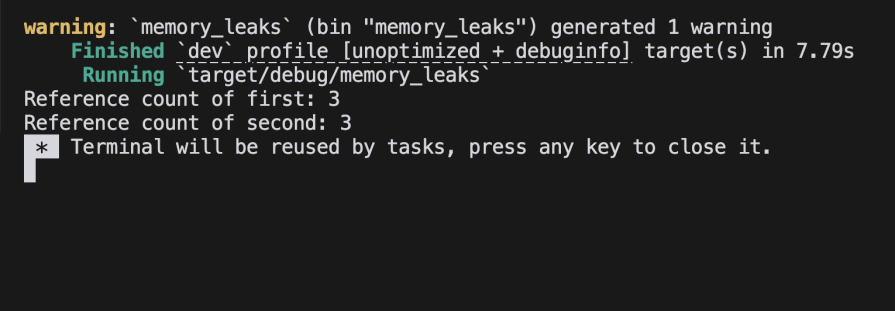
The problem with this program occurs with the circular reference between two nodes, resulting in a memory leak. Since RC smart pointers don’t handle cyclic references by default, each node holds a strong reference to the other, creating a cycle.
After the main function is executed, the reference count for the second and first variables will equal the first value, although it’s no longer accessible. This results in a memory leak since none of the nodes are deallocated:
You can fix cases like this by:
Weak<T> for one link directionHere’s an example where I address the reference problem with Weak pointers on the prev field:
use std::rc::{Rc, Weak};
use std::cell::RefCell;

struct Node {
 value: i32,
 next: Option<Rc<RefCell<Node>>>,
 prev: Option<Weak<RefCell<Node>>>,
}

fn main() {
 let first = Rc::new(RefCell::new(Node {
 value: 1,
 next: None,
 prev: None,
 }));

 let second = Rc::new(RefCell::new(Node {
 value: 2,
 next: Some(Rc::clone(&first)),
 prev: Some(Rc::downgrade(&first)),
 }));

 first.borrow_mut().next = Some(Rc::clone(&second));
 first.borrow_mut().prev = Some(Rc::downgrade(&second));

 println!("Reference count of first: {}", Rc::strong_count(&first));
 println!("Reference count of second: {}", Rc::strong_count(&second));

 println!("First value: {}", first.borrow().value);
 println!("Second value: {}", second.borrow().value);

 let next_of_first = first.borrow().next.as_ref().map(|r| r.borrow().value);
 println!("Next of first: {}", next_of_first.unwrap());

 let prev_of_second = second.borrow().prev.as_ref().unwrap().upgrade().unwrap();
 println!("Prev of second: {}", prev_of_second.borrow().value);
}
You can use <Weak<RefCell<Node>>> to prevent the memory leak since the Weak reference doesn’t increase the strong reference count, and the nodes can be deallocated.
std::mem::forget functionYou can intentionally use the std::mem::forget function to leak memory in your Rust project when necessary. Rust includes the function for this behavior, so the compiler considers it safe.
Even if the memory isn’t reclaimed, there’ll be no unsafe access or memory issues.
The std::mem::forget takes ownership of a value and forgets it without running the destructor, and since resources held in memory aren’t released, there will be a memory leak:
use std::mem;

fn main() {
 let data = Box::new(42);
 mem::forget(data);
}
At runtime, Rust skips the usual cleanup process, the data variable’s value is not dropped, and the memory allocated for data is leaked after the function is executed.
Using raw pointers gives you the responsibility to manage memory. Here’s how using raw pointers in an unsafe block may lead to a memory leak:
fn main() {
 let x = Box::new(42);
 let raw = Box::into_raw(x);

 unsafe {
 println!("Memory is now leaked: {}", *raw);
 }
}
In this case, the memory isn’t freed explicitly, and there will be a memory leak at runtime. After the program’s execution, the memory will be deallocated, so this isn’t the most critical case, but it’s not memory efficient.
Box::leakThe Box::leak function allows you to leak memory deliberately. This function is proper when you need to use a value throughout runtime:
fn main() {
 let x = Box::new(String::from("Hello, world!"));
 let leaked_str: &'static str = Box::leak(x);
 println!("Leaked string: {}", leaked_str);
}
Don’t abuse this; leak is helpful if you need a static reference to meet specific API requirements.
The golden rule for fixing memory leaks is avoiding them in the first place, except if your use case requires you to. Following the ownership rules is always a great idea. In fact, with the borrow checker, Rust enforces great memory management practices:
Drop trait on custom types for cleanups.std::mem::forget unnecessarily. Check out Box<T> for automatic cleanups on heap allocations when a value is off the scope.unsafe blocks everywhere without reason.Rc<T> or Arc<T> for shared ownership of variables.RefCell<T> or Mutex<T> for interior mutability. They’re helpful if you need to ensure safe concurrent access.Following these tips and building more Rust programs with lower memory requirements should provide everything you need to handle memory leaks in your Rust programs.
You’ve learned how memory leaks can happen in your Rust programs and how you can simulate them in necessary cases for different purposes, like having a persistent variable in a memory location at runtime.
Understanding the fundamentals of ownership, borrowing, and unsafe Rust can help manage memory and reduce memory leaks.
Debugging Rust applications can be difficult, especially when users experience issues that are hard to reproduce. If you’re interested in monitoring and tracking the performance of your Rust apps, automatically surfacing errors, and tracking slow network requests and load time, try LogRocket.
LogRocket lets you replay user sessions, eliminating guesswork around why bugs happen by showing exactly what users experienced. It captures console logs, errors, network requests, and pixel-perfect DOM recordings — compatible with all frameworks.
LogRocket's Galileo AI watches sessions for you, instantly identifying and explaining user struggles with automated monitoring of your entire product experience.
👁 LogRocket Dashboard Free Trial BannerModernize how you debug your Rust apps — start monitoring for free.
Learn how to use Gemini CLI subagents to delegate frontend, backend, testing, and docs tasks to specialized agents with guardrails and clear ownership.
Learn how next-browser gives AI agents runtime context for debugging Next.js apps, including React props, hydration, PPR, forms, and performance.
Build dynamic LLM routing in Next.js with OpenRouter, TanStack AI, task classification, model fallbacks, and cost-aware routing.
TSRX adds first-class control flow, conditional hooks, and scoped styles to React via a TypeScript compiler extension — no new framework required.
Hey there, want to help make our blog better?
Join LogRocket’s Content Advisory Board. You’ll help inform the type of content we create and get access to exclusive meetups, social accreditation, and swag.
Sign up now