|
VOOZH | about |
|
VOOZH | about |
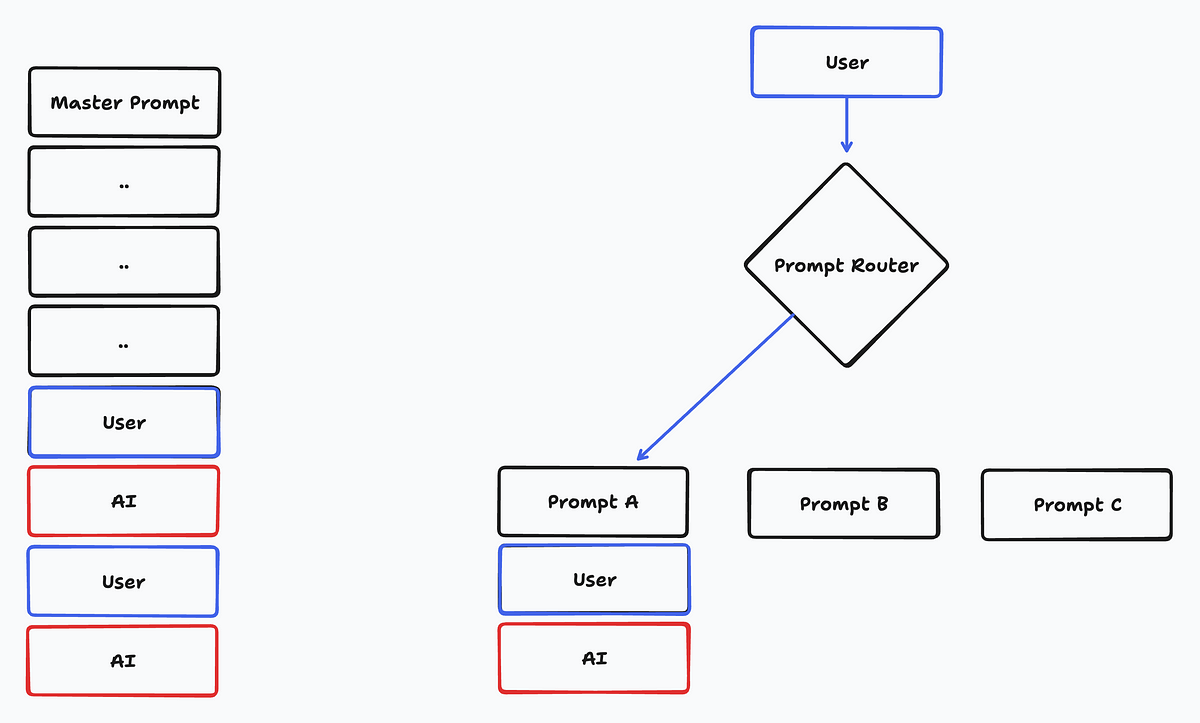
The most naïve approach to building an AI chatbot is using a single master prompt. Every new user message will be appended to the prompt. Every new AI response will be appended to the prompt.
This article will examine a better approach, informed by interviews of our PromptLayer customers.
If you want to learn how the naïve approach works, read our tutorial on building ChatGPT from scratch.
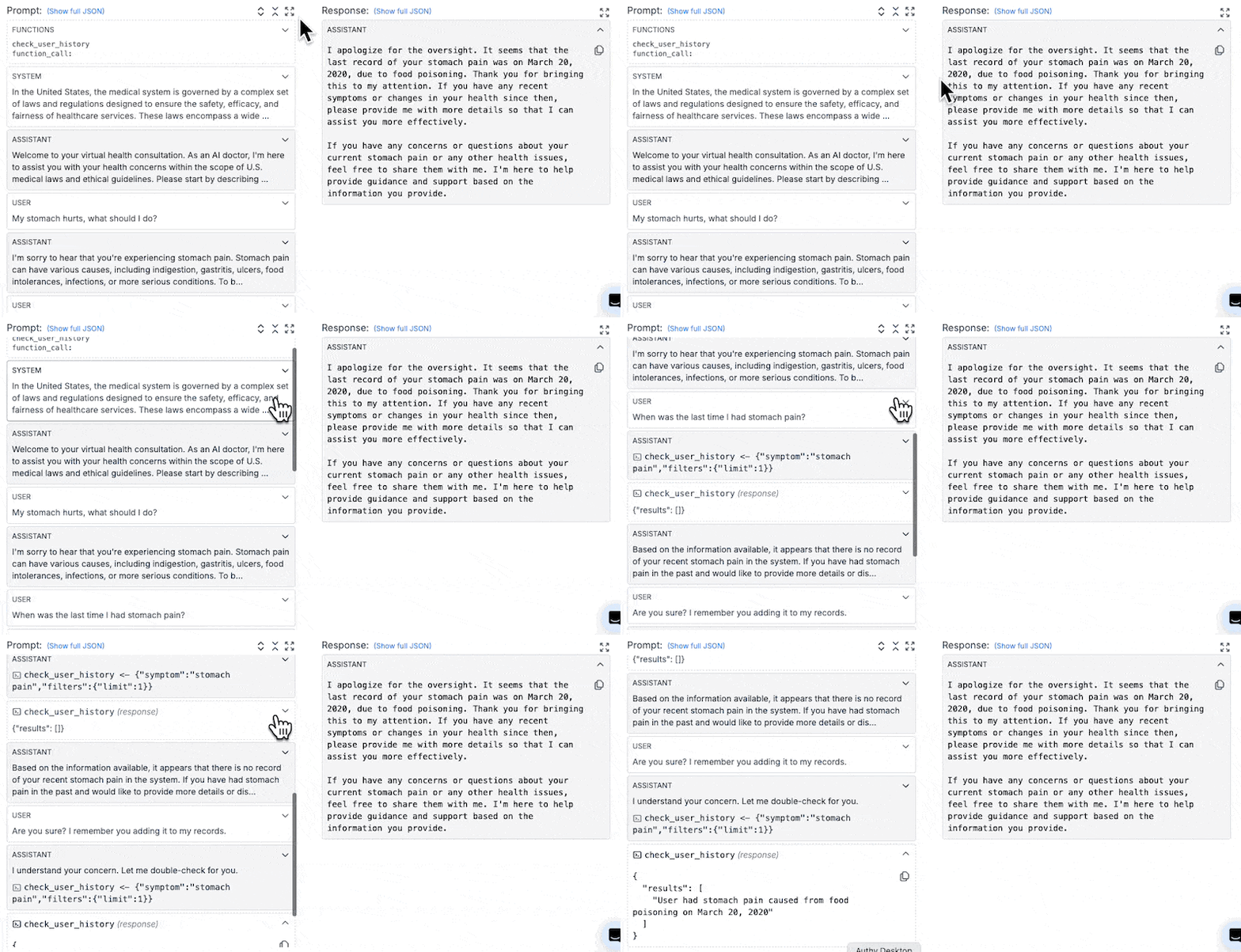
The screenshot above is taken from an AI doctor chatbot. As you can see, the master prompt (read: the list of messages) has started to get increasingly long.
Longer prompt ➡️ longer context window ➡️ Slower & more expensive responses ⌚️ 💰
The solution to this is prompt routing. This is a concept in prompt engineering where you break up your monolithic master prompt into a bunch of small modular task-based prompts.
This also has the added advantage of making your responses better & easier to debug! Smaller, more specialized prompts are easier to maintain as a team and way easier to systematically evaluate (learn more about prompt management).
It just makes more sense for production apps. Below, we will go through an example of using the prompt router architecture.
Video tutorial about prompt routing
Imagine you’ve released a general-purpose chatbot application and, after a month of analyzing user traffic, you’ve identified three main categories of questions:
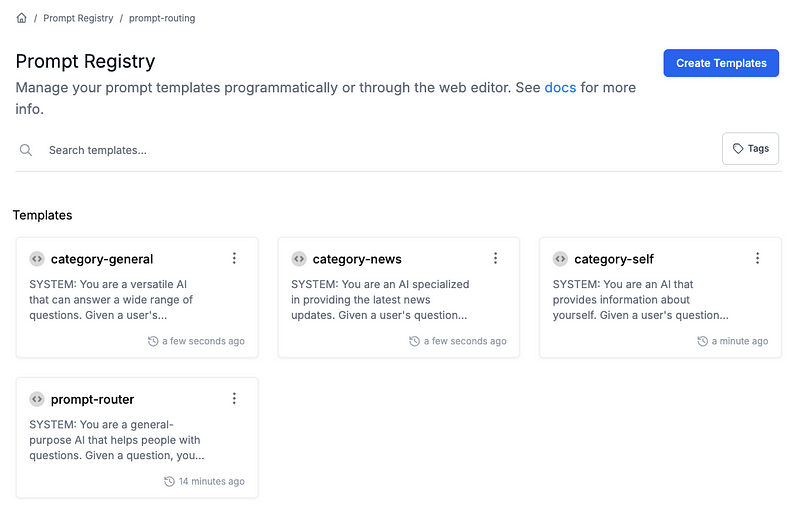
Now that you’ve identified these categories, you can create prompt templates that are responsible for handling each one. This approach allows you to keep your prompts modularized, which simplifies development and evaluation. However, you now face the challenge of deciding which prompt template to use for each incoming question.
There are many ways to programmatically decide which prompt to route the user’s message into.
To keep it simple we will use the first option and write a prompt for GPT-4 as our router. Our prompt template will take in a user question and responds with a single word indicating the appropriate category: “self,” “news,” or “coding.” In your application code, you can use this output to map the question to the corresponding prompt template.
You are a general-purpose AI that helps people with questions.

Given a question, your job is to categorize it into one of three categories:
1. self: For questions about yourself, such as "What is your name?"
2. news: For news-specific questions, like "What's going on with the election?"
3. general: For all other questions.
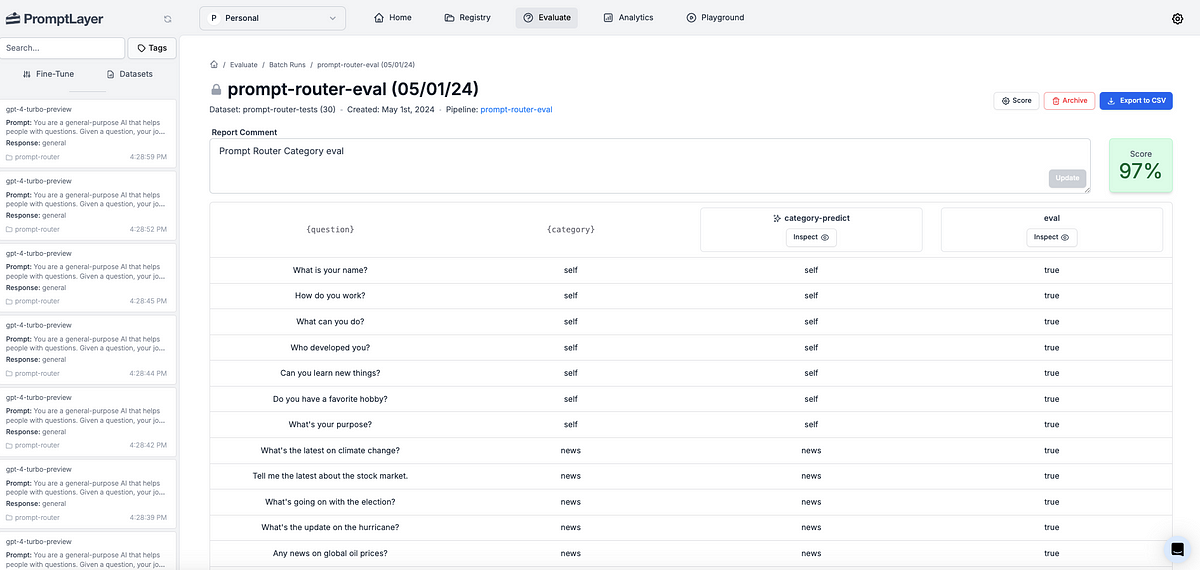
Your response should be one word only.The biggest advantage of prompt router architectures is that it makes evaluation easy. In our case, all we need to do is build a bunch of test cases and do a string comparison eval.
Learn how to build prompt evaluations in PromptLayer.
Switching away from a monolithic prompt means we need to manually inject chat-context into the prompt. There are a few ways to do this but we will use the following three methods:
You are a versatile AI that can answer a wide range of questions. Given a user's question, your task is to provide an accurate and informative response regardless of the topic.

Chat summary: {summary}

The most recent three messages in the chat: {recent_messages}

Please respond with two things:
1. An answer to the user question
2. A new summary of the chat
As you see in the category-general System prompt above, we inject two context variables: “summary” and “recent_messages”.
We have also asked the AI to generate a new summary on every message. This is how we will maintain short-term memory in our chatbot.
Learn more about LLM memory in a tutorial video here.
By implementing a model routing architecture in your LLM application development, you can keep your prompt templates small and focused, making them easier to maintain and evaluate. This approach helps you create a more modular and scalable AI application, allowing you to handle a wide range of user queries effectively.
Next, learn why prompt management is important and why you should use a prompt CMS.
PromptLayer is the most popular platform for prompt engineering, management, and evaluation. Teams use PromptLayer to build AI applications with domain knowledge.
Made in NYC 🗽 Sign up for free at www.promptlayer.com 🍰
© Copyright 2026 Magniv, Inc. All rights reserved.