Qwen 2.5 Omni Guide 2026: Building Multimodal Chatbots with Voice and Vision#
Most AI chatbots still only handle text. Users send a photo and get "I can't process images." They send a voice message and get silence. Qwen 2.5 Omni changes that equation — it handles text, images, and audio in a single model, which means you can build genuinely multimodal products without stitching together three separate pipelines.
What is Qwen 2.5 Omni?#
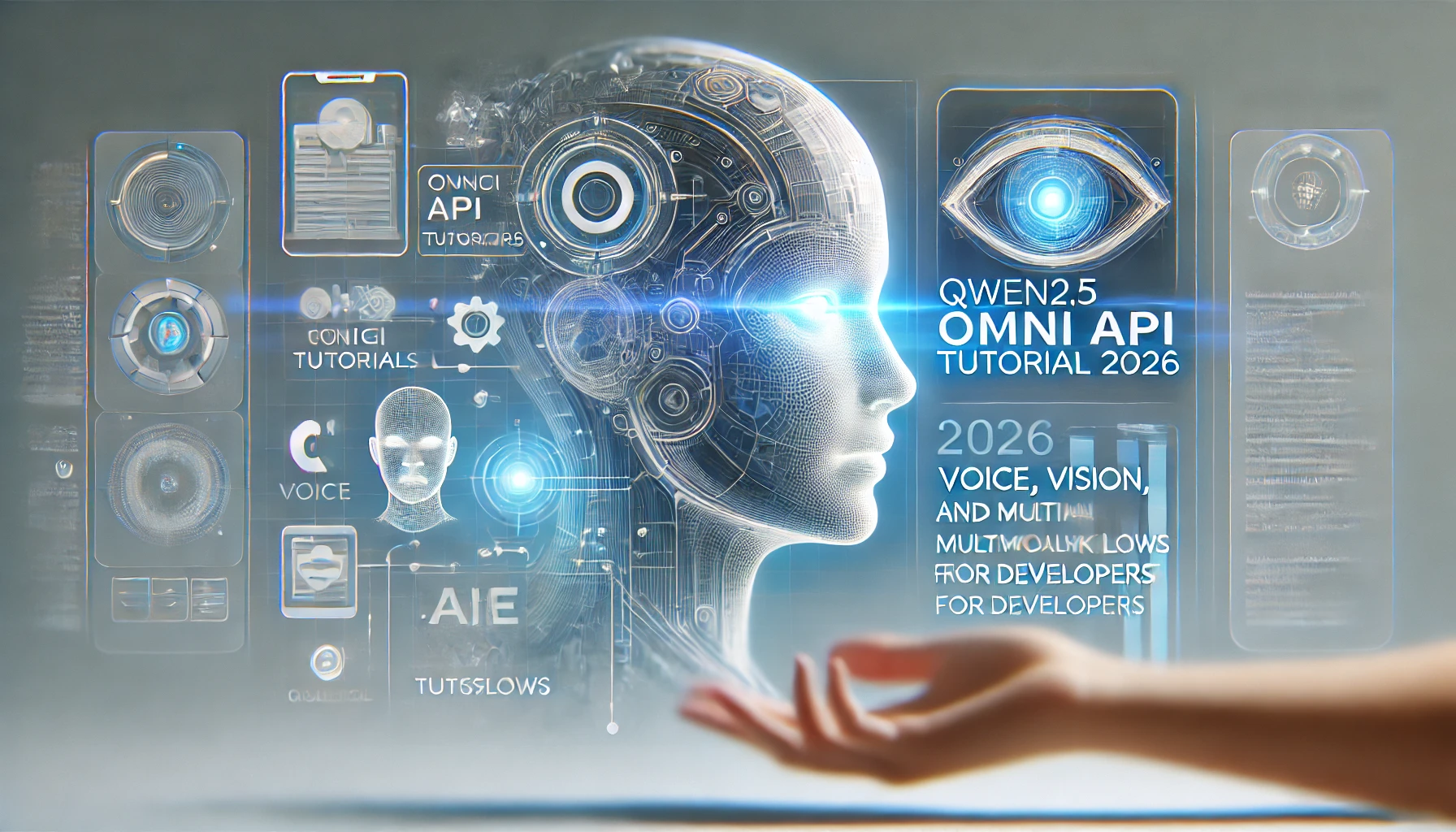
Qwen 2.5 Omni is Alibaba's multimodal model that natively processes text, images, and audio input, and can generate text and audio output. Unlike traditional setups where you chain a speech-to-text model → a language model → a text-to-speech model, Qwen 2.5 Omni handles the full loop in one inference call.
Key capabilities:
- Text understanding: standard chat, reasoning, coding
- Image understanding: describe photos, read documents, analyze charts
- Audio input: process voice messages, transcribe, understand spoken instructions
- Audio output: generate spoken responses (text-to-speech built in)
- Bilingual strength: excellent Chinese and English performance
For developers, the practical value is fewer moving parts. One model, one API call, multiple modalities.
Qwen 2.5 Omni vs Alternatives#
| Model | Text | Images | Audio In | Audio Out | Chinese Quality |
|---|---|---|---|---|---|
| Qwen 2.5 Omni | ✅ | ✅ | ✅ | ✅ | Excellent |
| GPT-4o | ✅ | ✅ | ✅ | ✅ | Good |
| Gemini 2.5 | ✅ | ✅ | ✅ | ✅ | Good |
| Claude Sonnet 4.5 | ✅ | ✅ | ❌ | ❌ | Good |
Qwen 2.5 Omni's edge is the combination of native multimodal support with strong Chinese language quality. If you're building for Chinese-speaking users or bilingual markets, it's one of the strongest options available.
Architecture Patterns for Multimodal Chatbots#
Pattern 1: Simple Multimodal Chat#
The most straightforward pattern — send whatever the user provides (text, image, audio) directly to Qwen 2.5 Omni.
User Input (text/image/audio)
 ↓
 Qwen 2.5 Omni
 ↓
 Response (text + optional audio)
Good for: customer support bots, personal assistants, internal tools.
Pattern 2: Modality Router#
For production apps with cost sensitivity, route by input type:
User Input
 ↓
[Modality Detector]
 ├── Text only → Cheaper text model (Qwen-turbo, Haiku)
 ├── Image + Text → Qwen 2.5 Omni or GPT-4o
 └── Audio → Qwen 2.5 Omni
This saves money because most messages are text-only, and you only pay multimodal pricing when needed.
Pattern 3: Voice-First Assistant#
For apps where voice is the primary interface (mobile apps, IoT devices, accessibility tools):
Voice Input → Qwen 2.5 Omni → Text + Audio Output
 ↓
 [Play audio to user]
No separate STT/TTS pipeline needed. One round trip.
How to Use Qwen 2.5 Omni with Code#
Python — Text + Image Input#
from openai import OpenAI
import base64

client = OpenAI(
 api_key="sk-your-crazyrouter-key",
 base_url="https://crazyrouter.com/v1"
)

# Read and encode an image
with open("receipt.jpg", "rb") as f:
 image_b64 = base64.b64encode(f.read()).decode()

response = client.chat.completions.create(
 model="qwen2.5-omni",
 messages=[
 {
 "role": "user",
 "content": [
 {"type": "text", "text": "Extract the total amount and date from this receipt."},
 {"type": "image_url", "image_url": {"url": f"data:image/jpeg;base64,{image_b64}"}}
 ]
 }
 ]
)

print(response.choices[0].message.content)
Python — Audio Input#
import base64
from openai import OpenAI

client = OpenAI(
 api_key="sk-your-crazyrouter-key",
 base_url="https://crazyrouter.com/v1"
)

with open("voice_message.wav", "rb") as f:
 audio_b64 = base64.b64encode(f.read()).decode()

response = client.chat.completions.create(
 model="qwen2.5-omni",
 messages=[
 {
 "role": "user",
 "content": [
 {"type": "text", "text": "Listen to this voice message and summarize the key request."},
 {"type": "input_audio", "input_audio": {"data": audio_b64, "format": "wav"}}
 ]
 }
 ]
)

print(response.choices[0].message.content)
Node.js — Image Understanding#
import OpenAI from "openai";
import fs from "fs";

const client = new OpenAI({
 apiKey: process.env.CRAZYROUTER_API_KEY,
 baseURL: "https://crazyrouter.com/v1"
});

const imageBuffer = fs.readFileSync("dashboard.png");
const imageB64 = imageBuffer.toString("base64");

const response = await client.chat.completions.create({
 model: "qwen2.5-omni",
 messages: [
 {
 role: "user",
 content: [
 { type: "text", text: "Analyze this dashboard screenshot and identify any anomalies." },
 { type: "image_url", image_url: { url: `data:image/png;base64,${imageB64}` } }
 ]
 }
 ]
});

console.log(response.choices[0].message.content);
cURL — Text Query#
curl https://crazyrouter.com/v1/chat/completions \
 -H "Authorization: Bearer $CRAZYROUTER_API_KEY" \
 -H "Content-Type: application/json" \
 -d '{
 "model": "qwen2.5-omni",
 "messages": [
 {"role": "user", "content": "Explain the difference between RAG and fine-tuning for a product manager."}
 ]
 }'
Pricing Considerations#
Multimodal models cost more per request than text-only models. The smart approach:
| Input Type | Cost Level | Optimization |
|---|---|---|
| Text only | Low | Use cheaper text models when possible |
| Text + small image | Medium | Resize images before sending |
| Text + large image | Higher | Compress and crop to relevant area |
| Audio input | Medium-High | Trim silence, send only relevant audio |
Official vs Crazyrouter#
| Factor | Official Qwen API | Crazyrouter |
|---|---|---|
| Direct access | ✅ | ✅ |
| Multi-model routing | Manual | Built-in |
| Fallback to GPT-4o/Gemini | Build yourself | Easy |
| Unified billing | No | Yes |
| OpenAI-compatible format | Varies | Yes |
Crazyrouter is especially useful for multimodal apps because you can fall back between Qwen 2.5 Omni, GPT-4o, and Gemini depending on availability and cost.
Real-World Use Cases#
1. Multilingual Customer Support#
Users send photos of broken products + voice descriptions in Chinese or English. Qwen 2.5 Omni processes both, generates a structured ticket, and responds in the user's language.
2. Field Inspection Apps#
Workers photograph equipment, describe issues by voice. The model analyzes the image, transcribes the audio, and generates a maintenance report.
3. Educational Tutoring#
Students photograph homework problems or speak questions aloud. The model sees the image, hears the question, and explains the solution step by step.
4. Accessibility Tools#
Voice-first interfaces for visually impaired users. They describe what they need, the model processes screen captures or documents, and responds with audio.
Common Mistakes#
- Sending full-resolution images — resize to 1024px max side before sending. Saves cost, rarely hurts quality.
- No modality routing — sending every text-only message through the multimodal model wastes money.
- Ignoring audio format — WAV is safest. MP3 works but check encoding compatibility.
- No fallback — if Qwen is down, your whole app breaks. Route through Crazyrouter for automatic failover.
- Expecting real-time streaming audio — latency exists. Design your UX around it.
FAQ#
What is Qwen 2.5 Omni best for?#
Qwen 2.5 Omni is best for applications that need text, image, and audio understanding in a single model — especially for Chinese-speaking or bilingual user bases.
Can Qwen 2.5 Omni replace separate STT and TTS models?#
For many use cases, yes. It can process audio input and generate audio output natively. For high-volume production TTS with specific voice requirements, you may still want a dedicated TTS service.
How does Qwen 2.5 Omni compare to GPT-4o?#
Both are strong multimodal models. Qwen 2.5 Omni has better Chinese language quality. GPT-4o has a larger ecosystem and more third-party integrations. For bilingual apps, Qwen is often the better fit.
Is Qwen 2.5 Omni available through Crazyrouter?#
Yes. Access Qwen 2.5 Omni through Crazyrouter using the standard OpenAI-compatible API format. One key, unified billing, easy fallback to other multimodal models.
What's the cheapest way to build a multimodal chatbot?#
Use modality routing: send text-only messages to a cheap text model, and only route image or audio messages to Qwen 2.5 Omni. This can cut costs by 60-70% compared to sending everything through the multimodal model.
Summary#
Qwen 2.5 Omni lets you build genuinely multimodal chatbots — voice, vision, and text — without stitching together separate pipelines. The key to using it well is routing: send multimodal inputs to Omni, keep text-only traffic on cheaper models, and use Crazyrouter to manage fallback and billing across providers.