Mastering Abacus AI pricing: A complete guide for 2026


Last edited June 23, 2026
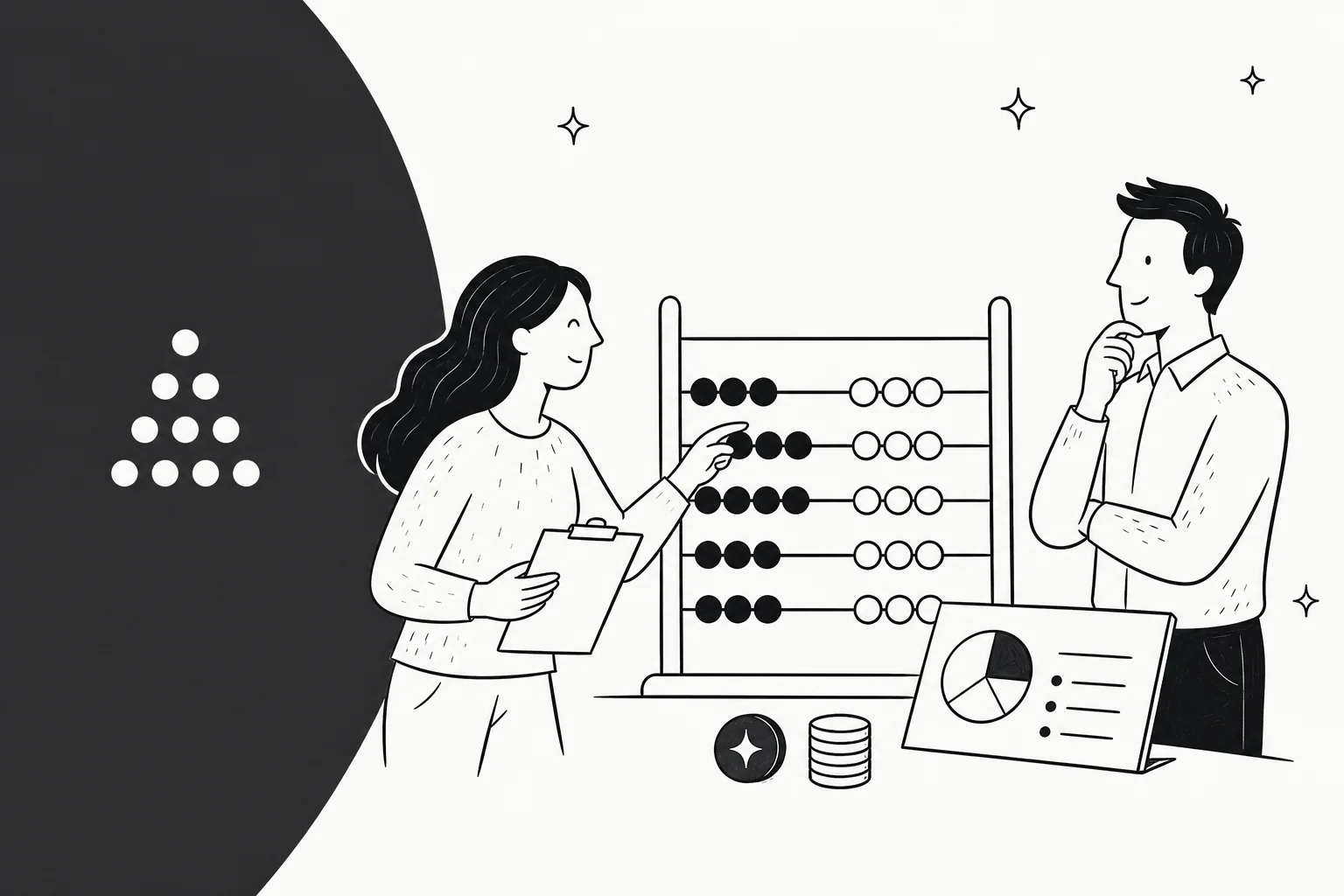
Let's be honest, Abacus AI looks pretty impressive on the surface. It bills itself as an all-in-one AI powerhouse, giving you access to heavy-hitters like GPT-5.5 and Claude Opus 4.8, plus slick automation tools like its AI Agent. For anyone looking to tap into serious AI power, it sounds like a dream. But then you click over to the pricing page, and the dream quickly turns into a headache. You're immediately hit with a complex, credit-based system that seems designed to be confusing. This lack of clarity can easily lead to sticker shock, unexpected bills, and a real mess when you're trying to set a budget.
I'll add a bias up front: I work on AI for support at eesel AI, and when we designed our own pricing we actually tried a credit model early on, then killed it. Every customer hit the same wall, "wait, what is a credit?", and that one question was enough to stall a sign-up. So when I look at Abacus AI's pricing, I'm not reading it as an outsider; I'm reading it as someone who's watched this exact model confuse real buyers. This guide pulls back the curtain on the Abacus AI pricing model, decodes that credit system, and points to a more predictable alternative.
What is Abacus AI?
So, what exactly is Abacus AI? Think of it as a big toolbox for generative AI. The platform bundles together access to various Large Language Models (LLMs), tools for generating images and video, and their own proprietary AI agent (recently rebranded from DeepAgent). They're aiming to serve a pretty wide audience, from hobbyists tinkering with their ChatLLM product to large companies with custom enterprise needs.
At its core, the platform lets you switch between different state-of-the-art models from big names like OpenAI, Anthropic, and Google. As of 2026, that lineup includes GPT-5.5, Claude Opus 4.8, and Gemini 3.1 Pro, alongside image and video models like Nano Banana Pro and Sora 2. It also includes its AI Agent for complex, multi-step tasks, CodeLLM for developers, and the ability to chat with your documents.
Abacus AI positions itself as a general-purpose "AI super assistant" that can do a little bit of everything. It's an interesting approach, but as we're about to see, this jack-of-all-trades model comes with a cost structure that's a real challenge to pin down, especially next to focused AI agents built for one job.
A deep dive into the Abacus AI pricing model
To get a real handle on how much Abacus AI will actually cost you, you have to look past the attractive monthly fee on the homepage. The price you pay is really built on two things: the subscription plan you choose and a notoriously vague credit system. Let's break them both down.
Breaking down the basic vs. pro plans
For most individuals and small teams, Abacus AI pushes two main subscription tiers:
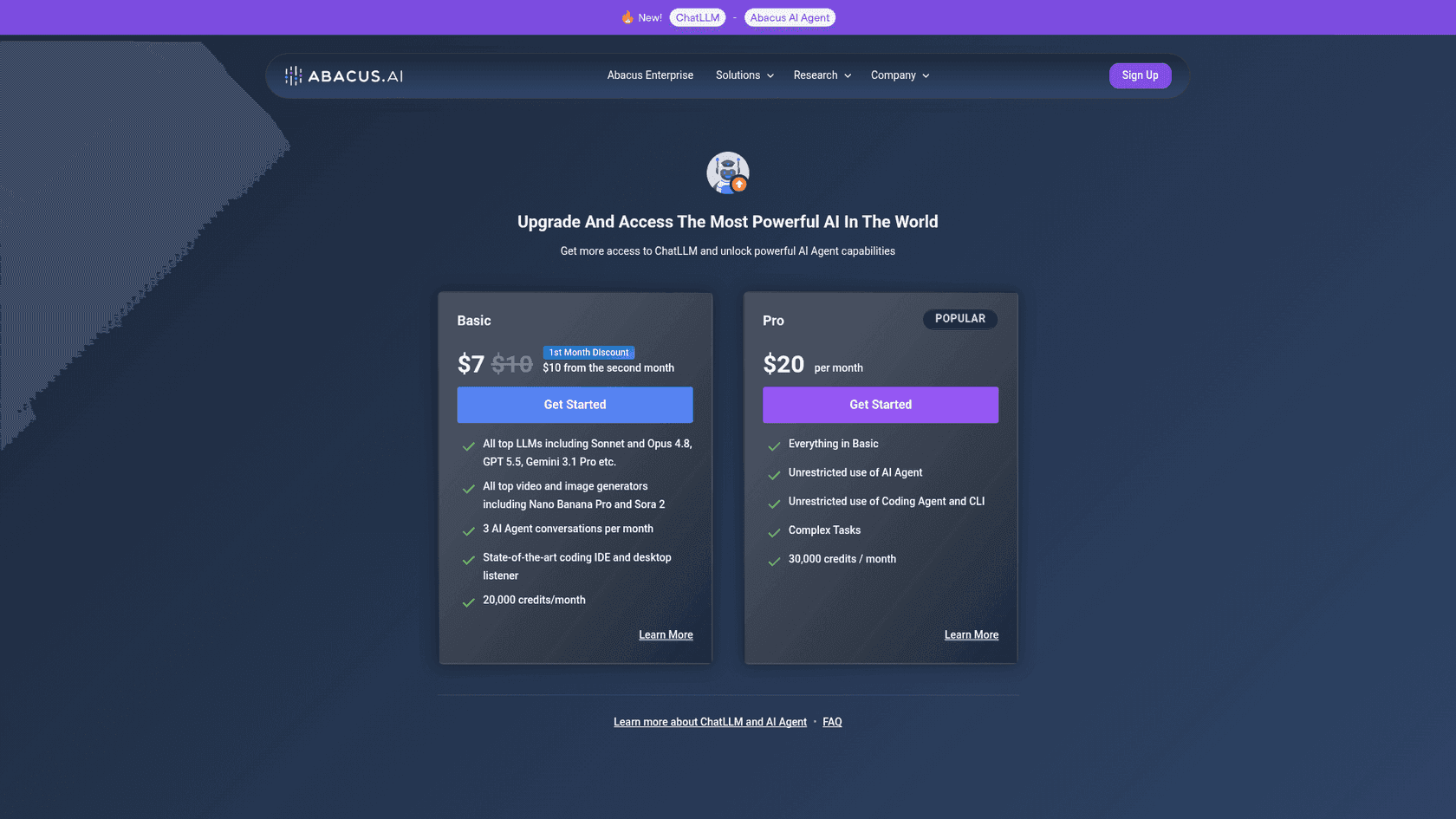
- Basic Plan ($10/user/month): This plan gets you in the door with access to most features and a starting pool of 20,000 credits. The catch? The AI Agent is basically a demo here, you only get three conversations per month.
- Pro Plan ($20/user/month): For double the price, you get a bump to 30,000 credits and, more importantly, you unlock the full, unrestricted version of the AI Agent, plus the Coding Agent and CLI.
For bigger companies, there's a custom-priced Abacus.AI Enterprise tier. It's also worth pointing out that full API access, which is essential for any serious business integration, is reserved for that enterprise tier.
Here's a quick look at how the two self-serve plans stack up:
| Feature | Basic Plan | Pro Plan |
|---|---|---|
| Monthly Cost | $10 per user | $20 per user |
| Monthly Credits | 20,000 | 30,000 |
| AI Agent Access | Limited (3 conversations) | Unrestricted |
| Top LLMs (GPT-5.5, Opus 4.8, Gemini 3.1 Pro) | Yes | Yes |
| Coding Agent + CLI | Limited | Unrestricted |
| API Access | Custom chatbots only | Custom chatbots only |
The confusing world of credits
Alright, this is where things start to get messy. Credits are the currency you use for just about everything on the platform, but their actual value is kept intentionally fuzzy.
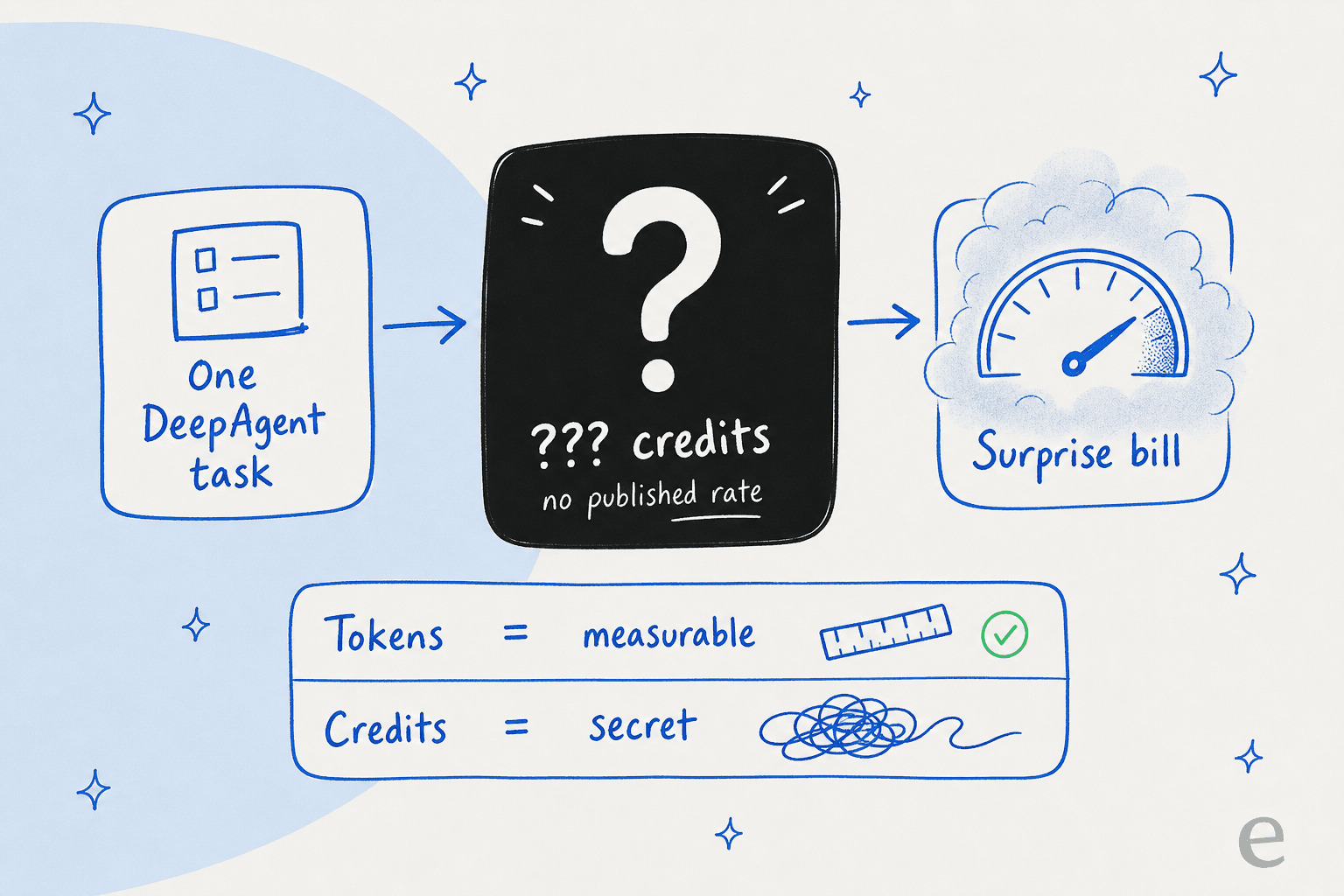
In their own billing FAQ, Abacus AI clearly states, "these credits are NOT TOKENS," and they "don't have exact credits published per model" because the rates are always changing. For anyone trying to manage a budget, that's a massive red flag. You might see some of the less powerful models advertised as "unlimited," but the fine print says they still "accrue credits on an ongoing basis", a contradictory statement that just adds to the confusion.
To make things even more complicated, any extra credits you buy will roll over to the next month, but the 20,000 or 30,000 credits included with your subscription? They disappear at the end of your billing cycle. It's just another layer of complexity in a system that already feels like a bit of a maze, and it's exactly the kind of "invented unit" we steered away from when pricing our own AI customer service tooling.
The hidden costs and limitations of Abacus AI pricing
That murky credit system is just the tip of the iceberg. Once you start digging into user reviews and the platform's own policies, you'll find a pattern of hidden costs and frustrating limitations.
Why credits aren't tokens (and why that's a problem)
In most other AI tools, cost is tied to something you can actually measure, like tokens (which are roughly equal to a word or part of a word). This lets you estimate your costs with some degree of accuracy. Abacus AI just throws that whole idea out the window. Without any clear conversion rate, you have no way of knowing if that big research task you're about to assign the AI Agent will burn through 500 credits or 50,000.
This level of unpredictability just doesn't work for most businesses. If you're on a team in a field like customer support, where the number of tickets can suddenly spike, you need a cost model you can count on. A system where your costs are tied to predictable things, like the number of customer interactions, is a much safer and more scalable way to go.
The 75% usage rule that can force you to buy more
One of the most user-unfriendly policies is buried deep in their FAQ. Abacus AI actually stops you from using the last 25% of your monthly credits until the final week of your subscription. Their official reason is to encourage you to spread out your usage, but the real-world effect is much more frustrating.
One user on Reddit shared a story that says it all: "I had used 1.5 million of my 2 million credits. Despite having 500k credits to spare, the tool forced me to buy another 1 million credits and would not allow me to use ANY of the 500k I had left."
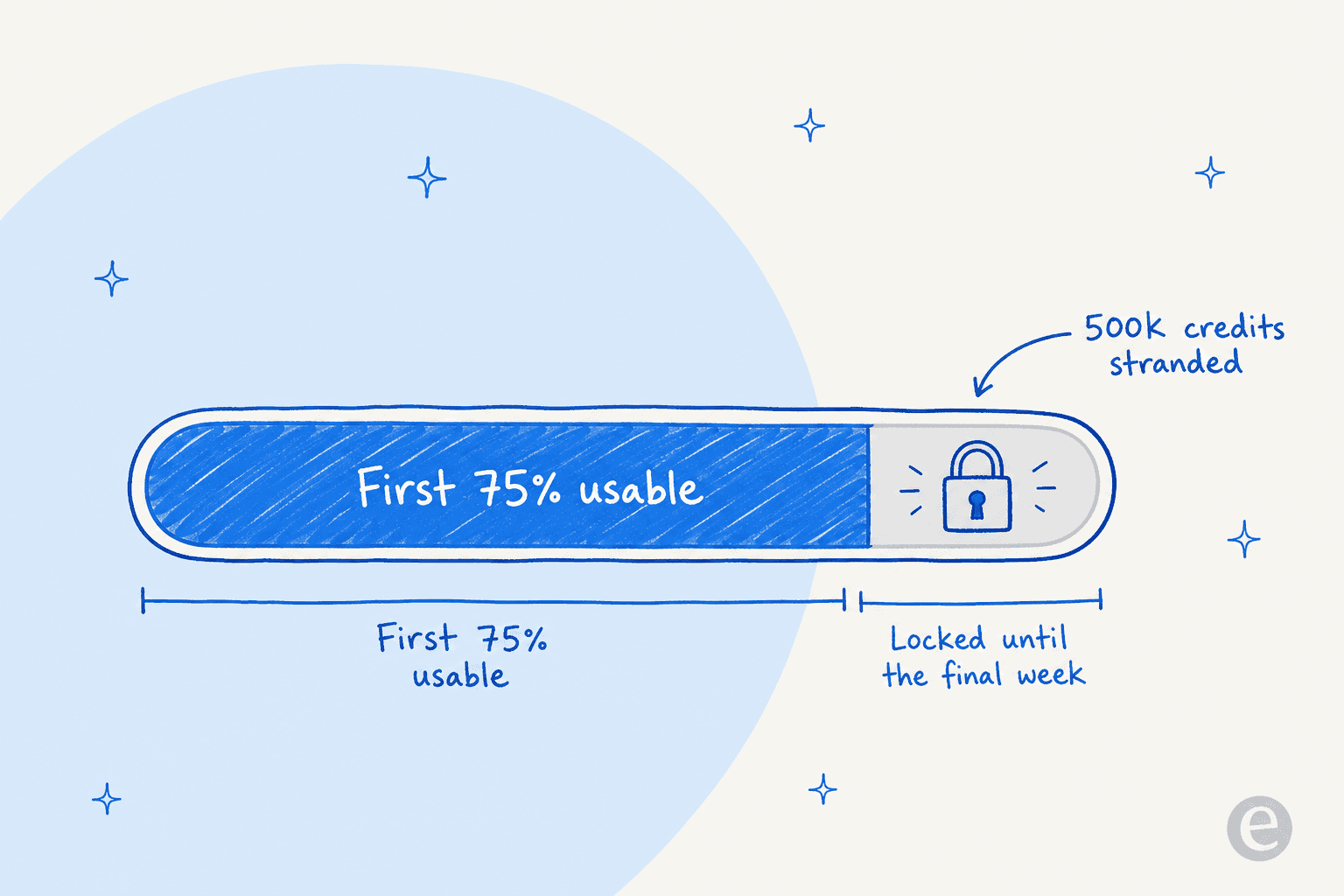
This policy feels less like a helpful reminder and more like a way to push people into buying more credits than they actually need. It's a perfect example of a hidden cost that can completely throw your budget off track, the kind of thing that pushes teams to look at Abacus AI alternatives.
What real users say about customer support and reliability
Beyond the pricing complaints, public feedback brings up some other concerns. That same Reddit thread has multiple people reporting that the app is "incredibly slow," "full of bugs," and has "nonexistent" customer support.
Another user talked about their attempt to get some simple answers about the pricing, explaining, "I then sent a brief follow up email requesting a little more detail... That email was completely ignored." When a company won't even answer basic questions about how you pay them, it's a pretty clear sign that transparency isn't high on their list of priorities. It's a reminder to weigh the Abacus AI reviews carefully before committing.
Looking for an alternative? Transparent pricing for AI support
If all this talk about confusing credits and hidden fees has you thinking there has to be a better way, you're right. For businesses focused on customer service and internal support, some platforms are built from the ground up with transparency and predictability in mind, the way the best AI agents for support should be.
Predictable costs with pay-as-you-go pricing
eesel AI is an AI platform made specifically to automate work in help desks like Zendesk and chat tools like Slack. Its approach to pricing couldn't be more different from Abacus AI's. The most important difference is its clear, pay-as-you-go model with no per-seat fees and no credit math.
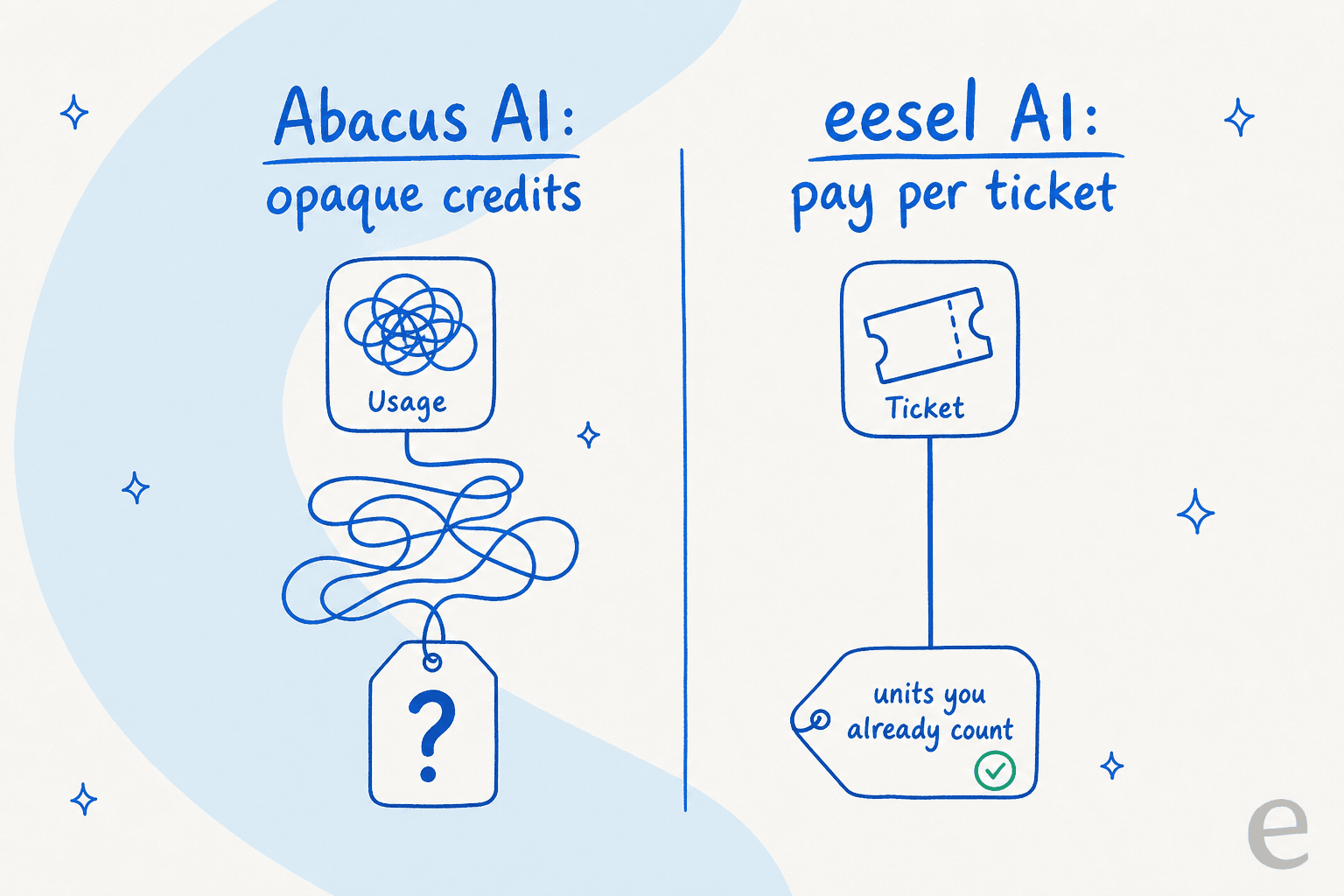
Instead of a confusing credit system, eesel AI prices in the units you already count, tickets and chats the AI actually handles. It's straightforward, easy to understand, and makes budgeting a breeze. You'll never be surprised by your bill at the end of a busy month, and you won't pay extra for follow-ups or internal actions inside a single ticket.
| Aspect | Abacus AI | eesel AI |
|---|---|---|
| Pricing Model | Confusing credits with variable costs | Pay-as-you-go per ticket and chat |
| Predictability | Low (costs are unpredictable) | High (priced in units you count) |
| Transparency | Low (credit values are a secret) | High (you see the cost before you commit) |
| Target Use Case | General Purpose | Customer Service & ITSM |
Beyond Abacus AI pricing: Test with confidence before you pay
While some Abacus AI users report a buggy experience and feeling left in the dark, eesel AI is designed to give you confidence right from the start. One of its best features is a simulation mode that lets you test your entire AI setup on thousands of your own past support tickets. This gives you an accurate forecast of how the AI will perform and what your return on investment will look like before it ever interacts with a live customer.
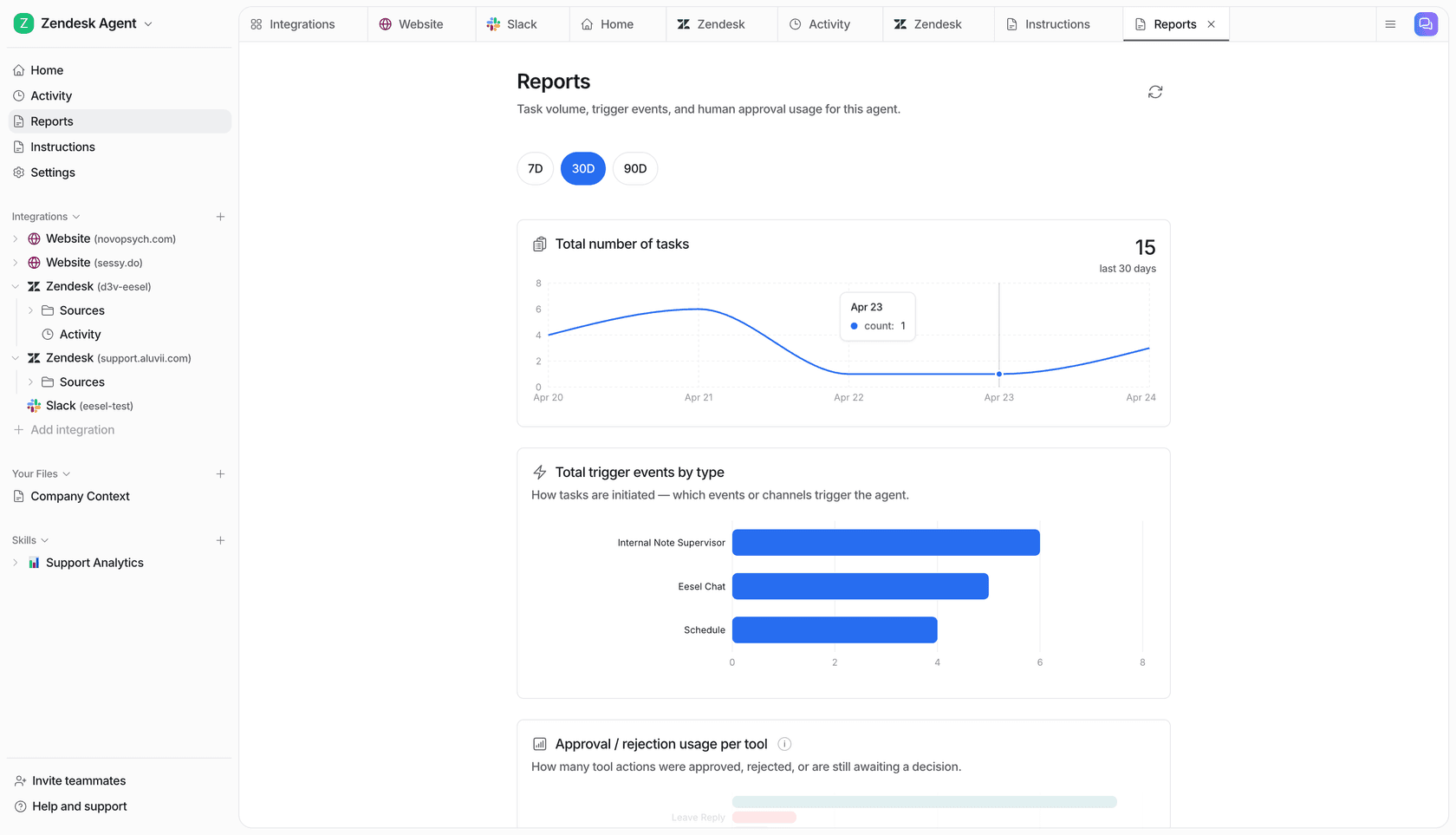
On top of that, eesel AI is completely self-serve. You can sign up, connect your help desk in a single click, and have a fully working AI agent running in minutes, no mandatory demos or sales calls required. It's a refreshingly direct contrast to the experience of Abacus AI users who couldn't even get a simple question answered over email.
Want predictable pricing for support automation? eesel AI works like a new support hire that plugs into your helpdesk in minutes, learns from your past tickets, and only charges for the tickets it handles, no credits, no seat fees, no surprises. Try eesel free, or simulate your costs on real data first.
Is Abacus AI pricing Worth It?
Abacus AI certainly offers an impressive list of powerful AI tools, but its value is seriously held back by a pricing model that feels intentionally confusing, unpredictable, and ultimately frustrating. The vague credit system, strange policies like the 75% usage rule, and reports of unresponsive customer support make it a risky choice for any serious user.
For an individual who just wants to play around with different models and isn't worried about a fluctuating monthly bill, it might be an interesting option. But for businesses that need reliable, scalable, and budget-friendly solutions for specific jobs like support automation, the risks and hidden costs are just too high. At the end of the day, the best AI platform isn't just the one with the most features; it's the one that provides a service you can actually trust.
Ready for an AI support solution with pricing that actually makes sense? eesel AI offers a transparent, pay-as-you-go model you can test with total confidence. Try eesel today and see how much you can automate, completely risk-free.
Frequently asked questions

Share this article