
"Resilience Needs Support": First Interview with UNHCR’s in Ukraine New Representative Castel-Hollingsworth
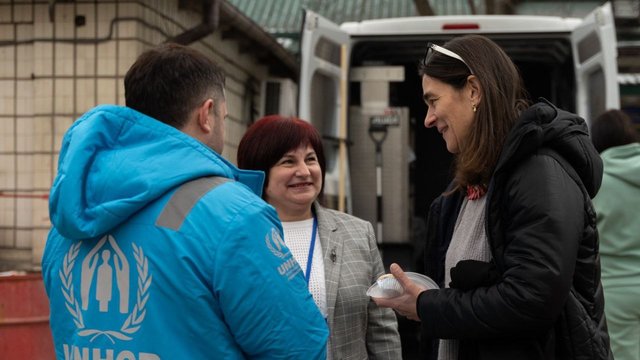
In her first in-depth interview since becoming the UNHCR Representative in Ukraine in October 2025, Bernadette Castel-Hollingsworth speaks candidly with Interfax-Ukraine about the escalating humanitarian toll of the full-scale war. Four months into her mission, she has travelled extensively to frontline and heavily affected regions, engaging directly with authorities and displaced communities to grasp the actual needs on the ground.
The conversation highlights the severity of 2025 — the deadliest year for civilians since the full-scale invasion began — with relentless attacks on energy infrastructure, widespread blackouts, and rising evacuations, especially of older people, persons with disabilities, and children. She details UNHCR’s major winter efforts, addresses funding challenges, demographic patterns among those leaving and wishing to return, the main barriers to return, and how prolonged displacement reduces return intentions.
Looking to 2026, Castel-Hollingsworth outlines UNHCR’s threefold strategy: sustaining emergency response where needed, scaling up durable housing and social infrastructure solutions, and supporting government reforms through legal and protection expertise.
Text: Valerie Proshchenko
-
You have been here for four months. When you just started your mission, what was the first city you visited?
The very first places I went to were Odesa, Mykolaiv, and Kherson — that was my first mission. My objective was to understand what we are doing on the ground. Because we really work to complement the efforts of the government, I wanted to hear directly from local authorities — at the oblast level, from hromadas, from city mayors — to understand how they see things, whether they are satisfied with our collaboration, and how our expertise can help them best.
Of course, I work very closely with several ministers and ministry colleagues together with my entire team, but I also wanted to see the reality on the ground and listen to the authorities. That is why I have travelled quite extensively. Very quickly — already in my first week — I was out in the regions, and then I went back several times.
Now I have started doing more focused missions. For example, in late December, I undertook a mission that was very focused on our shelter programming and housing. I discussed with Zaporizhzhia’s Governor, for example, and with a number of heads of hromadas, what works best. And then, when I come back here, I can have discussions with the Ministry for Development of Communities and Territories or with the Ministry of Social Policy. We are able to think together about what works best, drawing also from what I learned in different oblasts.
-
An overall question from the very beginning. Your assessment of the current situation on the ground. What do you see that needs to be done better, or what has become worse in the humanitarian area?
Well, you know that our human rights colleagues at the UN Human Rights Monitoring Mission in Ukraine have assessed and reported that in 2025 there were more civilian deaths and injuries — more casualties — than in any other year since the full-scale invasion began, and really since the war started in 2014.
Of course, being very often at the front line, these past two to three months there have been many attacks on the energy infrastructure. I am very concerned about the humanitarian needs in general and about the evacuations, which actually seem to be increasing. Evacuations mean more displacement, again of vulnerable populations. For example, this morning I heard from my colleagues in Kharkiv that among the recent evacuations, the majority are older people, people with disabilities, and children who are leaving frontline communities — mostly from Donetsk, Dnipropetrovsk oblast, and Zaporizhzhia. So this is very concerning.
In my view, the situation is deteriorating. It is deteriorating because the attacks are targeting Ukraine overall, the people themselves, and what they need to survive: essential infrastructure, transportation, energy, housing.
At the same time, because I interact a lot with the authorities, I see that there is a real willingness to start recovery efforts. That, I think, is very important. And in 2026 we are going to scale up our work on solutions.
But the final thing I want to say is that I think the people of Ukraine are very determined. You are not only resilient but also resistant. Yet the relentless attacks are taking a toll on people, especially with the winter we’ve just had. I had a meeting with the Minister of Foreign Affairs recently, and he said that it has been the coldest winter since 1999 — some 26 years ago. I see that this has been very difficult, and it has impacted everyone across the country. My own colleagues have had to leave their homes and stay in hotels; others had to go to their summer houses. Once I even gave the keys of my apartment to a neighbour I don’t really know when I was leaving for a week, because their water pipe burst and there was so much water in their apartment. It is impacting everybody, and especially, of course, those who are already displaced and those who need more assistance than you and I in their daily lives — older people, especially those who live in high-rise apartment buildings.
So yes, we are monitoring the situation, we are providing assistance where we can, but I’m concerned about the ongoing russian attacks. And keep in mind that overall, more than 10.8 million people in Ukraine still require humanitarian assistance.
-
So, am I right that you will continue your winter support for Ukrainians? And what has already been done during these horrible winter months?
At the request and under the coordination of the President’s Office, we have assisted some 195,000 people with cash assistance specifically for buying solid fuel such as firewood. Primarily, people in frontline areas, within 0 to 10 kilometres from the front line — people who are really staying in villages and settlements under constant attack. We did that to complement the efforts of the government. We just finished the last disbursement few weeks ago, and in total we provided directly, without overhead costs, $57 million of assistance to these 195,000 people.
Provision of winter cash assistance is now over because we don’t have more money. But what we will continue doing through our shelter interventions is to work on the rehabilitation of houses. We help people with repairs of the roof, windows, and doors, or the external perimeter of the houses; we help insulate houses or apartments. According to our estimates, people are able to save about 25% of their energy needs through that. I talked to some families in Mykolaiv two weeks ago and they really appreciate it. And then the third thing we have done, and that we are still in the process of distributing, is power stations, in particular to collective sites, to the human rights offices of the Ombudsperson of Ukraine, to some invincibility points — wherever the authorities tell us there is a need. Sometimes it’s administrative buildings, TSNAP centres. So these, I would say, are the three major areas of assistance during this winter.
-
You mentioned that cash assistance is over because you don’t have money anymore. Can you please clarify: has this part of the assistance ended only for winter support?
Yes, for winter support. We have appealed for $470 million for this year, 2026. We have started implementation, but if we had more money, we would have been able to assist more people. We had to close the cash programme for this winter two weeks ago because, based on the list of beneficiaries we received from the Pension Fund, the Ministry of Social Policy and the oblast authorities, we could no longer assist more people.
-
I’m asking because we all understand that the longer the war continues, the harder it is to get money from donors, and how does that affect your agency’s ability to get more funding for Ukrainians, to support your programmes for us?
First of all, we have to be very grateful for the support from the government and private sector donors that we have received so far. My main message is what the Ukrainian people are telling me. That’s what I tell donors. People are saying, “do not forget us”. People don’t want to be forgotten. It’s not enough to be resilient. Yes, resilience is important, but resilience only lasts if it is being supported.
The UN High Commissioner for Refugees Barham Salih visited Ukraine in February, and what he told the donors was: be reassured and tell your taxpayers that from what I have seen, the assistance that has been received in Ukraine has been put to very good use. Certainly, at UNHCR, we’re really changing lives and saving lives. We are very impactful because we are very focused on protection assistance, as well as on shelter and cash support. He also said that it is very important to sustain the funding level. It should not decrease because the needs are increasing.
-
And on internal displacement. You’ve already mentioned some regions. Where is the largest number of IDPs now?
The largest numbers are in Dnipropetrovsk, Kharkiv and Kyiv oblasts. So those three oblasts, and then the three main cities: Kharkiv, Dnipro, and Kyiv City. And overall, around 3.7 million people remain internally displaced within Ukraine.
-
Seeing the heavy attacks on the energy system, do you see that the number of IDPs has scaled up since the energy attacks intensified?
We are monitoring the situation, also the borders. You know that every day I have colleagues and teams of partners at 30 border crossing points here. We monitor both the people who are leaving Ukraine — and we have done that since 2022 — and those coming back. We have not seen an increase in the number of people leaving the country. There may have been some movements within Ukraine, but from what we can see, they have been temporary movements. So, you know, during the very cold weeks, people may have gone to family members, but then they return.
For people leaving to go abroad, what I can tell you is that the number of people who have left since November has not increased, but among them, the proportion of people leaving because of energy issues, lack of heating, or water has increased. So the total number of people leaving — no — but the reasons why they leave are linked more to energy than in the past, including water, which, for example, we never saw in 2024. So water-related and energy-related reasons are cited more often , and concerns about water is something new.
-
Regarding those who are leaving or internally displaced, are there any clear demographic patterns? For instance, is it mostly younger people, older adults, children, women, or certain household types?
There is no such thing as one group or the other. We have seen in September–October a bit more young men leaving, following the change of the law in August, but it did not continue. It’s often families, single-headed households, also with children, vulnerable people, and older people who leave.
-
And how do you support IDPs in Ukraine? What is the situation in transit centers and collective sites now?
In the transit centres people don’t stay more than a couple of days. And of course, the majority of the evacuees don’t go through the transit centres. They are self-evacuating, which is always, as you know, a very difficult decision for them to make. For me, it’s very difficult to hear about lives interrupted by this war.
But out of the people who go through the transit centres, there are only very few going through the collective sites. We have not seen a big increase in these collective sites, so there are some 1,600 of them, and there are more or less 70,000 people living in them. As UNHCR, and I have discussed this with Minister of Social Policy, Family and Unity of Ukraine Denys Uliutin, I would like to see how we can have a more durable approach to these collective sites. For the people in these facilities, I would like us to see how we can focus on providing them housing so they can leave the collectives sites.
And then there is another group who may have some special needs, these people are in the collective site because there is no, for example, facilitated home-based care for them. So, we have been working with the Ministry of Social Policy, Family and Unity to try to use some of the social services that exist — social adaptation, facilitated home-based care, etc. — to basically show people that they can live on their own without being in the collective sites.
In 2026, we are going to work on that. So, long answer to your question is: there has not been an increase, but there has also not been a decrease in the number of people in the collective sites. And I think one of our ambitions is to try to see with the authorities if we can find solutions for people. We are ambitious, but we are still realistic — we won’t be able to find a solution for 70,000 people, but even if it’s 3,000 or 5,000 or 500, I think it’s very important. And if the evacuations continue, there is a need in the collective sites to accommodate new people, then we can help in that way. And keep in mind that 71% of IDPs have already been displaced for more than two years, and many have moved multiple times.
-
In the very beginning, you mentioned the bad situation was evacuation. Is it across all regions where evacuations are happening, or in some regions the situation is worse — I mean, like Zaporizhzhia or Sumy?
I think the Donetsk authorities mentioned that in 2025, 115,000 people left Donetsk oblast. In 2025, we assisted 90,000 people through transit centres that we support as UNHCR. This is more than before. We see now that since the beginning of this year, there has been an increase of people moving through transit centres in Kharkiv, in Dnipro and in Zaporizhzhia regions. The authorities in Zaporizhzhia oblast opened a transit centre in November. If there was no need for that, they would not have done this.
-
Referring to refugees — also a very important part of your work — your colleague, Karolina Lindholm Billing (UNHCR Representative in Ukraine in 2021-2025), said in 2023 that 80% of refugees want to come back, and in September 2025, when she ended her mission, she said that 60% of refugees want to come back to Ukraine. As for now, what numbers can you provide?
Actually, we’ve just completed the seventh round of UNHCR’ Intentions Survey in 20 European countries, and the findings will be released soon. We see that the number of people who intend to return declines. It’s not unique to Ukraine. I’ve worked in many parts of the world, and you always see that when the displacement situation lasts for years, the intentions to return decrease.
But what the refugees are telling us is that they are very keen on returning if the situation improves. And as soon as the situation improves, they will come back immediately.
-
So the longer they stay abroad, the less possibility for them to come back…
Everywhere, it’s always like that. You know, it’s the same thing with the Syrian refugees. I’ve worked in Africa for many years. You always see that the longer the displacement, returns become less likely. But still, many refugees from Ukraine who participated in our survey say that they are very keen to return.
-
As a specialist, can you explain what the main obstacles are for people to return home once the security situation has normalized?
Refugees ask for three main things — and internally displaced people in Ukraine say the same. The most important is security (which translates to at least a ceasefire, and preferably a just peace). Beyond security, they name three key elements: housing first, livelihoods (a way to find employment), and access to services — primarily schools for those with children, hospitals for older people, and similar essentials. And our surveys show that 62% of IDPs report their homes are destroyed, damaged, or on occupied territory — that’s a huge barrier.
-
In your assessment, do you believe that up to 3.5 million refugees could potentially return to Ukraine?
We are looking at a range of scenarios. According to a published study, depending on the end-of-war/ceasefire scenarios, between 2.3 million and 3.5 million refugees could return. Though the exact figure depends on various factors. Of course, in a scenario with no ceasefire or lasting peace, the number of returns in 2026 would remain very low.
That said, as UNHCR, one key reason we are focusing on solutions for internally displaced people in collective sites is precisely to be prepared. When the conditions become safe, refugees tend to return very quickly — the majority within the first year. They do not wait long, once safety is assured; large numbers come back almost immediately. And estimates show that around 1.4 million refugees have already returned and stayed for at least three months, with over 300,000 going to locations other than their original homes.
That’s why we want to be ready. The work we are planning with the Ministry of Social Policy and oblast authorities on people currently in collective centres will directly support future refugee returns as well. This is exactly why we are shifting toward longer-term solutions alongside our emergency response.
We will maintain our emergency capacity for as long as necessary, so that we, with our partners, can respond immediately to families impacted by attacks and evacuations. At the same time, we are advancing solutions, and I believe we have strong, practical ideas for how to best complement the authorities’ efforts.
-
If we look at the current peace process and preparations for a possible ceasefire — something we all hope will happen soon — how exactly is UNHCR approaching this? Are you involved in building the right infrastructure for returns, and how do you manage to combine support for returning refugees with solutions for internally displaced people?
Essentially, UNHCR focuses on three main areas of preparation for potential returns once peace is achieved.
First, we have developed a robust forecast model outlining where people are likely to return. This model provides a clear picture of potential return destinations. Building on that, we have engaged with major development banks, the Ministry of Development of Communities and Territories, the Ministry of Social Policy, the IMF, and other UN agencies to share our underlying assumptions. The key point we emphasize is that millions may return — even 2 million would represent a significant influx — and Ukraine needs those people.
Second, we are significantly scaling up our housing programmes to offer long-term, durable solutions with a variety of options. We collaborate closely with the Ministry of Social Policy on this, and I had a meeting with the Ministry for Communities and Territories Development to discuss tailored approaches. Needs differ greatly: some people can afford to purchase new apartments, while others have lost everything. By providing diverse housing pathways, we address recovery needs — and this is arguably the most substantial element of our response to your question. With UNHCR’s support, approximately 55,000 homes have been repaired overall, enabling families to return or remain in their homes, and we’ve provided emergency shelter materials for quick repairs to about 565,000 people.
We also support social infrastructure. For example, just few weeks ago, in Mykolaiv — and similarly in Kherson — my UNDP colleague and I inaugurated a rehabilitated community and administrative centre in a hromada that had been temporarily occupied in 2022 and where the Government of Ukraine regained control later. This centre now enables residents to access local authorities, services, and community spaces, fostering reconnection and rebuilding.
Third, our protection teams — including legal experts — assist the government in addressing gaps through law reform and improvements. As you may know, the President recently signed a new framework law on the fundamental principles of housing policy. We are now working with the Cabinet of Ministers to develop subsidiary legislation, including provisions tailored to internally displaced persons and other vulnerable groups. This forms part of our broader legal and protection advocacy — and since 2022, we have provided around 700,000 legal consultations to help people restore documents, confirm property rights, and access compensation.
-
Among those two million or more potential returnees, how significant a share do you think will be men? Martial law has a major bearing on this, and though it’s a delicate subject here, what insights can you share from similar contexts in other countries you’ve worked in?
It’s a good question. There are really two ways to look at it. From what our forecast model shows — and from what refugees themselves have told us in the intention surveys — the people most likely to return first will primarily be the more vulnerable groups. So we’re talking about older people, single women, women-headed households, persons with disabilities, and similar profiles. Interestingly, this also reflects the majority of those who originally left Ukraine — the most vulnerable were the first to depart.
At the same time, we very much hope that peace will come, and with it the lifting of martial law. The question of conscription and mobilization is obviously one that would need to be addressed by the authorities over time, as part of any peace process or agreement. Ultimately, that’s a decision for the Ukrainian government to make.
-
Does that mean that after a potential ceasefire — and ultimately when the war ends — your agency would face even more work on the ground in Ukraine?
Yes, initially. Of course, the country will require extensive reconstruction of physical infrastructure, but UNHCR sees its essential role in the human dimension of recovery: supporting the reintegration of returnees, with shelter programmes remaining a critical component.
As you know, the ultimate measure of success for UNHCR is always to be able to leave a country, to close our office because the protection and assistance needs have been met and the situation is sustainable. I have had the privilege of closing several offices in my career, and each time it felt like a far greater achievement than opening a new one (which I have also done). Here in Ukraine, however, I believe we will unfortunately still have substantial work ahead.
And of course, we must not overlook the people in the occupied territories. There, too, we anticipate important tasks: family reunification, documentation and civil status issues, risks of statelessness, housing and property rights disputes — areas where UNHCR brings unique legal and protection expertise that no other UN agency possesses to the same degree.
So yes, regrettably, the context suggests that our presence and support will remain necessary for some time to come.
-
Turning to the medium-term perspective — this year and potentially the next — what are UNHCR’s primary goals and intended results in Ukraine? You noted that the agency’s greatest success is exiting a country once needs are sustainably addressed. Assuming continued presence here, what tangible achievements would you regard as most meaningful?
The first thing I should tell you is what our High Commissioner said during his visit to Ukraine: first and foremost, we want peace in this country as soon as possible — a just and lasting peace. We also — and I should say this from the very beginning — will stand here for as long as is needed with the people of Ukraine. That is number one.
If you ask me what we will do in 2026, we will stand with the people of Ukraine for as long as they need us. Now, in terms of our programming, you could say it will be threefold.
One is to keep our emergency response going for as long as it’s needed — focusing on immediate support after strikes, after displacement or evacuation: legal aid, legal counselling, psychosocial counselling, and immediate shelter response. You know, all those wooden boards you see nailed up everywhere in Ukraine — half of them are ours. UNHCR is the largest provider of shelter materials after the strikes in Ukraine. So that remains number one: we keep that capacity. And since 2022, we have provided psychosocial support to nearly 325,000 people, including immediate aid after shelling or evacuation and longer-term support.
Number two is to work on solutions, focused on longer-term housing for internally displaced people and others, as well as social infrastructure, linked to social benefits. This builds on our track record: we have repaired homes for about 1,500 IDP families in rural areas who bought or rented housing, and supported reconstruction of social housing for 260 more families.
And the third thing is our protection advocacy, as I explained to you earlier: supporting the government in its ongoing reform efforts. That’s the threefold approach we will pursue in 2026.
-
Turning to the High Commissioner’s Barham Salih visit — his first since taking up the post recently — President Volodymyr Zelensky noted after the meeting that he would like UNHCR to expand its support. Recognizing that UNHCR is already among the largest contributors in many sectors, what additional efforts or increases do you think would be most impactful?
Last year, we provided 400,000 fewer services than in 2024. This was not due to any limitation in our operational capacity; it was simply because we had less funding available. We believe — and this is confirmed by what people tell us on the ground — that UNHCR is highly impactful. If the needs continue and if we receive adequate funding, we will be able to deliver the response required.
In a very optimistic scenario where a ceasefire is reached, it would allow us to redirect resources from emergency assistance toward the longer-term solutions I have been describing — particularly housing solutions — almost immediately. However, if the war persists, we will need to maintain a careful balance: continuing our frontline interventions where attacks and displacement are ongoing, while at the same time supporting areas with large concentrations of internally displaced people and collective sites, and gradually identifying durable solutions for those people.
Ultimately, it all depends on the evolving context.