
Electricity prices make operations unprofitable, my job is to convince the Group to support and believe in Ukraine – CEO of "ArcelorMittal Kryvyi Rih"
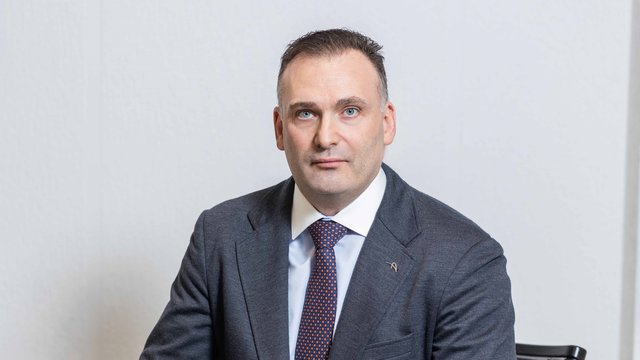
The exclusive interview with Mauro Longobardo, CEO of the Kryvyi Rih Mining and Metallurgical Plant PJSC “ArcelorMittal Kryvyi Rih” (AMKR, Dnipropetrovsk region)
Text: Yuriy Guly
What is the current production load at the plant? How many blast furnaces are operating, how many are idle, and why?
Let’s start from the mining department first and then go to the steel plant.
The mining department is running around 75% of its full capacity. And, today, it is more than enough to cover everything that we need at our steel plant, all the exports towards the sister companies in Europe, and different exports to China. So, somehow this is the volume that we are after him now – approximately, 7.5 million tons of concentrate per year, that represents 75% of our full capacity. Before the war – around a million tons of monthly production capacity.
Now, at the steel plant, we are still operating with two blast furnaces. Unfortunately, the first days of this year were very difficult in the sense that we did not always have availability of electricity. I mean, it is not always the problem of the price of it. But, especially in January, we had a lot of blackouts. So, we couldn’t actually operate two blast furnaces in a continuous way. We had some incidents, blackouts, which required us to safely put on idle one of two blast furnaces some days. Now we are back with two, and we hope that we can maintain this production rate along the year.
Generally, the main problem with blast furnaces was the lack of electricity after specific missile and drone attacks over electricity infrastructure.
So, you mean that there was a period when you did not operate with blast furnaces at all, fully on idle. Is that correct?
Yes, this is correct. In January, when we experienced one of the full blackouts, it caused the loss of the cooling system of the blast furnaces for at least 3-5 hours. That generated some damages to the blast furnace itself – our tuyeres – it’s an equipment which is inside blast furnaces rounded by the cooling system. Some of the tuyeres were burnt. Due to that, we had to stop and to repair all the tuyeres before we could restart. This stop lasted around a week.
What is the current situation with the plant’s raw material supply, especially coking coal and coke? What is the status of limestone supplies from the Kherson region?
We purchase coal internationally (from Australia or the US) to Pivdenny or Odesa ports. Remember, that we have a coke plant as part of AMKR, so we buy coals and we produce coke. But we have some issues in delay in receiving coal due to attacks over ports. The problem is that unloading coal from the vessel took more time than was expected initially in January. So, to summarize, we purchase coal at the market price. We are OK with that.
Let’s talk about getting limestone from our facility. We are consuming it much less in comparison to what we consumed before because limestone is linked to production of hot metal and production of steel. We are working at half of capacity compared to the pre-war level.
So, to make sure, the plant is fully supplied with raw materials, right?
Yes, this is correct.
In recent months, the company has stated that it is unable to increase production particularly due to high tariffs for energy resources and railway transportation. How has the situation changed since then?
Well, let’s say that the situation has gotten worse. The electricity price, when it is available, is extremely high and completely uneconomical. The average electricity price in January reached over $220 per MW*h. And in February it has reached $230 with surges even up to $370. So, it is clear that we are losing a lot of money.
We are also in discussions with Energoatom about so-called modular nuclear reactors. It is a very constructive idea to place one of them in Kryvyi Rih. The reason is that we will consume all the energy generated by the reactor 24/7. It will be a win-win situation. But we are very far from this dream: it takes approximately 5-10 years to implement the project. It's been a long time. I agree it could be a part of the solution for cheap energy in the long term.
With respect to the logistics, e.g. railway tariff, last year, thanks to the support from the Cabinet of Ministers, the push that our teams and all the metallurgical and mining industry had on the government, we didn’t have the forecasted tariff increase.
As you may remember, at the start of 2025 it was announced 37%. And this should cover the gap in financial numbers of Ukrzaliznytsia. However, the government found a way to support this company in a different way without charging this burden on the business. But we are very careful: there are still rumors about the increase in terms of this tariff. It is clear that for money-losing businesses increasing this tariff will make the situation much worse.
To what extent has AMKR been affected by enemy strikes on railway and port infrastructure?
That delays of delivery period have created an economical effect on us. Let’s have an example: we had a coal vessel that was waiting to reach Pivdenny port for several weeks. So, unfortunately, the delay in receiving ships because of strikes and inability to unload the vessel with the speed that it was forecasted created of course damages that we need to sustain and pay, especially when the vessels are outside of the sea and they cannot actually be unloaded at the port in the forecasted time.
Did the port tariffs and freight grow? The Ukrainian agricultural business complains about that a lot.
Let’s divide your question into two tracks. Firstly, I can confirm that freight prices are systematically going up. Secondly, I didn’t receive any alarm in terms of an excessive increase of the port tariff. However, port dues and tariffs in Ukraine are among the highest both in the Black Sea region and globally compared to other ports worldwide. This is caused by the structure of port regulation in Ukraine: rates are approved by state authorities, yet the regulatory methodology has still not been adopted. Moreover, instead of investing in the development of the port industry, more than 80% of port dues are transferred to budgets at all levels of government. Amid the conditions of full-scale war, logistics costs continue to rise: due to increased insurance premiums for Black Sea risks, frequent attacks on infrastructure, heightened military risks, and other cost factors, expenses for operators and shipowners are increasing.
However, I am sure we have to focus on electricity prices. To be honest, we do not ship a lot of raw materials now. The electricity shortages made us also unable to ship big quantities of materials out.
It is also true that we get coal with delays, but it is also true that we use less coal. Overall, the attacks affect everything. They affected us so that we do not produce at the forecasted pace. For instance, when we stopped one of two blast furnaces for a week, it impacted 25% of monthly production. So, the consumption of coal proportionally went down.
The next question is about electricity imports. How has the situation changed with the introduction of longer-term auctions and higher price caps?
Somehow, the long-term auctions were supposed to provide us with support. In reality, it is not working because these auctions are open for everybody. But they are not the same as the market.
Okay, what have we been asking? We asked for support the metallurgy and mining sector which is suffering from the current situation. And when long-term auctions were proposed (not only for imports, but also for electricity purchases in Ukraine, too), we hoped that such an auction would reserve some amount of electricity for the metallurgy and mining sector. However, that was not the case and we didn’t have good results there.
Moreover, we are still obliged to buy 60% of imported electricity. I heard that they want to increase this per cent. So, everything is moving in the opposite direction!
The biggest problem is that we do not always have electricity. Let’s imagine we could have enough of it. Its price is economically unviable, and we are losing money for every tone of product we produce, even for the domestic market. Up to now, the ArcelorMittal Group is supporting us. However, if there is no future… I mean, the problem is that we do not see the future and how the situation is going to improve. Actually, it is getting worse. Regulations that are being discussed are not making it better – they are making it worse! And this is a big issue for the Group like us – not to see the future which is supposed and forecasted to be worse. The regulations, as I stated, instead of giving release to the metallurgy and mining sector, are imposing more burden on us.
I also heard the rumors about increasing the minimum amount of energy that has to be imported to, somehow, to pay bills, going from 60% to 90%. It was already 80%, as you may remember. To summarize, the government is levelling to bring money to the budget (hopefully, to the budget – it is not always the case). But somehow it is used to do that, and there is not any action in electricity that can be really effective to improve the situation for big industry consumers.
How relevant are the projects you previously announced regarding alternative electricity supply, considering strikes on the energy infrastructure? And what about the other projects, especially installing generators on your underground mining site #1. It was planned to use it during electricity shortages. Are they actual? Are there any other projects?
During the last 6 years, we have purchased many inhouse generators of different capacities in order to create an energy-saved island in case of blackouts. For example, we own 10 generators of 1 MW laying across the coke plant. During a blackout, the generators started working, and the coke plant went to idle relying on 10 MW of electricity that was available at that moment to continue operations without major incidents. This equipment cost several millions of dollars because we had to create a true station. It is not just a generator connected to the equipment; it is a station of generators connected to the main facility’s grid.
We also have smaller generators located closer to the different equipment. It is used when the blackout is coming. In one case in January, when all the power stations around us were simultaneously hit, we had problems with a pumping station delivering water from Inhulets river, securing the full circulation of water inside the facility. It was pretty difficult to restart because the electricity volume to reboot that station was too big. The generators we had were not enough to do that, so we had to wait up to 4 hours for that electricity line in order to get enough power to restart the supply of water. So, we are able to safely put on idle our main equipment in case of blackouts by using diesel generators we secured during last years.
But this is not enough for production itself. Here we are talking about independently producing approximately 15 MW when we (mining and steel plant) regularly consume 250 MW. In a pre-war period, it was 400-450 MW. 15 MW – it is all about breathing support.
According to Mr. Serhii Leshchenko, Member of Ukrzaliznytsia Supervisory Board, it is not only about railway tariff but about overall company’s ability to be afloat after the Russian strikes. Do you agree?
Definitely, we had ups and downs. Sometimes we experienced a lack of trains which resulted in supply delivery delays. Instead of shipping to Poland 2-3 trains of iron ore concentrate we ship only one.
However, as for now, I don’t see this big issue in the train performance. Maybe, it is also linked that we do not ship a lot. Unfortunately, this is a sign of a sad reality. It is also possible that Ukrzaliznytsia doesn’t work at its full capacity but we also do not need a full amount of shipping. We definitely need that shipping for our iron ore and pig iron. However, during the last month, this was not the biggest problem. If we practiced full productions, we might have faced shipping limitations. So, everything is balanced here.
You reported electricity shortages. In addition, the natural gas price has also grown. How could you comment on natural gas buyings and what share of gas and electricity in the production do you have? How does that impact AMKR’s competitiveness?
AMKR is definitely a big consumer of natural gas. Currently, we purchase gas in Europe and from local production. European gas costs us the European hub price plus delivery to Ukraine, while local producers sell at import parity, meaning TTF plus a premium. This is the opposite of the pre-war situation: at that time, gas production in Ukraine was at a certain level, and Ukrainian gas was sold roughly at the level of the European TTF or at a discount (without a premium). It is also worth noting the increase in other costs, such as gas transportation and storage facility usage. At the current moment, state-owned companies which extract gas collect it in special storages, not participating in the market. Paying market prices plus premium, we overpay approximately UAH 100 million per month.
At the current moment, the share of electricity and natural gas in production cost has already reached 40%. These are huge numbers.
And previously, in a pre-war period?
In 2020, for example, it was about 18% only.
AMKR is currently operating at a loss. What is the forecast or plan regarding overall profitability in 2026? What factors will impact it?
Energy is a big item, especially during this winter season. But let’s start on-by-one.
Our goal is to bring the plant at least back to break-even. Today we are not there because of this increase in Q1. Last year we finished with extremely high utilities and energy prices. The Q1 so far is even worse. We are talking now about 30% worse, and it was not forecasted. During last year, we tried to make a budget approaching zero-level in terms of losses. Q1 was not predicted to be so devastating due to electricity prices.
We also have an additional factor which hit us in Q1 – it is the introduction of CBAM (carbon border adjustment mechanism). Of course, we knew that CBAM is going to be introduced starting at the beginning of 2026. However, during last years (and specifically in 2025) there were a lot of discussions led by the government and the European Commission to get some waivers. This logic is very simple and natural considering the war situation in Ukraine. A company like other companies in 2021 was ready with all the funding to invest in modernizing the facility and, finally, to comply with the CBAM. That was the plan. However, the investments stopped, and all the money we had available we spent. Currently, we do not have any funding for investing in this type of technology.
So, we were expecting (and that is not only our case) a waiver for CBAM. At least, for a certain period. This waiver would allow us, right after the war finishes, to start a normal business again and to accumulate enough finances for this type of investments. We were aware that these are only discussions between Ukraine and the EU.
Finally, the EU stated that there would be no waiver for Ukraine (and for nobody). As a result, starting from January, our European customers (which we obtained so ‘quickly’ in the last 3 years and which, in 2025, bought 920 000 tons (1/3 of our production)) cancelled all the orders. They refused everything. Why? Because they need to pay from $60 to $90 additionally for each ton of product they receive from Ukraine.
This is the main CBAM impact on our product, because CBAM is paid by the importer. So, we started this year at almost zero! As you remember, prior to the war Ukraine had some quotas. Our sales to Europe were almost zero: from 100 000 to 150 000 tons per year over total production of 5.5 million tons. When the war broke, Europe provided Ukraine with a waiver to the quota and to any tariff to the country’s product exporters. But we couldn’t start selling our products immediately: we needed to qualify with the customer and convince them to choose us instead of another supplier like Egypt, Northern Africa, Algeria etc. And we achieved that: in 2025, we sold to Europe 920 000 tons. The customers were happy.
The business plan for 2026 was considering a waiver, so we thought about selling to the EU a little bit more: from 1 to 1.2 million tons. Obviously, when the customers in Europe were given information that they have to pay additional $60-$90 per each ton from Ukraine (depending on the product), they stopped everything and we were not able to convince them. To sum it up, in Q1, I’ve already have unsold 300 000 tons of products.
Did you try to talk to Deputy Prime Minister for European and Euro-Atlantic Integration of Ukraine Mr. Taras Kachka?
We spoke to him continuously. Before this season and after this season. But Europe is very tough on this. The reason is that Ukraine is a big country, and when they were designing CBAM they were thinking about big countries and big imports which originate from border countries – Turkey and Ukraine. So, considering Ukraine as an exemption from this means that CBAM is not making so much sense anymore because someone else will ask for the next exemption.
I disagree. Why? Because this should be a political decision. Europe claims it provides us with 90 billion euros to sustain Ukraine during the war. On the other hand, the CBAM effect will cause losses up to 5 billion euros. Definitely, the European financial help will not cover local business’s needs but will go to defense expenses and working capital.
In other words, they will not answer the metallurgy and mining sector’s needs. The help is there but not for everyone. This approach will condemn Ukraine’s industry because CBAM is implemented for a long future. Not to mention, that it will be increased. So, I predict that in the 2nd half of this year we will be able to sell something to Europe because of the price increase in Europe itself. This increase might balance the taxes of this year. But later when the taxes will increase more, we will be uncompetitive.
To summarize, Q1 will be a nightmare for us. And it is my responsibility to discuss this problem with the Group which pays the bills on the losses thinking about the future. But when the future is becoming worse and worse right now, then, there is a problem. Because everything is based on the hope that the future will be better: reconstruction, investments, end of the war. All of this looks positive. However, if this is cancelled one-by-one, how can we persuade the Group to continue investing in Ukraine if there is no immediate or at least medium-term future for the country?
Previously you have stated that, due to CBAM, costs will be rising, and as a result one shop – the blooming mill – may have to be closed. Do the planes to shut down the shop still stand?
Yes, they do. At the beginning of February, we have already announced the blooming mill closing. It will probably be executed at the end of May. Unfortunately, we are not able to continue operations of that mill because its ownership causes more costs than any other manufacturing route. In a situation like ours, having a manufacturing route with $50-$60 higher costs is not possible at all.
We still have to fulfill everything that was promised to our customers. Closing by May was dictated by necessity to operate it in the first 5 months of the year. Now, maybe, it will be a little bit less because we do not operate continuously. Therefore we, probably, will need to extend a little bit to June when we will be able to roll the full amount of material - billets that we cover the needs of this year when we will proceed with the closure of that mill.
(to be continued)
“ArcelorMittal Kryvyi Rih” is the largest producer of rolled steel in Ukraine. The company specializes in long steel products, in particular rebar and wire rod. The enterprise has a full production cycle, with production capacities designed to produce more than 6 million tonnes of steel annually, over 5 million tonnes of rolled products, and more than 5.5 million tonnes of pig iron.
ArcelorMittal owns the largest mining and metallurgical plant in Ukraine, “ArcelorMittal Kryvyi Rih,” as well as a number of smaller companies, including PJSC “ArcelorMittal Beryslav.”