Electricity prices make operations unprofitable, my job is to convince the Group to support and believe in Ukraine – CEO of "ArcelorMittal Kryvyi Rih" (P. 2)
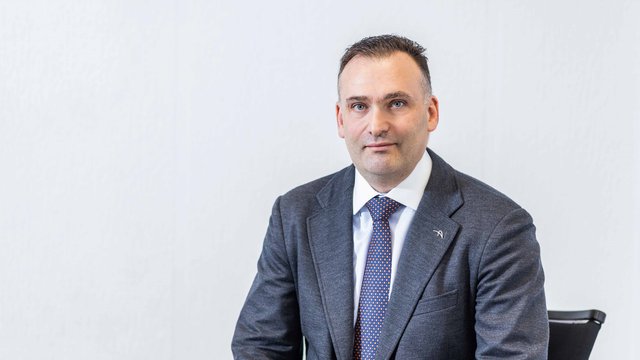
The exclusive interview with Mauro Longobardo, CEO of the Kryvyi Rih Mining and Metallurgical Plant PJSC “ArcelorMittal Kryvyi Rih” (AMKR, Dnipropetrovsk region)
(part II)
Text: Yuriy Guly
How big was the Group’s help to AMKR in 2025-2026? Is the Group going to help you in the future?
Since 2022, the Group has already injected $1.2 billion to our company for its survival. For this year, the profitability forecast is also negative: the business will likely lose at least $150 million.
It seems that we will experience these losses in Q1 because of loss of markets and energy prices which are extremely high compared to any historical period, so we couldn’t budget it. Previously, we predicted such a loss for a whole year! This picture ($150 million losses in Q1) is pretty scary. It is not what we expected. And we do not see how it all is about to improve so much.
Are you able to sell products to other markets than European ones?
In 2025, we only had three markets: US (for pig iron), EU and domestic one. The first and third markets remain but the European market is lost as of now.
The EBRD recently provided AMKR with an additional loan of up to $200 million to replenish working capital and support operations. How will this support the plants’ operations?
We are pretty happy that EBRD is continuously trying to help local businesses. I must say that it has already supported and they have been consumed. We just restructured the repayment scheme because the initial one they gave us 3 years ago was supposed to start being paid at the end of 2025. But that didn’t happen, and EBRD decided to continue helping us and they restructured it. So, we don’t have this big issue of repayment but, definitely, $200 million is not obviously enough if, in Q1, the plant has $150 million losses.
Do you plan to file for further support from EBRD?
Yes, we did it. And this $200 million support actually was confirmed at the end of the last year. So, we asked them to prolong the support that they previously provided. So, this was a result of negotiations.
When we tried to get financing from other big institutions, nobody was eager to take current risks, especially when they also observed our financial forecasts. Electricity prices are killing every possibility for us to be economically positive. Even big organizations are afraid to face such risks and help the company that cannot do anything because energy prices are not in our hands. As a result, we couldn’t get more.
Earlier, you stated that if losses continue, the ArcelorMittal Group may reconsider its presence in Ukraine. Against the backdrop of the sale of ArcelorMittal Tubular Products Iași to Metinvest B.V., does such a possibility remain for the Kryvyi Rih plant?
I can confirm that if the situation does not improve the Group will take some decisions. I do not know which decision exactly but the Group will take it for sure. You cannot forever run a money-losing business. It is not a normal situation.
Our company is a publicly listed corporation. Our shareholders will not allow that to happen. It is not a private company where an owner may take a decision to support the plant for, let’s say, 10 years. I may say that our shareholders will ask us to provide some options on how to improve the situation.
So far, the fact that Ukraine's future is looking to be positive helps a lot to keep the Group’s interest in our asset and keep its financing into our asset. This future means, as I previously mentioned, finishing the war, joining the EU and reconstruction. But these tectonic steps must be implemented indeed! If this does not happen, then we have a huge problem.
What investment plans does AMKR have? Where does the company intend to invest in the short and long term?
At the current moment, we do not have any investment plans. The strategic plan for the company is to survive, spending from $100 to $150 million per year for standard investments. By ‘standard investment’ I mean the investment which guarantees the continuity of the business at the current production rate. These are so-called survival investments.
Scrap collectors are opposing the government’s decision on a zero-quota (100% prohibition) for scrap metal exports. How much has it helped the company? How do you assess the situation?
I think that it is a good decision as the economic situation is not good. It is good to keep the resources within the country and to prevent price increase of these raw materials. This government’s decision is productive but will not change the whole situation for AMKR but it is a help.
Do you have any other options to cut costs? Maybe, to freeze or to mothball metallurgy and leave mining only? As far as ‘Interfax-Ukraine’ understands, the AMKR could not reduce costs because you are at the minimum.
Yes. The problem is that the size of our facility doesn’t allow a further size optimization without spending advanced money. For example, there are 400 km of railways inside the plant. Of course, I can reduce its length to some extent. However, if I plan to completely change its structure then I need to invest and build different types of railways which connect the existing ones and cut off ones which I had previously. Without further investments and capex upfront I cannot change the structure of my railway system.
The same is with blast furnaces. As you may know, they work with an auxiliary shop. We also have sinter plant, HPPs and other plants – all of these were constructed as a whole. We also have tens of km of gas pipelines which we must maintain. Here we read the same story: if we need to cut infrastructure that has been built for double production then I need to invest. In other words, I need to put money into making it smaller. I cannot just cut it and use half of it. The problem we have is that we cannot reduce the size in one moment.
On the contrary, if I plan to reduce production and use one blast furnace instead of two, I will lose more money because it is not proportional to the volume. Even if I use only one blast furnace, I must keep the power plant, sinter plant and all auxiliary systems operating. We are not an isolated plant, it is integral in its essence.
Of course, you might save some money by cutting personnel but you will not resolve the biggest problem. It will not become profitable if you make it smaller. The production will be profitable at least if running full with the current footprint with the proper energy price. That will be the way of making it profitable or, at least, zero.
Is there any viable scenario that AMKR can survive without a full metallurgical cycle? Will the enterprise be profitable?
The mining has always, historically, supplied iron ore to the steel plant. In 2021, 80% of the concentrate production was used by the steel plant to produce steel. This is how you properly add value to your concentrate. If you need to operate the mining at this current level (7.5 million tons of concentrate per year), you don’t have your steel production and you would like to export all of these materials, so that the majority of it will be shipped to China, according to price forecasts, your access cost to China will be higher than the price forecasted for this market.
The mining itself is also remaining profitable when it is supplying the steel plant as the main supplier. If you would like only to export it and you consider the costs of exporting (costs to the port, costs for loading and shipping overseas), all these expenses will make you uncompetitive vs. the forecast market price of concentrate. So, my answer is as follows: there are no such scenarios. Maybe, temporarily, but not in the long-term.
In the long term, the price of concentrate in China is supposed to be between $80-$90. This price is lower than the cost Ukrainian mine companies will have to export the material there. So, now the price is higher and we are still able to send but with no profit.
How is the AMKR’s management independent from the global head office in taking serious decisions?
We are not independent in serious financial decisions because we are supplied by the Group. Moreover, when we file for expenses, we are obliged to inform how this cash will be used and utilized to improve the situation. Of course, the Group has an authority to check our budget and numbers (they were able to do so when we also were profitable) because the data is consolidated within one group. Currently, the situation is much more limiting for us because we actually are not profitable enough for the survival of the facility – these resources come from the Group. That is why limitations are higher, and the decision making is not in our hands.
The next question will be dedicated to HR. For many enterprises, this is a very huge problem. You previously announced 1 000 vacancies at the plant. Has the situation with staff turnover and employment changed? What are the problems with employee reservations and how is it being resolved?
This year, reservation effectiveness is much higher. Its procedure during 2024 and 2025 was a big problem because nobody knew how it was going to be handled. In 2026, reservations will be handled properly. We have been maintaining our reservation percentage, so our workers are with us and they did not leave because of that. So we didn’t have an extra number of people leaving the company because of reservation issues during the 2025-2026 expiration and renewal of reservations. So, the reservation is not an issue for us.
Still, we do not have some professionals and, respectively, offer vacancies on the number that you mentioned. Now, if the production is lower, we close the vacancies because they were supposed to be there in order to comply with a certain business plan in terms of production. If, for example, this year the European market which was supposed to reach 1.2 million tones has transformed into 600 000 tones then we will revise the number of vacancies. The reason here is that we do not need all these personnel to produce this limited amount of production. However, professionals like electricians, locomotive drivers etc. are difficult to find. But it is not a main issue in priority right now.
What is happening in the domestic market? Why is it shrinking while the share of imports is increasing? What are your expectations for recovery and its financing?
Yes, we are pretty concerned about processes happening to the domestic market. In 2025, there were many cases of significant volumes entering the country at dumping prices from countries that anyway continue trading with the aggressor. Somehow, Turkey and China are the main tools. We are talking about our products - rebar and wire rod. We observed an increase of these imports.
There are also other troubling examples. For instance, we received market information that 2,800 tonnes of Turkish rebar were supplied to the municipal utility Kyivteploenergo at prices 30% above market levels. Even if the funds were provided by a charitable foundation to support energy infrastructure recovery, they were used very inefficiently, raising many questions. In general, importing products that can be manufactured in Ukraine is extremely harmful — it means money is effectively leaving the country, negatively affecting both the economy and the budget of our war-time state, as well as the ability of Ukrainian industries to remain operational.
We have already discussed that with the government as we cannot comprehend why the rest of the world (the US, the EU through CBAM and, by June 2026, through restarting quotas and increasing tariffs by 50% for steel products) is protecting its markets. I really hope that Ukraine will enjoy a waiver from the European Union. As everyone is protecting themselves, Ukraine, not doing so, gets too vulnerable. I am sure that we also have to protect Ukraine's domestic market. We are somehow a part of the European space: the EU provided us with a waiver and zero-level quotas. Definitely, we suffer from CBAM but in terms of quotas and tariffs we stand on the same soil. So, we should apply the same rules. If we do not, all the production volumes that used to be delivered to Europe will be stopped due to these rules. Then they will be rerouted to vulnerable countries. If Ukraine does not protect its market itself, all the volumes will come to us, especially from Turkey, the state on the other side of the Black Sea.
How do we handle that? There are some actions from our side specifically linked to stop imports of rebar and wire rod at dumping price. That is already ongoing. We also hope that the government will take into consideration the same rules that Europe will apply. In case that we get a waiver-extension about the quota and tariffs so that we will have to protect our market as they do. It would be very strange that the production would flow into Ukraine and then into Europe without protection – that doesn’t make any sense.
War insurance. The government has announced the first programs in frontline regions, but for small amounts. How likely is it that the AMKR will insure its war risks?
As for today, we do not have any war insurance. The insurance existed in 2022 in the form of overall protection of the Group’s assets in Ukraine. That year was covered because the insurance agreement was signed at the very beginning of 2022. Damages we suffered (bombings of rolling mills) somehow were covered by that insurance.
Currency restrictions and VAT refunds — how pressing are these issues for AMKR?
We do not have big issues with that. VAT is refunded on time. I want to give thanks to the Ministry of Finance, the Ministry of Economy and the Prime Minister of Ukraine for that. Automatically, we get a refund one time in three months, and they are eager to put an audit for everything. But, in some cases, there is no need for such an audit which should be originally triggered by some specific parameters. In the rest of the cases, it is just a refund. So, we are trying to ask them to refund quicker in cases where there is no need for an audit. To sum it up, they are on time. So, the VAT refund cycle is on time, too.
Do you feel Hryvnia devaluations help you anyhow?
Well, if there is more devaluation, this could help us at the current moment. However, the country is provided with a lot of US dollars, so the government is able to keep the national currency’s level. It is slowly moving, and we expect more devaluation. To be honest, we expected a dollar reaching an average of 43 Hryvnias last year, and it was reached now.
In March 2025, you called on international partners to create a joint venture with your company to develop natural mineral extraction in the region. Did this arouse interest?
We have not observed any substantial interest in any cooperation in iron ore extraction. I am aware of the fact that the spectrum of mineral resources is very wide. Much probably, the US companies are more interested in rare minerals, and iron ore is not invited to that party.
In 2025, AMKR increased its tax and fee payments to budgets at all levels by nearly 28% compared with 2024, reaching UAH 8.5 billion. What drove this increase? What are your forecasts for 2026? Can we talk about increasing or decreasing?
I think that, in 2026, there will be a tax paying decrease. The boost of 2025 was caused by our presence at the EU’s market which we were previously developing for two years. So, 2025 started giving us results. As I earlier stated, we sold to the European Union 920 000 tons – it’s a very big number! This year, we believe this volume will be halved. In Q1, there was zero delivery, so I’ve lost 25%. In Q2, so far, we did not receive any orders. The most positive situation will be when we could sell half of last year’s volumes. As a result, tax paying cannot remain the same as we are not able to replace missing orders (volumes). And that is a big issue.
Actually, Europe opened its doors to replace all the markets which we have lost. Now, if they take this market from us, we cannot go back to old markets I’ve already lost. They are gone! Europe has already become a replacement of markets that we have had before. We lost them because of lack of competitiveness in many dimensions, difficulties in logistics and so on. The EU compensated them, despite the efforts that we have to make to get it. So, we cannot replace the lost volume.
The only solution is the domestic market exploding because the war finishes causing excessive reconstruction and rebuilding. However, it cannot replace 1 million tons of European volumes.
What is your opinion on Ukraine? Will our country win? Do you, theoretically, consider any other scenario?
I will try to be very straightforward: I do not see the future of Ukraine’s economy in the context of war. With hostilities on the same level and with continuous attack on the infrastructure, I do not see any development.
Just compare the numbers of the state's GDP. Some incorrectly compare it to pre-war 2021 $200 billion GDP with only 6% linked to the defense and security sector (now, it takes about 43 % of GDP). If we take into consideration the rest of the economy, excluding defense, and compare GDP of 2021 and 2025, we may observe a 40% fall. In other words, the GDP is down 40% for the same industries!
I’m aware that new industries are being born. But the rest of the industry, including metallurgy, is declining. For instance, prior to the war, the production of steel in Ukraine reached 20-24 million tons per year. As for now, less than 10 million. Obviously, it caused a negative effect on the GDP.
So, I do not see how all this will change or dramatically improve if the war will not finish. I observe that the competitiveness of all steel companies is permanently and slowly declining. The war should be stopped. If that doesn’t happen, everything will be very difficult. Not only my industry is dramatically affected by the electricity prices. If the average country’s electricity capacity falls from 11 GW to 7,9 GW which is the current capacity of a nuclear power plant, so we already remain only with that. Previously, there was 14 GW, with the Enerhodar power plant. The main difference between 11 GW and 7,9 GW is the additional input of solar, wind, and water. Power plants are still operating. But it is practically nothing. Electricity imports may reach 2.5 GW but it is lower than the consumption. We cannot be confused that declining consumption is a good approach. No, it is not good because when Ukraine consumes 11 GW it means that its economy is almost dead. Previously, the country consumed 20-24 GW! To produce more, the economy should consume more energy. This is why I don’t see the future positive for the business itself if the war is not finished.
And this is a big problem when I meet with the Group and try to justify helping AMKR because ‘good news are coming’. But my colleagues are also reading newspapers, and they ask me: ‘When exactly will this news come?’. One year? Two years? Three years? It costs a lot.
However, I remain positive. My job is to convince the Group to go on supporting and believing in Ukraine. My job is also to push governmental authorities of Ukraine to consider our problems. Not just to listen and forget about them. Because this is how it looks to be: we are discussing the same topic during one year. There is no real big advance, especially on electricity. Some other steps were made: scrap, VAT, mobilization. Unfortunately, this positive is, economically speaking, very tiny and brings a very small effect. But the big problem has to be taken into consideration.
If the government prefers to give all support to energy and defense sectors, well, it is fine but the effect will last short because there will not be any industrial consumers for this energy. The authorities should balance these interests but I do not see any real willingness or decision to balance two sectors.
Thank you for the interview! And may the war end sooner on our terms!
“ArcelorMittal Kryvyi Rih” is the largest producer of rolled steel in Ukraine. The company specializes in long steel products, in particular rebar and wire rod. The enterprise has a full production cycle, with production capacities designed to produce more than 6 million tonnes of steel annually, over 5 million tonnes of rolled products, and more than 5.5 million tonnes of pig iron.
ArcelorMittal owns the largest mining and metallurgical plant in Ukraine, “ArcelorMittal Kryvyi Rih,” as well as a number of smaller companies, including PJSC “ArcelorMittal Beryslav.”