You can help expand this article with text translated from the corresponding article in Polish. (April 2020) Click [show] for important translation instructions.
|


| Blasisaurus | |
|---|---|
| 👁 Image | |
| Skull fossils | |
| Scientific classification 👁 Edit this classification | |
| Kingdom: | Animalia |
| Phylum: | Chordata |
| Class: | Reptilia |
| Clade: | Dinosauria |
| Clade: | †Ornithischia |
| Clade: | †Ornithopoda |
| Family: | †Hadrosauridae |
| Subfamily: | †Lambeosaurinae |
| Tribe: | †Arenysaurini |
| Genus: | † Cruzado-Caballero et al., 2010 |
| Type species | |
| †Blasisaurus canudoi Cruzado-Caballero et al., 2010
| |

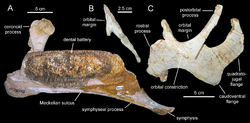

Blasisaurus is a genus of lambeosaurine hadrosaurid dinosaur from the Late Cretaceous. It is known from a partial skull and skeleton found in late Maastrichtian-age rocks of Spain.[1] The type species is Blasisaurus canudoi, described in 2010 by Penélope Cruzado-Caballero, Xabier Pereda-Suberbiola and José Ignacio Ruiz-Omeñaca, a group of researchers from Spain.
Naming and discovery
[edit]The generic name refers to the Blasi 1 site where the fossil was found. The specific epithet honours paleontologist José Ignacio Canudo.[1] The holotype, MPZ99/667, is housed in Huesca. It was found in a layer of the Arén Formation dating from the upper Maastrichtian, about 66 million years ago.[1] It consists of a skull with fragmentary lower jaws.[1]
Description
[edit]

Blasisaurus was a medium-sized ornithopod. Its describers identified two distinct features: the cheekbone has a rear projection with a hook-shaped upper edge and the lower temporal fenestra is narrow and D-shaped.[1] From the same formation is Arenysaurus, a related species. They are distinguished by the shape of the teeth and missing secondary ridges. Blasisaurus also differs from Koutalisaurus by a downward bent front edge of the lower jaw.[1]
Phylogeny
[edit]

Blasisaurus' discoverers performed an exact cladistic analysis to determine its phylogenetic position, which placed it as the sister taxon to Arenysaurus.[1] Together they form a tribe, the Arenysaurini, that is more derived than Tsintaosaurus and Jaxartosaurus.[1] Blasisaurus confirmed the hypothesis that, in the Late Cretaceous, different hadrosaurids from Asia and Europe migrated across land bridges.[1] Where in Lambeosaurinae Blasisaurus and Arenysaurus belong is disputed. Some put them in the tribe Lambeosaurini[2] at the base of the lambeosaurin-parasaurolophin split,[1] some in Parasaurolophini.[3] Below is the most recent cladogram including Blasisaurus and Arenysaurus, published by Penélope Cruzado-Caballero et al. in 2013:[3]
See also
[edit]
References
[edit]- ^ a b c d e f g h i j Cruzado-Caballero, Penélope; Xabier Pereda-Suberbiola; José Ignacio Ruiz-Omeñaca (2010). "Blasisaurus canudoi gen. et sp. nov., a new lambeosaurine dinosaur (Hadrosauridae) from the Latest Cretaceous of Arén (Huesca, Spain)". Canadian Journal of Earth Sciences. 47 (12): 1507–1517. Bibcode:2010CaJES..47.1507S. doi:10.1139/E10-081.[permanent dead link]
- ^ Prieto-Márquez, A.; Dalla Vecchia, F. M.; Gaete, R.; Galobart, À. (2013). Dodson, Peter (ed.). "Diversity, Relationships, and Biogeography of the Lambeosaurine Dinosaurs from the European Archipelago, with Description of the New Aralosaurin Canardia garonnensis". PLOS ONE. 8 (7) e69835. Bibcode:2013PLoSO...869835P. doi:10.1371/journal.pone.0069835. PMC 3724916. PMID 23922815.
- ^ a b Cruzado-Caballero, P. L.; Canudo, J. I.; Moreno-Azanza, M.; Ruiz-Omeñaca, J. I. (2013). "New material and phylogenetic position of Arenysaurus ardevoli, a lambeosaurine dinosaur from the late Maastrichtian of Arén (northern Spain)". Journal of Vertebrate Paleontology. 33 (6): 1367–1384. Bibcode:2013JVPal..33.1367C. doi:10.1080/02724634.2013.772061. S2CID 86453373.