
| Jeyawati | |
|---|---|
| 👁 Image | |
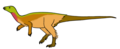
| Reconstruction | |
| Scientific classification 👁 Edit this classification | |
| Kingdom: | Animalia |
| Phylum: | Chordata |
| Class: | Reptilia |
| Clade: | Dinosauria |
| Clade: | †Ornithischia |
| Clade: | †Ornithopoda |
| Superfamily: | †Hadrosauroidea |
| Genus: | † McDonald, Wolfe & Kirkland, 2010 |
| Type species | |
| Jeyawati rugoculus McDonald, Wolfe & Kirkland, 2010
| |


Jeyawati (meaning "grinding mouth" in the Zuni language) is a genus of hadrosauroid dinosaur which lived during the Turonian stage of the Late Cretaceous. The type species, J. rugoculus, was described in 2010, based on fossils recovered in the U.S. state of New Mexico. The holotype, MSM P4166, was discovered in the Moreno Hill Formation.[2]
Classification
[edit]A cladistic analysis indicates that Jeyawati was more plesiomorphic (ancestral) than Shuangmiaosaurus, Telmatosaurus, and Bactrosaurus, but more derived (less like the common ancestor) than Eolambia, Probactrosaurus, and Protohadros.[2]
In the description of Eotrachodon, it was placed inside a clade as a sister taxa to a smaller clade with Eolambia and Protohadros.[3]
|
References
[edit]


Wikimedia Commons has media related to Jeyawati.


Wikispecies has information related to Jeyawati.
- ^ Cilliers, Charl D.; Tucker, Ryan T.; Crowley, James L.; Zanno, Lindsay E. (2021). "Age constraint for the Moreno Hill Formation (Zuni Basin) by CA-TIMS and LA-ICP-MS detrital zircon geochronology". PeerJ. 9. e10948. doi:10.7717/peerj.10948. PMC 7953880. PMID 33854833.
- ^ a b McDonald Andrew T.; Wolfe, Douglas G. and Kirkland, James I. (2010). "A new basal hadrosauroid (Dinosauria: Ornithopoda) from the Turonian of New Mexico". Journal of Vertebrate Paleontology. 30(3): 799–812.
- ^ Prieto-Marquez, Albert; Erickson, Gregory M.; Ebersole, Jun A. (2016). "A primitive hadrosaurid from southeastern North America and the origin and early evolution of 'duck-billed' dinosaurs". Journal of Vertebrate Paleontology. 36 (2) e1054495. Bibcode:2016JVPal..36E4495P. doi:10.1080/02724634.2015.1054495. S2CID 86032549.







Retrieved from "https://en.wikipedia.org/w/index.php?title=Jeyawati&oldid=1346943198"