| Cheiracanthus Temporal range: Middle Devonian
| |
|---|---|
| 👁 Image | |
| Fossil of Cheiracanthus latus at the London Natural History Museum | |
| Scientific classification 👁 Edit this classification | |
| Kingdom: | Animalia |
| Phylum: | Chordata |
| Class: | Chondrichthyes |
| Subclass: | †Acanthodii |
| Order: | †Acanthodiformes |
| Family: | †Cheiracanthidae |
| Genus: | † Agassiz, 1835 |
| Type species | |
| † Cheiracanthus murchisoni | |


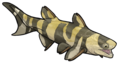
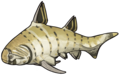
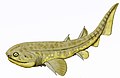
Cheiracanthus (from Greek: χείρ kheír, 'hand' and Greek: ἄκανθα akantha, 'spine')[1] is an extinct genus of a group of fish called Acanthodii (or "spiny sharks").[2] It was a deep-bodied acanthodian about 12 in. (30 cm) in length. It had a blunt head, upturned tail, and fins protected by spines. Unlike many other acanthodians, it had one, solitary dorsal fin. Cheiracanthus swam at mid-depth in lakes and rivers, seizing small prey in its gaping jaws. Whole fossils of this fish occur only in Mid-Devonian rocks in Scotland, but its distinctive small, ornamented scales crop up around the world, as far south as Antarctica.


See also
[edit]References
[edit]- ^ Roberts, George (1839). An etymological and explanatory dictionary of the terms and language of geology. London: Longman, Orme, Brown, Green, & Longmans. p. 29. Retrieved 29 December 2021.
- ^ Burrow, Carole; Blaauwen, Jan den; Newman, Michael (2020-04-01). "A redescription of the three longest-known species of the acanthodian Cheiracanthus from the Middle Devonian of Scotland". Palaeontologia Electronica. 23 (1): 1–43. doi:10.26879/1035. ISSN 1094-8074.