
| Saivodus | |
|---|---|
| 👁 Image | |
| Preserved cranial material of S. striatus found at Mammoth Cave | |
| Scientific classification 👁 Edit this classification | |
| Kingdom: | Animalia |
| Phylum: | Chordata |
| Class: | Chondrichthyes |
| Subclass: | Elasmobranchii |
| Order: | †Ctenacanthiformes |
| Genus: | † Duffin & Ginter, 2006 |
| Species: | †S. striatus
|
| Binomial name | |
| †Saivodus striatus Agassiz, 1843
| |
| Synonyms | |
| |
.jpg)


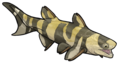
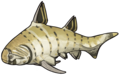
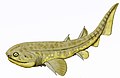
Saivodus is an extinct genus of ctenacanthiform fish that existed during the Carboniferous and Permian periods.[1] Fossils have been found in Ireland, Scotland, England, Belgium, Morocco, and the United States.[2]
Taxonomy
[edit]Saivodus was erected in 2006. The single species belonging to this genus was formerly included in the unrelated genus Cladodus.[1]
Description
[edit]Saivodus is the largest known member of its group measuring 4–5 metres (13–16 ft) or more in total body length, possibly even up to 6–7 metres (20–23 ft), based on individual teeth about 3 centimetres (1.2 in) or more in length.[3][4] The shape of the teeth suggest it targeted soft-bodied prey.[5]
.jpg)


References
[edit]- ^ a b Duffin, C.J.; Ginter, M. (2006). "Comments on the selachian genus Cladodus Agassiz, 1843". Journal of Vertebrate Paleontology. 26 (2): 253–266. doi:10.1671/0272-4634(2006)26[253:COTSGC]2.0.CO;2.
- ^ Hodnett, John-Paul M.; Elliott, David K.; Olson, Tom J.; Wittke, James H. (2012). "Ctenacanthiform sharks from the Permian Kaibab Formation, northern Arizona". Historical Biology. 24 (4): 381–395. doi:10.1080/08912963.2012.683193. ISSN 0891-2963. S2CID 85332499.
- ^ Hodnett, J.-P.M.; Tweet, J.S.; Santucci, V.L. (2022). "The occurrence of fossil cartilaginous fishes (Chondrichthyes) within the parks and monuments of the National Park Service". New Mexico Museum of Natural History and Science Bulletin. 90: 183–208.
- ^ Engelman, Russell K. (2023). "A Devonian Fish Tale: A New Method of Body Length Estimation Suggests Much Smaller Sizes for Dunkleosteus terrelli (Placodermi: Arthrodira)". Diversity. 15 (3): 318. doi:10.3390/d15030318. ISSN 1424-2818.
- ^ Katz, B. (February 4, 2020). "Jaw of 330-Million-Year-Old Shark Discovered in Kentucky Cave".
External links
[edit]







Retrieved from "https://en.wikipedia.org/w/index.php?title=Saivodus&oldid=1318659730"