


Frizzled-9 (Fz-9) is a protein that in humans is encoded by the FZD9 gene.[5][6][7] Fz-9 has also been designated as CD349 (cluster of differentiation 349).
Function
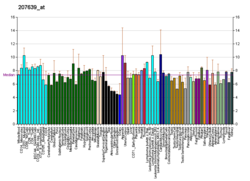
[edit]Members of the 'frizzled' gene family encode 7-transmembrane domain proteins that are receptors for Wnt signaling proteins. The FZD9 gene is located within the Williams syndrome common deletion region of chromosome 7, and heterozygous deletion of the FZD9 gene may contribute to the Williams syndrome phenotype. FZD9 is expressed predominantly in brain, testis, eye, skeletal muscle, and kidney.[7]
References
[edit]- ^ a b c GRCh38: Ensembl release 89: ENSG00000188763 – Ensembl, May 2017
- ^ a b c GRCm38: Ensembl release 89: ENSMUSG00000049551 – Ensembl, May 2017
- ^ "Human PubMed Reference:". National Center for Biotechnology Information, U.S. National Library of Medicine.
- ^ "Mouse PubMed Reference:". National Center for Biotechnology Information, U.S. National Library of Medicine.
- ^ Wang YK, Samos CH, Peoples R, Pérez-Jurado LA, Nusse R, Francke U (Mar 1997). "A novel human homologue of the Drosophila frizzled wnt receptor gene binds wingless protein and is in the Williams syndrome deletion at 7q11.23". Human Molecular Genetics. 6 (3): 465–72. doi:10.1093/hmg/6.3.465. PMID 9147651.
- ^ Wang YK, Spörle R, Paperna T, Schughart K, Francke U (Apr 1999). "Characterization and expression pattern of the frizzled gene Fzd9, the mouse homolog of FZD9 which is deleted in Williams-Beuren syndrome". Genomics. 57 (2): 235–48. doi:10.1006/geno.1999.5773. PMID 10198163.
- ^ a b "Entrez Gene: FZD9 frizzled homolog 9 (Drosophila)".
Further reading
[edit]- Datta DV (May 1977). "Viral hepatitis (Chandigarh study)". The Journal of the Association of Physicians of India. 25 (5): 325–30. PMID 914765.
- Finch PW, He X, Kelley MJ, Uren A, Schaudies RP, Popescu NC, Rudikoff S, Aaronson SA, Varmus HE, Rubin JS (Jun 1997). "Purification and molecular cloning of a secreted, Frizzled-related antagonist of Wnt action". Proceedings of the National Academy of Sciences of the United States of America. 94 (13): 6770–5. Bibcode:1997PNAS...94.6770F. doi:10.1073/pnas.94.13.6770. PMC 21233. PMID 9192640.
- Tanaka S, Akiyoshi T, Mori M, Wands JR, Sugimachi K (Aug 1998). "A novel frizzled gene identified in human esophageal carcinoma mediates APC/beta-catenin signals". Proceedings of the National Academy of Sciences of the United States of America. 95 (17): 10164–9. Bibcode:1998PNAS...9510164T. doi:10.1073/pnas.95.17.10164. PMC 21479. PMID 9707618.
- Karasawa T, Yokokura H, Kitajewski J, Lombroso PJ (Oct 2002). "Frizzled-9 is activated by Wnt-2 and functions in Wnt/beta -catenin signaling". The Journal of Biological Chemistry. 277 (40): 37479–86. doi:10.1074/jbc.M205658200. PMID 12138115.
- Omoto S, Hayashi T, Kitahara K, Takeuchi T, Ueoka Y (Jun 2004). "Autosomal dominant familial exudative vitreoretinopathy in two Japanese families with FZD4 mutations (H69Y and C181R)". Ophthalmic Genetics. 25 (2): 81–90. doi:10.1080/13816810490514270. PMID 15370539. S2CID 32817238.
- Winn RA, Marek L, Han SY, Rodriguez K, Rodriguez N, Hammond M, Van Scoyk M, Acosta H, Mirus J, Barry N, Bren-Mattison Y, Van Raay TJ, Nemenoff RA, Heasley LE (May 2005). "Restoration of Wnt-7a expression reverses non-small cell lung cancer cellular transformation through frizzled-9-mediated growth inhibition and promotion of cell differentiation". The Journal of Biological Chemistry. 280 (20): 19625–34. doi:10.1074/jbc.M409392200. PMID 15705594.
- Rual JF, Venkatesan K, Hao T, Hirozane-Kishikawa T, Dricot A, Li N, Berriz GF, Gibbons FD, Dreze M, Ayivi-Guedehoussou N, Klitgord N, Simon C, Boxem M, Milstein S, Rosenberg J, Goldberg DS, Zhang LV, Wong SL, Franklin G, Li S, Albala JS, Lim J, Fraughton C, Llamosas E, Cevik S, Bex C, Lamesch P, Sikorski RS, Vandenhaute J, Zoghbi HY, Smolyar A, Bosak S, Sequerra R, Doucette-Stamm L, Cusick ME, Hill DE, Roth FP, Vidal M (Oct 2005). "Towards a proteome-scale map of the human protein-protein interaction network". Nature. 437 (7062): 1173–8. Bibcode:2005Natur.437.1173R. doi:10.1038/nature04209. PMID 16189514. S2CID 4427026.
- Winn RA, Van Scoyk M, Hammond M, Rodriguez K, Crossno JT, Heasley LE, Nemenoff RA (Sep 2006). "Antitumorigenic effect of Wnt 7a and Fzd 9 in non-small cell lung cancer cells is mediated through ERK-5-dependent activation of peroxisome proliferator-activated receptor gamma". The Journal of Biological Chemistry. 281 (37): 26943–50. doi:10.1074/jbc.M604145200. PMID 16835228.
External links
[edit]- "Frizzled Receptors: FZD9". IUPHAR Database of Receptors and Ion Channels. International Union of Basic and Clinical Pharmacology. Archived from the original on 2012-03-19. Retrieved 2008-12-04.
- FZD9+protein,+human at the U.S. National Library of Medicine Medical Subject Headings (MeSH)


This article incorporates text from the United States National Library of Medicine, which is in the public domain.


