
This article's lead section may be too short to adequately summarize the key points. Please consider expanding the lead to provide an accessible overview of all important aspects of the article. (August 2024) |


| Discovery | |
|---|---|
| Discovered by | Kepler spacecraft |
| Discovery date | 2017[1] |
| Transit | |
| Designations | |
| KOI-3138.01 | |
| Orbital characteristics | |
| 0.0514 ± 0.0028 AU | |
| 8.689099 ± 0.000025 d | |
| Inclination | 89.150 |
| Star | Kepler-1649 |
| Physical characteristics | |
| 1.017 ± 0.051 R🜨 | |
| Mass | 1.03 M🜨 |
Kepler-1649b is an exoplanet orbiting the red dwarf star Kepler-1649, discovered in 2017.[2] It is similar to Venus,[3][4] but in the past it was thought to be a candidate for habitability.[5]
Host star
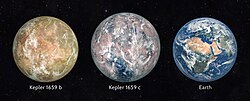
[edit]Kepler-1649 is a type-M red dwarf star estimated to be roughly ¼ the radius of the Sun [6] with only two confirmed planets in its orbit, the other being Kepler-1649c.[7] Kepler-1649c is similar to Earth from our own solar system in two ways: both Kepler-1649c and Earth have orbits roughly twice the radius of the previous known planets (Kepler-1649b and Venus respectively), and they are of similar size.
Orbit
[edit]Kepler-1649b takes only 8.6 Earth days to orbit Kepler-1649.

References
[edit]- ^ Angelo, Isabel; Rowe, Jason F.; Howell, Steve B.; Quintana, Elisa V.; Still, Martin; Mann, Andrew W.; Burningham, Ben; Barclay, Thomas; Ciardi, David R.; Huber, Daniel; Kane, Stephen R. (2017-04-01). "Kepler-1649b: An Exo-Venus in the Solar Neighborhood". The Astronomical Journal. 153 (4): 162. arXiv:1704.03136. Bibcode:2017AJ....153..162A. doi:10.3847/1538-3881/aa615f. ISSN 0004-6256.
- ^ "Exoplanet-catalog". Exoplanet Exploration: Planets Beyond our Solar System. 2 May 2017. Retrieved 2020-04-16.
- ^ "Possible Venus Twin Discovered Around Dim Star". SETI Institute. Archived from the original on 2020-07-01. Retrieved 2025-05-06.
- ^ Angelo, Isabel; Rowe, Jason F.; Howell, Steve B. (November 2015). "An Exo-Venus Around a Cool, Nearby Star". AAS/Division for Planetary Sciences Meeting Abstracts #47. 47: 417.03. Bibcode:2015DPS....4741703A.
- ^ Kane, Stephen R.; Hill, Michelle L.; Kasting, James F.; Kopparapu, Ravi Kumar; Quintana, Elisa V.; Barclay, Thomas; Batalha, Natalie M.; Borucki, William J.; Ciardi, David R.; Haghighipour, Nader; Hinkel, Natalie R.; Kaltenegger, Lisa; Selsis, Franck; Torres, Guillermo (2016-10-10). "A Catalog of Kepler Habitable Zone Exoplanet Candidates". The Astrophysical Journal. 830 (1): 1. arXiv:1608.00620. Bibcode:2016ApJ...830....1K. doi:10.3847/0004-637X/830/1/1. ISSN 0004-637X.
- ^ McDonald, Rebecca (April 15, 2020). "Dedicated Team of Scientists Discover Habitable-Zone Earth-Size Planet in Kepler Data". Seti Institute. Archived from the original on July 1, 2020. Retrieved April 17, 2020.
- ^ "Exoplanet-catalog". Exoplanet Exploration: Planets Beyond our Solar System. 2 May 2017. Retrieved 2020-04-16.