


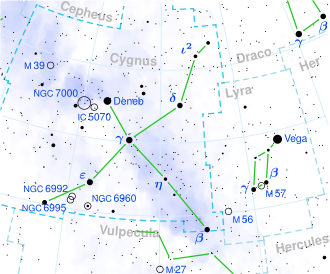

17 Cygni is the Flamsteed designation for a multiple star system[5] in the northern constellation of Cygnus. It has an apparent visual magnitude of 5.00,[2] so, according to the Bortle scale, it is visible from suburban skies at night. Measurements of the annual parallax find a shift of 0.0477″,[1] which is equivalent to a distance of around 68.5 ly (21.0 pc) from the Sun. It has a relatively high proper motion, traversing the celestial sphere at the rate of 0.451″/year.[14]
This system consists of two visual binary systems that were discovered by John Herschel in the 1820s. Components A and B form a bright, wide pair with an angular separation of 26.0 arcsecond and an estimated orbital period of ~6,200 years. The faint, close system consists of components F and G with a separation of 2.6 arcsecond and a period of 238 years. The two binaries form a hierarchical system with a separation of about 800 arcseconds and orbital period of 3.7 million years or more.[5] Although the CCDM lists four other companions, these are not associated with the system.[15]
The stellar classification of the primary star, component A, is F7 V,[2] which means it is a main sequence star like the Sun. The star has 1.24[8] times the mass of the Sun and 1.54[9] times the Sun's radius. It is some 2.8[7] billion years old and shines with 3.66[10] times the Sun's luminosity. The effective temperature of the stellar atmosphere is 6,455[10] K, giving it the yellow-white hued glow of an F-type star.[16]
References
[edit]- ^ a b c d e Vallenari, A.; et al. (Gaia collaboration) (2023). "Gaia Data Release 3. Summary of the content and survey properties". Astronomy and Astrophysics. 674: A1. arXiv:2208.00211. Bibcode:2023A&A...674A...1G. doi:10.1051/0004-6361/202243940. S2CID 244398875. Gaia DR3 record for this source at VizieR.
- ^ a b c d e f Takeda, Yoichi; et al. (February 2005), "High-Dispersion Spectra Collection of Nearby F--K Stars at Okayama Astrophysical Observatory: A Basis for Spectroscopic Abundance Standards", Publications of the Astronomical Society of Japan, 57 (1): 13–25, Bibcode:2005PASJ...57...13T, doi:10.1093/pasj/57.1.13.
- ^ a b c d Vallenari, A.; et al. (Gaia collaboration) (2023). "Gaia Data Release 3. Summary of the content and survey properties". Astronomy and Astrophysics. 674: A1. arXiv:2208.00211. Bibcode:2023A&A...674A...1G. doi:10.1051/0004-6361/202243940. S2CID 244398875. Gaia DR3 record for this source at VizieR.
- ^ Lasker, Barry M.; Lattanzi, Mario G.; McLean, Brian J.; Bucciarelli, Beatrice; Drimmel, Ronald; Garcia, Jorge; Greene, Gretchen; Guglielmetti, Fabrizia; Hanley, Christopher; Hawkins, George; Laidler, Victoria G.; Loomis, Charles; Meakes, Michael; Mignani, Roberto; Morbidelli, Roberto; Morrison, Jane; Pannunzio, Renato; Rosenberg, Amy; Sarasso, Maria; Smart, Richard L.; Spagna, Alessandro; Sturch, Conrad R.; Volpicelli, Antonio; White, Richard L.; Wolfe, David; Zacchei, Andrea (2008). "The Second-Generation Guide Star Catalog: Description and Properties". The Astronomical Journal. 136 (2): 735. arXiv:0807.2522. Bibcode:2008AJ....136..735L. doi:10.1088/0004-6256/136/2/735.
- ^ a b c Romanenko, L. G. (March 2017), "A dynamical study of the multiple system 17 Cygni ABFG", Astronomy Reports, 61 (3): 206–220, Bibcode:2017ARep...61..206R, doi:10.1134/S1063772917020056, S2CID 255199959.
- ^ a b Nordström, B.; et al. (May 2004), "The Geneva-Copenhagen survey of the Solar neighbourhood. Ages, metallicities, and kinematic properties of ˜14,000 F and G dwarfs", Astronomy and Astrophysics, 418 (3): 989–1019, arXiv:astro-ph/0405198, Bibcode:2004A&A...418..989N, doi:10.1051/0004-6361:20035959, S2CID 11027621.
- ^ a b c d Holmberg, J.; et al. (July 2009), "The Geneva-Copenhagen survey of the solar neighbourhood. III. Improved distances, ages, and kinematics", Astronomy and Astrophysics, 501 (3): 941–947, arXiv:0811.3982, Bibcode:2009A&A...501..941H, doi:10.1051/0004-6361/200811191, S2CID 118577511.
- ^ a b Halbwachs, J. -L; et al. (2018), "Multiplicity among solar-type stars. IV. The CORAVEL radial velocities and the spectroscopic orbits of nearby K dwarfs", Astronomy and Astrophysics, 619: A81, arXiv:1808.04605, Bibcode:2018A&A...619A..81H, doi:10.1051/0004-6361/201833377, S2CID 119437322.
- ^ a b Schofield, Mathew; et al. (2019), "The Asteroseismic Target List for Solar-like Oscillators Observed in 2 minute Cadence with the Transiting Exoplanet Survey Satellite", The Astrophysical Journal Supplement Series, 241 (1): 12, arXiv:1901.10148, Bibcode:2019ApJS..241...12S, doi:10.3847/1538-4365/ab04f5, S2CID 119481586.
- ^ a b c d e f Takeda, Yoichi (April 2007), "Fundamental Parameters and Elemental Abundances of 160 F-G-K Stars Based on OAO Spectrum Database", Publications of the Astronomical Society of Japan, 59 (2): 335–356, Bibcode:2007PASJ...59..335T, doi:10.1093/pasj/59.2.335.
- ^ a b c d e f g h i j k l m n o Stassun, Keivan G.; et al. (2019). "The Revised TESS Input Catalog and Candidate Target List". The Astronomical Journal. 158 (4): 138. arXiv:1905.10694. Bibcode:2019AJ....158..138S. doi:10.3847/1538-3881/ab3467.
- ^ a b Sissa, E.; Gratton, R.; Desidera, S.; Martinez Fiorenzano, A. F.; Bonfanti, A.; Carolo, E.; Vassallo, D.; Claudi, R. U.; Endl, M.; Cosentino, R. (2016). "Hα-activity and ages for stars in the SARG survey". Astronomy and Astrophysics. 596. arXiv:1609.04660. Bibcode:2016A&A...596A..76S. doi:10.1051/0004-6361/201628531.
- ^ "* 17 Cyg". SIMBAD. Centre de données astronomiques de Strasbourg. Retrieved 2013-10-26.
- ^ Lépine, Sébastien; Shara, Michael M. (March 2005), "A Catalog of Northern Stars with Annual Proper Motions Larger than 0.15" (LSPM-NORTH Catalog)", The Astronomical Journal, 129 (3): 1483–1522, arXiv:astro-ph/0412070, Bibcode:2005AJ....129.1483L, doi:10.1086/427854, S2CID 2603568.
- ^ Phillips, N. M.; et al. (April 2010), "Target selection for the SUNS and DEBRIS surveys for debris discs in the solar neighbourhood", Monthly Notices of the Royal Astronomical Society, 403 (3): 1089–1101, arXiv:0911.3426, Bibcode:2010MNRAS.403.1089P, doi:10.1111/j.1365-2966.2009.15641.x, S2CID 119262858. See the note for F094.
- ^ "The Colour of Stars", Australia Telescope, Outreach and Education, Commonwealth Scientific and Industrial Research Organisation, December 21, 2004, archived from the original on March 18, 2012, retrieved 2012-01-16.