
| Observation data Epoch J2000.0 Equinox J2000.0 (ICRS) | |
|---|---|
| Constellation | Cygnus[1] |
| Right ascension | 20h 31m 18.81655s[2] |
| Declination | +49° 13′ 13.0638″[2] |
| Apparent magnitude (V) | 5.5292±0.0013[3] |
| Characteristics | |
| Evolutionary stage | AGB[4] |
| Spectral type | M2 III[4] |
| Astrometry | |
| Radial velocity (Rv) | −64.15±0.20[3] km/s |
| Proper motion (μ) | RA: +8.959[2] mas/yr Dec.: −32.092[2] mas/yr |
| Parallax (π) | 7.1833±0.0675 mas[2] |
| Distance | 454 ± 4 ly (139 ± 1 pc) |
| Absolute magnitude (MV) | +0.00[1] |
| Details | |
| Mass | 1.4[5] M☉ |
| Radius | 45[6] R☉ |
| Luminosity | 398[6] L☉ |
| Surface gravity (log g) | 2.02[5] cgs |
| Temperature | 3,920[5] K |
| Metallicity [Fe/H] | −0.10[5] dex |
| Other designations | |
| ω2 Cyg, 46 Cygni, BD+48°3154, HD 195774, HIP 101243, HR 7851, SAO 49741.[7] | |
| Database references | |
| SIMBAD | data |

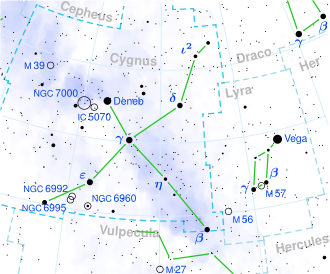

Omega2 Cygni, Latinized from ω2 Cygni, is the Bayer designation for a solitary[8] star in the northern constellation of Cygnus. It has an apparent visual magnitude of 5.5,[3] which is faintly visible to the naked eye on a dark night. Based upon an annual parallax shift of 7.18 mas,[2] it is located roughly 454 light years from the Sun. At that distance, the visual magnitude is diminished by an extinction factor of 0.08 due to interstellar dust.[3]
This is a red giant star on the asymptotic giant branch, with a stellar classification of M2 III.[4] It is a suspected variable star, although the evidence is considered "doubtful or erroneous". If it does exist, the variability is small with an amplitude of 0.05 magnitude and a timescale of around 30 days.[9] There is a 58.3% chance that this star is a member of the Hercules stream.[3]
References
[edit]- ^ a b Anderson, E.; Francis, Ch. (2012). "XHIP: An extended hipparcos compilation". Astronomy Letters. 38 (5): 331. arXiv:1108.4971. Bibcode:2012AstL...38..331A. doi:10.1134/S1063773712050015. XHIP record for this object at VizieR.
- ^ a b c d e f Vallenari, A.; et al. (Gaia collaboration) (2023). "Gaia Data Release 3. Summary of the content and survey properties". Astronomy and Astrophysics. 674: A1. arXiv:2208.00211. Bibcode:2023A&A...674A...1G. doi:10.1051/0004-6361/202243940. S2CID 244398875. Gaia DR3 record for this source at VizieR.
- ^ a b c d e Famaey, B.; et al. (January 2005). "Local kinematics of K and M giants from CORAVEL/Hipparcos/Tycho-2 data. Revisiting the concept of superclusters". Astronomy and Astrophysics. 430 (1): 165–186. arXiv:astro-ph/0409579. Bibcode:2005A&A...430..165F. doi:10.1051/0004-6361:20041272. S2CID 17804304.
- ^ a b c Eggen, Olin J. (July 1992). "Asymptotic giant branch stars near the sun". Astronomical Journal. 104 (1): 275–313. Bibcode:1992AJ....104..275E. doi:10.1086/116239.
- ^ a b c d Khalatyan, A.; Anders, F.; Chiappini, C.; Queiroz, A. B. A.; Nepal, S.; Dal Ponte, M.; Jordi, C.; Guiglion, G.; Valentini, M.; Torralba Elipe, G.; Steinmetz, M.; Pantaleoni-González, M.; Malhotra, S.; Jiménez-Arranz, Ó.; Enke, H.; Casamiquela, L.; Ardèvol, J. (2024). "Transferring spectroscopic stellar labels to 217 million Gaia DR3 XP stars with SHBoost". Astronomy and Astrophysics. 691: A98. arXiv:2407.06963. Bibcode:2024A&A...691A..98K. doi:10.1051/0004-6361/202451427.
- ^ a b Fetherolf, Tara; Pepper, Joshua; Simpson, Emilie; Kane, Stephen R.; Močnik, Teo; English, John Edward; Antoci, Victoria; Huber, Daniel; Jenkins, Jon M.; Stassun, Keivan; Twicken, Joseph D.; Vanderspek, Roland; Winn, Joshua N. (2023). "Variability Catalog of Stars Observed during the TESS Prime Mission". The Astrophysical Journal Supplement Series. 268 (1): 4. arXiv:2208.11721. Bibcode:2023ApJS..268....4F. doi:10.3847/1538-4365/acdee5.
- ^ "ome02 Cyg". SIMBAD. Centre de données astronomiques de Strasbourg. Retrieved 2017-02-22.
- ^ Eggleton, P. P.; Tokovinin, A. A. (September 2008). "A catalogue of multiplicity among bright stellar systems". Monthly Notices of the Royal Astronomical Society. 389 (2): 869–879. arXiv:0806.2878. Bibcode:2008MNRAS.389..869E. doi:10.1111/j.1365-2966.2008.13596.x. S2CID 14878976.
- ^ Percy, John R.; Fleming, David E. B. (February 1992). "A photometric survey of suspected small-amplitude red variables". Publications of the Astronomical Society of the Pacific. 104: 96–100. Bibcode:1992PASP..104...96P. doi:10.1086/132963.