


This is a list of robotic space probes that have flown by, impacted, orbited or landed on the Moon for the purpose of lunar exploration, as well as probes launched toward the Moon that failed to reach their target.
The crewed Apollo missions are listed at List of missions to the Moon.
Major programs encompassing several probes include:
- Luna program — USSR Lunar exploration (1959–1976)
- Ranger program — US Lunar hard-landing probes (1961–1965)
- Zond program — USSR Lunar exploration (1964–1970)
- Surveyor program — US Lunar soft-landing probe (1966–1968)
- Lunar Orbiter program — US Lunar orbital (1966–1967)
- Lunokhod program — USSR Lunar Rover probes (1970–1973)
- Chang'e program - China Lunar orbiters, landers, rovers and sample return spacecrafts (2004–present)
- Chandrayaan programme - Indian Lunar Exploration Programme incorporates lunar orbiters, impactors, soft landers and rover spacecrafts (2008–present)
👁 Image Chandrayaan-3's lander Vikram on the Moon imaged by rover Pragyan 15 meters away


Colour key:
– Mission or flyby completed successfully (or partially successfully) – Failed or cancelled mission – Mission en route or in progress (including mission extensions) – Planned mission
- † means "tentatively identified", as classified by NASA [1]. These are Cold War-era Soviet missions, mostly failures, about which few or no details have been officially released. The information given may be speculative.[needs update]
- Date is the date of:
- closest encounter (flybys)
- impact (impactors)
- orbital insertion to end of mission, whether planned or premature (orbiters)
- landing to end of mission, whether planned or premature (landers)
- launch (missions that never got underway due to failure at or soon after launch)
- In cases which do not fit any of the above, the event to which the date refers is stated. Note that as a result of this scheme missions are not always listed in order of launch.
- In the case of flybys (such as gravity assists) that are incidental to the main mission, "success" indicates the successful completion of the flyby, not necessarily that of the main mission.
Lunar probes by date
[edit]1958–1960
[edit]| Spacecraft | Organization | Date | Type | Status | Notes | Image | Ref | |
|---|---|---|---|---|---|---|---|---|
| Pioneer 0 | 👁 United States DoD |
17 August 1958 | orbiter | failure | first attempted launch beyond Earth orbit; launch vehicle failure; maximum altitude 16 km | 👁 Image |
ABLE1 | |
| Luna E-1 No.1 | 👁 Soviet Union USSR |
23 September 1958 | impactor | failure | launch vehicle failure | 👁 Image |
[2] | |
| Pioneer 1 | 👁 United States NASA/ 👁 Image DoD |
11 October 1958 | orbiter | failure | second stage premature shutdown; maximum altitude 113,800 km; some data returned | 👁 Image |
1958-007A | |
| Luna E-1 No.2 | 👁 Soviet Union USSR |
12 October 1958 | impactor | failure | launch vehicle failure | 👁 Image |
[3] | |
| Pioneer 2 | 👁 United States NASA/ 👁 Image STL |
8 November 1958 | orbiter | failure | third stage failure; maximum altitude 1,550 km; some data returned | 👁 Image |
PION2 | |
| Luna E-1 No.3 | 👁 Soviet Union USSR |
4 December 1958 | impactor | failure | launch vehicle failure | 👁 Image |
[4] | |
| Pioneer 3 | 👁 United States NASA/ 👁 Image DoD |
6 December 1958 | flyby | failure | fuel depletion; maximum altitude 102,360 km; some data returned | 👁 Image |
1958-008A | |
| Luna 1 | 👁 Soviet Union USSR |
4 January 1959 | flyby | partial success | first spacecraft in the vicinity of the Moon (flew within 5,995 km, but probably an intended impactor) | 👁 Image |
1959-012A | |
| Pioneer 4 | 👁 United States NASA/ 👁 Image DoD |
4 March 1959 | flyby | partial success | achieved distant flyby; first US probe to enter solar orbit | 👁 Image |
1959-013A | |
| Luna E-1A No.1 | 👁 Soviet Union USSR |
18 June 1959 | impactor | failure | failed to reach Earth orbit | 👁 Image |
[5] | |
| Luna 2 | 👁 Soviet Union USSR |
14 September 1959 | impactor | success | first impact on Moon | 👁 Image |
1959-014A | |
| Pioneer P-1 | 👁 United States NASA |
24 September 1959? | orbiter? | failure | designation sometimes given to a failed launch or launchpad explosion during testing; conflicting information between sources | 👁 Image |
||
| Luna 3 | 👁 Soviet Union USSR |
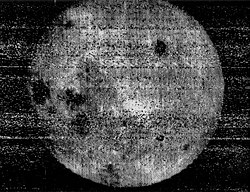
6 October 1959 | flyby | success | first images from the lunar farside | 👁 Image |
1959-008A | |
| Pioneer P-3 | 👁 United States NASA |
26 November 1959 | orbiter | failure | disintegrated shortly after launch | 👁 Image |
PIONX | |
| Luna 1960A† | 👁 Soviet Union USSR |
15 April 1960 | flyby | failure | failed to attain correct trajectory | [6] | ||
| Luna 1960B† | 👁 Soviet Union USSR |
16 April 1960 | flyby | failure | launch vehicle failure | [7] | ||
| Pioneer P-30 | 👁 United States NASA |
25 September 1960 | orbiter | failure | second stage failure; failed to reach Earth orbit | 👁 Image |
PIONY | |
| Pioneer P-31 | 👁 United States NASA |
15 December 1960 | orbiter | failure | first stage failure | 👁 Image |
PIONZ | |


.jpg)


1962–1965
[edit]| Spacecraft | Organization | Date | Type | Status | Notes | Image | Ref | |
|---|---|---|---|---|---|---|---|---|
| Ranger 3 | 👁 United States NASA |
28 January 1962 | impactor | failure | missed target | 👁 Image |
1962-001A | |
| Ranger 4 | 👁 United States NASA |
26 April 1962 | impactor | failure | hit the lunar farside; no data returned | 👁 Image |
1962-012A | |
| Ranger 5 | 👁 United States NASA |
21 October 1962 | impactor | failure | power failure, missed target | 👁 Image |
1962-055A | |
| Sputnik 25 | 👁 Soviet Union USSR |
5 January 1963 | lander | failure | failed to escape Earth orbit | 1963-001A | ||
| Luna E-6 No.3† | 👁 Soviet Union USSR |
2 February 1963 | lander? | failure | failed to reach Earth orbit | [8] | ||
| Luna 4 | 👁 Soviet Union USSR |
5 April 1963 | lander? | failure | missed target, became Earth satellite | 1963-008B | ||
| Ranger 6 | 👁 United States NASA |
2 February 1964 | impactor | partial success | impacted, but no pictures returned due to power failure | 👁 Image |
1964-007A | |
| Luna 1964A† | 👁 Soviet Union USSR |
21 March 1964 | lander | failure | failed to reach Earth orbit | |||
| Ranger 7 | 👁 United States NASA |
31 July 1964 | impactor | success | returned pictures until impact | 👁 Image |
1964-041A | |
| Ranger 8 | 👁 United States NASA |
20 February 1965 | impactor | success | returned pictures until impact | 👁 Image |
1965-010A | |
| Cosmos 60 | 👁 Soviet Union USSR |
12 March 1965 | lander | failure | failed to leave Earth orbit | 1965-018A | ||
| Ranger 9 | 👁 United States NASA |
24 March 1965 | impactor | success | TV broadcast of live pictures until impact | 👁 Image |
1965-023A | |
| Luna 1965A† | 👁 Soviet Union USSR |
10 April 1965 | lander | failure | failed to reach Earth orbit? | [9] | ||
| Luna 5 | 👁 Soviet Union USSR |
12 May 1965 | lander | failure | crashed into Moon | 1965-036A | ||
| Luna 6 | 👁 Soviet Union USSR |
8 June 1965 | lander | failure | missed Moon | 1965-044A | ||
| Zond 3 | 👁 Soviet Union USSR |
20 July 1965 | flyby | success | possibly originally intended as a Mars probe, but target changed after launch window missed | 1965-056A | ||
| Luna 7 | 👁 Soviet Union USSR |
7 October 1965 | lander | failure | crashed into Moon | 1965-077A | ||
| Luna 8 | 👁 Soviet Union USSR |
6 December 1965 | lander | failure | crashed into Moon | 1965-099A | ||


1966–1967
[edit]| Spacecraft | Organization | Date | Type | Status | Notes | Image | Ref | |
|---|---|---|---|---|---|---|---|---|
| Luna 9 | 👁 Soviet Union USSR |
3 February 1966 – 6 February 1966 |
lander | success | first soft landing; first images from the surface | 1966-006A | ||
| Cosmos 111 | 👁 Soviet Union USSR |
1 March 1966 | orbiter | failure | failed to escape Earth orbit | 1966-017A | ||
| Luna 10 | 👁 Soviet Union USSR |
3 April 1966 – 30 May 1966 |
orbiter | success | first artificial satellite of the Moon | 1966-027A | ||
| Luna 1966A† | 👁 Soviet Union USSR |
30 April 1966 | orbiter | failure | failed to reach Earth orbit | [10] | ||
| Surveyor 1 | 👁 United States NASA |
2 June 1966 | lander | success | first US soft landing; Surveyor program performed various tests in support of forthcoming human landings | 👁 Image |
1966-045A | |
| Explorer 33 | 👁 United States NASA |
1 July 1966 – 15 September 1971 |
orbiter | partial success | studied interplanetary plasma, cosmic rays, magnetic fields and solar X rays; failed to attain lunar orbit as intended, but achieved mission objectives from Earth orbit | 👁 Image |
1966-058A | |
| Lunar Orbiter 1 | 👁 United States NASA |
14 August 1966 – 29 October 1966 |
orbiter | success | photographic mapping of lunar surface; intentionally impacted after completion of mission | 👁 Image |
1966-073A | |
| Luna 11 | 👁 Soviet Union USSR |
28 August 1966 – 1 October 1966 |
orbiter | success | gamma-ray and X-ray-based observations of Moon's composition; gravity, radiation and meteorite studies | 1966-078A | ||
| Surveyor 2 | 👁 United States NASA |
23 September 1966 | lander | failure | crashed into Moon | 👁 Image |
1966-084A | |
| Luna 12 | 👁 Soviet Union USSR |
25 October 1966 – 19 January 1967 |
orbiter | success | lunar surface photography | 1966-094A | ||
| Lunar Orbiter 2 | 👁 United States NASA |
10 November 1966 – 11 October 1967 |
orbiter | success | photographic mapping of lunar surface; intentionally impacted after completion of mission | 👁 Image |
1966-100A | |
| Luna 13 | 👁 Soviet Union USSR |
24 December 1966 | lander | success | TV pictures of lunar landscape; soil measurements | 1966-116A | ||
| Lunar Orbiter 3 | 👁 United States NASA |
8 February 1967 – 9 October 1967 |
orbiter | success | photographic mapping of lunar surface; intentionally impacted after completion of mission | 👁 Image |
1967-008A | |
| Surveyor 3 | 👁 United States NASA |
20 April 1967 – 4 May 1967 |
lander | success | various studies, primarily in support of forthcoming human landings. First lander visited by a later crewed mission (Apollo 12) that even brought its components back to Earth. | 👁 Image |
1967-035A | |
| Lunar Orbiter 4 | 👁 United States NASA |
May–October 1967 | orbiter | success | lunar photographic survey | 👁 Image |
1967-041A | |
| Explorer 35 | 👁 United States NASA |
July 1967 – 24 June 1973 |
orbiter | success | studies of interplanetary plasma, magnetic fields, energetic particles and solar X rays | 👁 Image |
1967-070A | |
| Surveyor 4 | 👁 United States NASA |
17 July 1967 | lander | failure | crashed into Moon | 👁 Image |
1967-068A | |
| Lunar Orbiter 5 | 👁 United States NASA |
5 August 1967 – 31 January 1968 |
orbiter | success | lunar photographic survey; intentionally impacted after completion of mission | 👁 Image |
1967-075A | |
| Surveyor 5 | 👁 United States NASA |
11 September 1967 – 17 December 1967 |
lander | success | various studies, primarily in support of forthcoming human landings | 👁 Image |
1967-084A | |
| Zond 1967A† | 👁 Soviet Union USSR |
28 September 1967 | failure | lunar capsule test flight; launch failure | 👁 Image |
[11] | ||
| Surveyor 6 | 👁 United States NASA |
10 November 1967 – 14 December 1967 |
lander | success | various studies, primarily in support of forthcoming human landings | 👁 Image |
1967-112A | |
| Zond 1967B† | 👁 Soviet Union USSR |
22 November 1967 | failure | lunar capsule test flight; launch failure | 👁 Image |
[12] | ||


1968–1970
[edit]| Spacecraft | Organization | Date | Type | Status | Notes | Image | Ref | |
|---|---|---|---|---|---|---|---|---|
| Surveyor 7 | 👁 United States NASA |
10 January 1968 – 21 February 1968 |
lander | success | various studies, primarily in support of forthcoming human landings; fifth and final Surveyor mission to achieve soft landing | 👁 Image |
1968-001A | |
| Luna 1968A† | 👁 Soviet Union USSR |
7 February 1968 | orbiter? | failure | failed to reach Earth orbit | [13] | ||
| Zond 4 | 👁 Soviet Union USSR |
2 March 1968 (launch) | lunar programme flight test, directed away from Moon, either intentionally or unintentionally | 👁 Image |
1968-013A | |||
| Luna 14 | 👁 Soviet Union USSR |
10 April 1968 – ? | orbiter | success | tests of radio communications technologies; lunar mascon studies | 1968-027A | ||
| Zond 1968A† | 👁 Soviet Union USSR |
23 April 1968 | flyby? | failure | launch failure | 👁 Image |
[14] | |
| Zond 5 | 👁 Soviet Union USSR |
18 September 1968 | flyby | success | bioscience experiments; returned to soft landing on Earth | 👁 Image |
1968-076A | |
| Zond 6 | 👁 Soviet Union USSR |
14 November 1968 | flyby | success | cosmic-ray, micrometeoroid and bioscience studies; returned to soft landing on Earth | 👁 Image |
1968-101A | |
| Zond 1969A† | 👁 Soviet Union USSR |
20 January 1969 | flyby | failure | launch aborted | 👁 Image |
[15] | |
| Luna 1969A† | 👁 Soviet Union USSR |
19 February 1969 | lander | failure | launch vehicle failure | [16] | ||
| Lunokhod 201† | rover | failure | ||||||
| Zond L1S-1† | 👁 Soviet Union USSR |
21 February 1969 | orbiter | failure | launch vehicle failure | 👁 Image |
[17] | |
| Luna 1969B† | 👁 Soviet Union USSR |
15 April 1969 | sample return? | failure | launch failure | [18] | ||
| Luna 1969C† | 👁 Soviet Union USSR |
14 June 1969 | sample return | failure | launch failure | [19] | ||
| Zond L1S-2† | 👁 Soviet Union USSR |
3 July 1969 | orbiter | failure | launch failure | 👁 Image |
[20] | |
| Luna 15 | 👁 Soviet Union USSR |
21 July 1969 | sample return? | failure? | completed 52 lunar orbits then crash-landed | 1969-058A | ||
| Zond 7 | 👁 Soviet Union USSR |
11 August 1969 | flyby | success | returned to soft landing on Earth | 👁 Image |
1969-067A | |
| Cosmos 300 | 👁 Soviet Union USSR |
23 September 1969 | sample return | failure | failed to escape Earth orbit | 1969-080A | ||
| Cosmos 305 | 👁 Soviet Union USSR |
22 October 1969 | sample return | failure | failed to escape Earth orbit | 1969-092A | ||
| Luna 1970A† | 👁 Soviet Union USSR |
6 February 1970 | sample return? | failure | launch vehicle failure | [21] | ||
| Luna 1970B† | 👁 Soviet Union USSR |
19 February 1970 | orbiter? | failure | launch vehicle failure | [22] | ||
| Luna 16 | 👁 Soviet Union USSR |
20 September 1970 | sample return | success | first robotic sample return | 1970-072A | ||
| Zond 8 | 👁 Soviet Union USSR |
24 October 1970 | flyby | success | returned to soft landing on Earth | 👁 Image |
1970-088A | |
| Luna 17 | 👁 Soviet Union USSR |
17 November 1970 – 4 October 1971 |
lander | success | deployed rover | 1970-095A | ||
| Lunokhod 1 | rover | success | first robotic rover; travelled over 10 km | 1970-095D | ||||
1971–1976
[edit]| Spacecraft | Organization | Date | Type | Status | Notes | Image | Ref | |
|---|---|---|---|---|---|---|---|---|
| Luna 18 | 👁 Soviet Union USSR |
11 September 1971 | lander/sample return? | failure | crashed into Moon | 1971-073A | ||
| Luna 19 | 👁 Soviet Union USSR |
3 October 1971 – October 1972 |
orbiter | success | 1971-082A | |||
| Luna 20 | 👁 Soviet Union USSR |
21 February 1972 | sample return | success | second successful robotic sample return | 1972-007A | ||
| Soyuz L3† | 👁 Soviet Union USSR |
23 November 1972 | orbiter | failure | launch failure | 👁 Image |
[23] | |
| Luna 21 | 👁 Soviet Union USSR |
15 January 1973 – May 1973? |
lander | success | deployed rover | 1973-001A | ||
| Lunokhod 2 | rover | success | second robotic rover; travelled 37 km | |||||
| Explorer 49 | 👁 United States NASA |
15 June 1973 – June 1975 |
orbiter | success | radio astronomy observations; last US lunar mission until 1994 | 👁 Image |
1973-039A | |
| Mariner 10 | 👁 United States NASA |
November 1973 | flyby | success | en route to Venus and Mercury | 👁 Image |
1973-085A | |
| Luna 22 | 👁 Soviet Union USSR |
2 June 1974 – November 1974 |
orbiter | success | 1974-037A | |||
| Luna 23 | 👁 Soviet Union USSR |
6 November 1974 | sample return | failure | damaged on landing, sample return failed | 1974-084A | ||
| Luna 1975A† | 👁 Soviet Union USSR |
16 October 1975 | sample return | failure | failed to reach Earth orbit | [24] | ||
| Luna 24 | 👁 Soviet Union USSR |
18 August 1976 | sample return | success | third and final successful sample return in Luna programme | 1976-081A | ||


1983–1998
[edit]| Spacecraft | Organization | Date | Type | Status | Notes | Image | Ref | |
|---|---|---|---|---|---|---|---|---|
| ICE (formerly ISEE-3) | 👁 United States NASA |
22 December 1983 | flyby | success | gravity assist en route to comet flybys | 👁 Image |
1978-079A | |
| Hiten | 👁 Japan ISAS |
March 1990 – October 1991 | flyby (approached 10 times) | success | in Moon-crossing Earth orbit from January 1990, later transferred to lunar orbit after failure of Hagoromo; intentionally impacted on Moon at end of mission; first Japanese probe (and non-USSR/US probe) to enter lunar orbit | 👁 Image |
1990-007A | |
| February 1992 – April 1993 | orbiter | success | ||||||
| Hagoromo | 👁 Japan ISAS |
March 1990 | orbiter | failure | released by Hiten into lunar orbit, but transmitter failed and orbit never confirmed | |||
| GEOTAIL | 👁 Japan ISAS / 👁 United States NASA |
September 1992 – November 1994 | flyby (approached 14 times) | success | gravity assist en route magnetotail around L2 / finally deployed into high Earth orbit | [25] | ||
| WIND | 👁 United States NASA |
1 December 1994 and 27 December 1994 | flyby | success | gravity assists en route to Earth–Sun L1 Lagrangian point | 👁 Image |
1994-071A | |
| Clementine | 👁 United States BMDO/ 👁 Image NASA |
February – June 1994 | orbiter | partial success | lunar and Earth observations and component testing; planned Geographos flyby failed | 👁 Image |
1994-004A | |
| HGS-1 | 👁 United States Hughes Global Services |
May/June 1998 | Flyby (orbital correction) | errant communications satellite, flew within 6,200 kilometers of Moon during orbit correction manoeuvres | 1997-086A | |||
| Lunar Prospector | 👁 United States NASA |
January 1998 – July 1999 |
orbiter | success | lunar surface mapping; intentionally impacted into polar crater at end of mission to test for liberation of water vapour (not detected) | 👁 Image |
1998-001A | |
| Nozomi | 👁 Japan ISAS |
24 September 1998 | flyby | success | gravity assists on planned mission to Mars | 1998-041A | ||
| 18 December 1998 | flyby | success | ||||||


2001–2009
[edit]| Spacecraft | Organization | Date | Type | Status | Notes | Image | Ref | |
|---|---|---|---|---|---|---|---|---|
| WMAP | 👁 United States NASA |
30 July 2001 | flyby | success | gravity assist en route to Earth–Sun L2 Lagrangian point | 👁 Image |
2001-027A | |
| SMART-1 | 👁 Image ESA |
13 November 2004 – 3 September 2006 |
orbiter | success | technology testbed and lunar geological studies; intentionally impacted at end of mission; first European probe to orbit the Moon | 2003-043C | ||
| STEREO A | 👁 United States NASA |
15 December 2006 | flyby | success | gravity assist to enter a heliocentric orbit | 👁 Image |
2006-047A | |
| STEREO B | 👁 United States NASA |
15 December 2006 and 21 January 2007 | flyby | success | gravity assists to enter a heliocentric orbit | 2006-047B | ||
| SELENE (Kaguya) |
👁 Japan JAXA |
3 October 2007 – 10 June 2009 | orbiter | success | mineralogical, geographical, magnetic and gravitational observations | 👁 Image |
2007-039A | |
| Okina (Relay Star) |
9 October 2007 – 12 February 2009 | Kaguya subsatellite | success | relay for Kaguya's Far Side operations | ||||
| Ouna (VRAD) |
12 October 2007 – 29 June 2009 | Kaguya subsatellite | success (still in orbit) | Very Long Baseline Interferometry | ||||
| Chang'e 1 | 👁 China CNSA |
5 November 2007 – 1 March 2009 | orbiter | success | 3D lunar mapping and geological observations; first Chinese probe to orbit a body besides Earth; impacted to collect data in preparation for future soft landings | 👁 Image |
2007-051A [26][27] | |
| Chandrayaan-1 | 👁 India ISRO |
8 November 2008 – 29 August 2009 | orbiter | success | high resolution 3D mapping, search water in polar region (first detection of water) and spectral analysis of the Moon's surface and inner compositions[1] | 👁 Image |
2008-052A [28] Archived 2014-04-12 at the Wayback Machine | |
| Moon Impact Probe (MIP) | 👁 India ISRO |
14 November 2008 | impactor | success | test and demonstrate targeting technologies for future soft landings, scientific observation from close range | [29] | ||
| Lunar Reconnaissance Orbiter | 👁 United States NASA |
23 June 2009 – | orbiter | in orbit | survey of lunar resources and identification of possible landing sites | 👁 Image |
2009-031A | |
| LCROSS | 👁 United States NASA |
23 June 2009 | flyby | success | consisted of the Shepherding Spacecraft and Centaur upper stage (Earth Departure Upper Stage) | 👁 Image |
2009-031B [30] | |
| LCROSS Shepherding Spacecraft | 9 October 2009 | impactor | success | analyzed upper-stage impact plume for traces of water liberated from the Moon's surface | ||||
| LCROSS Earth Departure Upper Stage | 9 October 2009 | impactor | success | |||||


2010–2019
[edit]| Spacecraft | Organization | Date | Type | Status | Notes | Image | Ref | |
|---|---|---|---|---|---|---|---|---|
| Chang'e 2 | 👁 China CNSA |
1 October 2010 – 27 August 2011 | orbiter | success | capture high resolution images of the landing zone for Chang'e 3, measure and analyze composition of the surface. Then sent to L2 and on to an asteroid flyby. | 👁 Image |
2010-050A [31] | |
| ARTEMIS P1 | 👁 United States NASA |
2 July 2011 – | orbiter | in orbit | to study the effect of the solar wind on the lunar surface | 👁 Image |
2007-004B [32] | |
| ARTEMIS P2 | 👁 United States NASA |
17 July 2011 – | orbiter | in orbit | to study the effect of the solar wind on the lunar surface | 2007-004C [33] | ||
| GRAIL A (Ebb) |
👁 United States NASA |
31 December 2011 – 17 December 2012 | orbiter | success | mapped the Moon's gravitational field; intentionally impacted at end of mission | 👁 Image |
2011-046A [34] | |
| GRAIL B (Flow) |
👁 United States NASA |
1 January 2012 – 12 December 2012 | orbiter | success | mapped the Moon's gravitational field; intentionally impacted at end of mission | 2011-046B [35] | ||
| LADEE | 👁 United States NASA |
6 September 2013 – 8 April 2014 | orbiter | success | designed to study the lunar exosphere and dust. Intentionally impacted on far side of Moon. | 👁 Image |
2013-047A | |
| Chang'e 3 | 👁 China CNSA |
1 December 2013 - | lander | in progress | soft-landed on the Moon and deployed Yutu rover on 14 December 2013; one functioning instrument as of 1 September 2020 [36] | 2013-070A [37] | ||
| Yutu | 👁 China CNSA |
1 December 2013 – 2016? |
rover | success | survived multiple lunar nights, became immobile 42 days after landing | 👁 Image |
2013-070C | |
| Chang'e 5-T1 | 👁 China CNSA |
28 October 2014 | flyby | success | Technology demonstrator for Chang'e 5 mission; after separating the Xiaofei reentry capsule, the service module eventually entered lunar orbit to conduct rendezvous exercises | 2014-065A [38] | ||
| 10 January 2015 – | orbiter | in progress | ||||||
| Manfred Memorial Moon Mission | 👁 Luxembourg Luxspace |
October 2014 | flyby/impactor (post mission) | success | privately funded payload attached to a Long March 3C rocket third stage; its dosimeter measured ionizing radiation in space. Unintentional Impact on 4 March 2022. | [39][40] | ||
| TESS | 👁 United States NASA |
17 May 2018 | flyby | success | gravity assist to achieve a lunar resonant high Earth orbit | 👁 Image |
2018-038A | |
| Queqiao | 👁 China CNSA |
25 May 2018 | flyby | success | Used a gravity assist en route to the Earth–Moon L2 Lagrangian point. Currently serving as relay for Chang'e 4 lander and rover on the far side. | 👁 Image |
2018-045A | |
| Longjiang-1 | 👁 China HIT |
25 May 2018 | orbiter | failure | malfunctioned after launch, became flyby | 2018-045B | ||
| Longjiang-2 | 👁 China HIT |
25 May 2018 – 31 July 2019 | orbiter | success | Very Long Baseline Interferometry, in orbit until 31 July 2019 when it was deliberately directed to crash onto the Moon. | 2018-045C | ||
| Chang'e 4 | 👁 China CNSA |
7 December 2018 – | lander | in progress | First spacecraft to soft land on the far side of the Moon. | 👁 Image |
2018-103A | |
| Yutu-2 | rover | active | 👁 Image |
|||||
| Beresheet | 👁 Israel SpaceIL |
22 February 2019 – 11 April 2019 | lander | failure | First Israeli and privately funded lunar lander. Entered lunar orbit on 4 April, hard-landed on 11 April 2019. | 2019-009B [41] | ||
| Chandrayaan-2 | 👁 India ISRO |
22 July 2019 – | orbiter | in orbit | observe lunar geography and mineralogy, search for water molecules | 2019-042A | ||
| Vikram | 👁 India ISRO |
6 September 2019 | lander | failure | crashed due to a software glitch[2] | |||
| Pragyan | 👁 India ISRO |
7 September 2019 | rover | not deployed | was to be deployed from Vikram | |||


.png)


.png)


2020–present
[edit]| Spacecraft | Organization | Date | Type | Status | Notes | Image | Ref | |
|---|---|---|---|---|---|---|---|---|
| Chang'e 5 | 👁 China CNSA |
16 December 2020 | sample return | success | Retrieved 1.731 kg of lunar sample and returned it to Earth | 👁 Image |
2020-087A[3] | |
| Chang'e 5 Lander | 👁 China CNSA |
30 November 2020 - 11 December 2020 | success | Obtained lunar sample and placed on ascent vehicle; conducted radar studies of underground structure | ||||
| Chang'e 5 Ascender | 👁 China CNSA |
3 December 2020 - 7 December 2020 | success | Transferred lunar sample onto return capsule via lunar-orbit rendezvous; intentionally deorbited | ||||
| Chang'e 5 Orbiter | 👁 China CNSA |
9 September 2021 | flyby | success | Extended mission following separation of Chang'e 5 Returner; returned from Sun-Earth L1[4] to conduct lunar flyby[5] | |||
| Chang'e 5 Orbiter | 👁 China CNSA |
Late 2021 - | orbiter | in orbit | First spacecraft to utilize Distant Retrograde Orbit (DRO) about Earth-Moon L1 and L2 | |||
| CAPSTONE | 👁 United States NASA |
14 November 2022[6] | orbiter[7][8] | in orbit | Lunar orbiting CubeSat that will test and verify the calculated orbital stability planned for the Gateway space station. | 👁 Image |
CAPSTONE | |
| Artemis 1 Orion MPCV CM-002 | 👁 United States NASA |
21 November 2022 | flyby | success | Uncrewed test of the Orion spacecraft in lunar flyby and DRO orbit. | 👁 Image |
ARTEMIS-1[9] | |
| 25 November 2022 | orbiter | success | ||||||
| 5 December 2022 | flyby | success | ||||||
| LunaH-Map | 👁 United States NASA |
21 November 2022 (flyby) | orbiter | failure | intended to perform engine burn to achieve a lunar orbit to search for evidence of lunar water ice inside permanently shadowed craters using its neutron detector. Orbit insertion failed possibly due to a struck valve. The mission was terminated after six month in solar orbit. | 👁 Image |
LUNAH-MAP[10][11] | |
| Lunar IceCube | 👁 United States NASA |
21 November 2022 (flyby) | orbiter | failure | intended to perform engine burn to achieve a lunar orbit to use its infrared spectrometer to detect water and organic compounds in the lunar surface and exosphere. | 👁 Image |
L-ICECUBE | |
| EQUULEUS | 👁 Japan JAXA |
21 November 2022 | flyby | success | image the Earth's plasmasphere, impact craters on the Moon's far side and L2 experiments. | EQUULEUS | ||
| LunIR | 👁 United States Lockheed Martin |
21 November 2022 | flyby | failure | image surface thermography, failed to observe the Moon due to faulty communication | 👁 Image |
LUNIR[12] | |
| NEA Scout | 👁 United States NASA |
21 November 2022 | flyby | failure | Solar sail intended to flyby a near-Earth asteroid. Communication failure. | 👁 Image |
NEA-SCOUT | |
| ArgoMoon | 👁 Italy ASI |
21 November 2022 | flyby | success | image the ICPS and perform deep space Nanotechnology experiments. | 👁 Image |
ARGOMOON | |
| OMOTENASHI solid motor and orbiting module | 👁 Japan JAXA |
21 November 2022 (flyby) | impactor | failure | intentional impact after separation from surface probe. Prepares the trajectory for landing of surface probe. Communication failure, missed target | OMOTENASH | ||
| OMOTENASHI surface probe | 👁 Japan JAXA |
semi-hard lander | failure | inflatable module attempting to land semi-hard at lunar surface. Communication failure, missed target | ||||
| CuSP | 👁 United States NASA |
21 November 2022 | flyby | failure | mission to study particles and magnetic fields. Did lunar flyby due to launch trajectory. | 👁 Image |
CUSP | |
| BioSentinel | 👁 United States NASA |
21 November 2022 | flyby | success | it contains yeast cards that will be rehydrated in space, designed to detect, measure, and compare the effects of deep space radiation. | 👁 Image |
BIOSENTNL | |
| Team Miles | 👁 United States Fluid & Reason |
21 November 2022 | flyby | failure | demonstrate low-thrust plasma propulsion in deep space. | TEAMMILES | ||
| Danuri (Korea Pathfinder Lunar Orbiter) |
👁 South Korea KARI/ 👁 United States NASA |
16 December 2022[13] | orbiter | in orbit | Lunar Orbiter by the Korea Aerospace Research Institute (KARI) of South Korea. The orbiter, its science payload and ground control infrastructure are technology demonstrators. The orbiter will also be tasked with surveying lunar resources such as water ice, uranium, helium-3, silicon, and aluminium, and produce a topographic map to help select future lunar landing sites. | 👁 Image |
KPLO | |
| Hakuto-R Mission 1 | 👁 Japan ispace |
25 April 2023 | lander | failure[14] | Lunar lander technology demonstration. Launched on 11 December 2022, orbit insertion on 21 March 2023, crashed on lunar surface on 25 April 2023 during landing attempt. | HAKUTO-R1 | ||
| Rashid | 👁 United Arab Emirates UAESA/MBRSC |
25 April 2023 | rover | failure | Lunar rover, part of the Emirates Lunar Mission. | |||
| SORA-Q | 👁 Japan JAXA/Tomy/Doshisha University |
25 April 2023 | rover | failure | Lunar rover technology demonstration. | |||
| Lunar Flashlight | 👁 United States NASA |
11 December 2022 (launch) | orbiter | failure[15][16] | was to enter a near-rectilinear halo orbit; couldn't leave Earth orbit due to propulsion failures. | 👁 Image |
L-FLASHLT | |
| JUICE | 👁 Europe ESA |
19 August 2024 | flyby | success | gravity assist en route to Jupiter. | 👁 Image |
[17] | |
| Chandrayaan-3 | 👁 India ISRO |
14 July 2023 (launch) 5 August 2023 (orbit insertion) |
orbiter | success | bring the lander from Earth parking orbit to pre-landing 100 km (62 mi) lunar orbit and study the spectral and polarimetric measurements of Earth from the lunar orbit. The spacecraft entered lunar orbit on 5 August, and India became the first country to touch down near the lunar south pole, at 69°S, the southernmost lunar landing on 23 August 2023 at 18:03 IST (12:33 UTC). | 👁 Image |
CHANDRYN3 | |
| Vikram | 👁 India ISRO |
23 August 2023 | lander | success | primary objective is to redo Chandrayaan-2 landing which had failed. In-site observation & conducting experiments on the materials available on the lunar surface to better understand composition of the Moon. | |||
| Pragyan | 👁 India ISRO |
23 August 2023 | rover | success | stowed inside lander. Demonstrating the rover's loitering capabilities on the Moon. In-site observation and conducting experiments on the materials available on the lunar surface to better understand composition of the Moon. | |||
| Chandrayaan-3 Propulsion Module | 👁 India ISRO |
Between 13 October and 10 November 2023 | 4 flybys | success | Extended mission following lunar orbit operations to returning to Earth orbit | |||
| Luna 25 | 👁 Russia Roscosmos |
19 August 2023 | lander | failure[18] | Launched 10 August 2023, orbit insertion 16 August 2023, crashed on lunar surface on 19 August 2023 following an anomalous orbital lowering maneuver. | 👁 Image |
LUNA-25 | |
| SLIM | 👁 Japan JAXA |
19 January 2024 | gravity assist/lander | success[19] | Successfully demonstrated precision landing by landing within 100 m (330 ft) of its target spot.[20][21] Its solar cells were initially not generating electricity due to wrong attitude[22] but in ten days the Sun moved enough to temporarily provide power to the spacecraft.[23] | 👁 Image |
SLIM | |
| LEV-1 | 👁 Japan JAXA |
19 January 2024 | rover | success | Lunar rover with a hopping mechanism. Conducted six hops on lunar surface.[22] | |||
| LEV-2 (SORA-Q) | 👁 Japan JAXA/Tomy/Doshisha University |
19 January 2024 | rover | success | Lunar rover, reflight of the SORA-Q rover launched with the failed Hakuto-R Mission 1. Imaged SLIM lander on lunar surface.[22] | |||
| Peregrine | 👁 United States Astrobotic Technology |
8 January 2024 (launch) | lander | failure | Lunar lander selected for NASA's Commercial Lunar Payload Services carrying a total of 25 payloads. Landing abandoned due to excessive propellant leak.[24] | 👁 Image |
PEREGRN-1 | |
| Colmena × 5 | 👁 Mexico UNAM |
8 January 2024 (launch) | rover | failure | Five small robots that will be catapulted onto the lunar surface. Mission phased out along with landing of Peregrine lander due to excessive propellant leak.[24] | |||
| Iris | 👁 United States CMU |
8 January 2024 (launch) | rover | failure | Lunar rover, will test small, lightweight rover mobility on the Moon, and collect scientific images for geological sciences. Mission phased out along with landing of Peregrine lander due to excessive propellant leak.[24] | |||
| IM-1 Odysseus | 👁 United States Intuitive Machines |
22 February 2024 | lander | success | Lunar lander selected for NASA's Commercial Lunar Payload Services carrying a total of 6 payloads. | 👁 Image |
IM-1-NOVA | |
| EagleCam | 👁 United States Embry–Riddle Aeronautical University |
28 February 2024 | semi-hard lander | failure | Deployable camera designed to attempt to capture the first third-person images of a lunar landing. Ejected post landing due to technical issues, failed to return images.[25] | |||
| DRO-A | 👁 China CAS |
13 March 2024 (launch) | orbiter | in orbit | YZ-1S upper stage failed to deliver spacecrafts into correct orbit. The satellites were intended to test Distant retrograde orbit.[26] Tracking data appears to show China is attempting to salvage spacecraft and they appear to have succeeded in reaching their desired orbit.[27][28] | 2024-048A | ||
| DRO-B | orbiter | in orbit | ||||||
| Queqiao-2 | 👁 China CNSA |
24 March 2024 | orbiter | in orbit | Lunar far side relay satellite. | 👁 Image |
QUEQIAO-2 | |
| Tiandu-1 | 👁 China Deep Space Exploration Laboratory |
orbiter | in orbit | will test communications for future lunar satellite constellation technologies. | ||||
| Tiandu-2 | orbiter | in orbit | ||||||
| Chang'e 6 | 👁 China CNSA |
3 May 2024 | sample return | operational[29] | First sample-return from the South Pole–Aitken basin on the far side of the Moon.[30][31] | 👁 Image |
CHANG-E-6 [29][32] | |
| Chang'e 6 Lander | 👁 China CNSA |
1 June 2024 - | success | Obtained lunar sample and placed on ascent vehicle; conducted radar studies of underground structure | ||||
| Chang'e 6 Ascender | 👁 China CNSA |
3 June 2024 - 7 June 2024 | success | Transferred lunar sample to return capsule on 6 June 2024 after lunar-orbit rendezvous; deorbited[32] | ||||
| Jinchan rover | 👁 China CNSA |
3 May 2024 | success | Conduct infrared spectroscopy of lunar surface and imaged Chang'e 6 lander on lunar surface.[33] | ||||
| Chang'e 6 Orbiter | 👁 China CNSA |
8 May 2024 - 20 June 2024 | orbiter | success | On extended mission orbiting Sun-Earth L2[34] | |||
| ICUBE-Q | 👁 Pakistan SUPARCO |
3 May 2024 | orbiter | operational | Pakistan's first lunar mission. | |||
| Blue Ghost M1 | 👁 United States Firefly Aerospace |
15 January 2025 (launch) 2 March 2025 (landing) |
lander | success | Lunar lander technology demonstration. Part of NASA's CLPS contract.[35] First ever soft landing by a private company. First successful American lunar lander after over 52 years,[36] the last being Apollo 17. Completed all objectives after landing in Mare Crisium on March 2,[37][38] including deep-surface drilling[39] and fortuitous observation of lunar eclipse from lunar nearside,[40] having operated for 346 continuous hours. Mission ended on March 16 upon passing into lunar night, and probe powered down.[37] The landing was live-streamed from command center.[41] First ever video of lunar final descent sequence and landing.[42] First fully successful CLPS contract.[35] | BLUEGHOST | ||
| Hakuto-R Mission 2 | 👁 Japan ispace |
5 June 2025 | lander | failure | Lunar lander technology demonstration. Launched on 15 January 2025, orbit insertion on 6 May 2025, crashed on lunar surface on 5 June 2025 during landing attempt. | 👁 Image |
RESILIENC | |
| Tenacious Rover | 👁 Luxembourg Ispace Europe |
5 June 2025 | rover | failure | Lunar rover to collect lunar resources. | |||
| IM-2 Athena | 👁 United States Intuitive Machines |
27 February 2025 (launch) 6 March 2025 (landing) |
lander | partial failure | Lunar lander contracted under NASA's Commercial Lunar Payload Services and carrying various scientific payloads. Probe suffered laser altimeter failure 3 minutes prior to south polar touchdown, leading to descent stage continuing to fire after landing.[43] Slid sideways and toppled into a shadowed crater. Mission terminated due to insufficient solar power on March 7, after 13 hours of much limited operations.[44][45] This is the second (partially successful) lunar landing by Intuitive Machines. | 👁 Image |
2025-038A | |
| Micro-Nova hopper | hopper | failure | Lunar hopper, exploring multiple difficult-to-reach areas such as deep craters on the lunar surface, by firing hydrazine rockets in controlled bursts to propel itself short distances. It will hop across craters in search of lunar ice, which could contain water critical to future crewed missions to the Moon. | |||||
| AstroAnt rover | 👁 United States MIT |
rover | failure | Lunar miniature rover, the size of a matchbox, to conduct contactless temperature measurements as it drives around on MAPP's roof. | ||||
| MAPP LV1 rover | 👁 United States 👁 Finland Lunar Outpost / Nokia |
rover | failure | Lunar rover to collect lunar samples for NASA under a contract worth just $1, which is symbolic of a new incentive for the emerging commercial space industry to access resources in space. It will also autonomously map the lunar surface, capture stereo images and thermal data, and inspect samples of lunar regolith in a special bin mounted on its wheels. | ||||
| Yaoki rover | 👁 Japan Dymon [ja] |
rover | failure | Lunar rover to test mobility technologies. | ||||
| Lunar Trailblazer | 👁 United States NASA |
3 March 2025 (flyby) | orbiter | failure | Intended to achieve a lunar orbit to aid in the understanding of lunar water and the Moon's water cycle.[46] | 👁 Image |
2025-038C | |
| Brokkr-2 | 👁 United States AstroForge |
3 March 2025 | flyby | failure | Asteroid probe intended to flyby the near-Earth asteroid 2022 OB5. Communication failure. | 2025-038D | ||
| Chimera-1 | 👁 United States Epic Aerospace |
3 March 2025 | flyby | failure? | Space tug planned TLI to Geosynchronous. Communication failure? | |||


.jpg)

_(cropped).jpg)


.png)

.jpg)


_(cropped).jpg)


Future
[edit]See also
[edit]
- Lists of spacecraft
- List of landings on extraterrestrial bodies
- List of missions to the Moon
- List of Solar System probes
- Robotic spacecraft
- Timeline of Solar System exploration
Notes
[edit]- ^ "Chandrayaan-1 - ISRO". www.isro.gov.in. Archived from the original on 2019-07-08. Retrieved 2022-07-15.
- ^ How did Chandrayaan 2 fail? ISRO finally has the answer. Mahesh Guptan, The Week. 16 November 2019.
- ^ "A Chinese spacecraft is testing out a new orbit around the moon". SpaceNews. 2022-02-15. Retrieved 2022-02-16.
- ^ "Chang'e-5 orbiter embarks on extended mission to Sun-Earth Lagrange point". SpaceNews. 2020-12-21. Retrieved 2021-09-08.
- ^ "China's Chang'e-5 orbiter is heading back to the moon". SpaceNews. 2021-09-06. Retrieved 2021-09-08.
- ^ Figliozzi, Gianine (8 June 2022). "CAPSTONE Mission Launch No Longer Targeting June 13". NASA. Retrieved 9 June 2022.
- ^ "NASA Funds CubeSat Pathfinder Mission to Unique Lunar Orbit". NASA (Press release). 13 September 2019. Retrieved 12 October 2021.
- ^ "Rocket Lab to Launch NASA Funded Commercial Moon Mission from New Zealand". Rocket Lab. 9 August 2021. Retrieved 4 September 2021.
- ^ Wall, Mike (November 21, 2022). "NASA's Artemis 1 Orion spacecraft aces close moon flyby in crucial engine burn". Space.com. Retrieved November 22, 2022.
- ^ Wall, Mike (November 23, 2022). "Artemis 1 cubesat fails to fire engine as planned during moon flyby". Space.com. Retrieved December 13, 2022.
- ^ "LunaH-Map Mission". 3 August 2023.
- ^ Lockheed Martin Space [@LMSpace] (9 December 2022). "As a @LockheedMartin funded tech demo mission, LunIR's primary goal was to gain knowledge to support future exploration. While we ran into an unexpected issue with our radio signal and couldn't snap any pics of the Moon, we DID try something new, and here's what we learned" (Tweet). Retrieved 21 December 2022 – via Twitter.
- ^ S.Korean Spaceflight [@KOR_Spaceflight] (28 July 2022). "Danuri(KPLO) launch now scheduled for August 5th 08:08 KST, according to MSIT/KARI" (Tweet) – via Twitter.
- ^ Komiya, Kantaro; Roulette, Joey (25 April 2023). "Japan's ispace assumes failure in bid to make first commercial moon landing". Reuters – via www.reuters.com.
- ^ "NASA ends Lunar Flashlight mission because of thruster problems". 15 May 2023.
- ^ Howell, Elizabeth (February 9, 2023). "Tiny NASA moon probe can't reach lunar orbit as planned". Space.com. Retrieved May 4, 2023.
- ^ "JUICE – JUpiter ICy moons Explorer". European Space Agency. Retrieved 27 August 2016.
- ^ Zak, Anatoly (19 August 2023). "Luna-Glob mission lifts off". RussianSpaceWeb. Retrieved 20 August 2023.
- ^ Jones, Andrew (19 January 2024). "Japan makes history with tense, successful moon landing". SpaceNews. Retrieved 19 January 2024.
- ^ Jones, Andrew (2024-01-22). "Japan's moon lander forced to power down but may yet be revived". SpaceNews. Retrieved 2024-01-25.
- ^ "SLIM Project Press Kit" (PDF). JAXA.
- ^ a b c 小型月着陸実証機(SLIM)および小型プローブ(LEV)の月面着陸の結果・成果等 の記者会見, 24 January 2024, retrieved 2024-01-25
- ^ Jones, Andrew (29 January 2024). "SLIM moon lander revived after solar power setback". SpaceNews. Retrieved 2024-02-06.
- ^ a b c Wattles, Jackie; Fisher, Kristin (2024-01-08). "Peregrine mission abandons Moon landing attempt after suffering 'critical' fuel loss". CNN. Retrieved 2024-01-09.
- ^ "2/3 mission plans and procedures in order to deploy its CubeSat camera system. Despite the team's strong effort, the technical complications ultimately resulted in an inability to capture images of the Odysseus lander".
- ^ Jones, Andrew (2024-03-14). "Surprise Chinese lunar mission hit by launch anomaly". SpaceNews. Retrieved 2024-03-14.
- ^ Jones, Andrew (2024-08-20). "Chinese spacecraft appear to reach lunar orbit despite launch setback". SpaceNews. Retrieved 2024-08-20.
- ^ Jones, Andrew (2024-03-28). "China appears to be trying to save stricken spacecraft from lunar limbo". SpaceNews. Retrieved 2024-03-29.
- ^ a b "嫦娥六号探测器成功实施近月制动顺利进入环月轨道飞行" (in Simplified Chinese). 中国新闻网. 2024-05-08. Retrieved 2024-05-08.
- ^ "China's Moon Missions Shadow NASA Artemis's Pace - IEEE Spectrum". IEEE.
- ^ Jones, Andrew (10 January 2024). "China's Chang'e-6 probe arrives at spaceport for first-ever lunar far side sample mission". SpaceNews. Retrieved 10 January 2024.
- ^ a b Jones, Andrew (6 June 2024). "Chang'e-6 spacecraft dock in lunar orbit ahead of journey back to Earth". SpaceNews. Retrieved 6 June 2024.
- ^ Jones, Andrew (6 May 2024). "China's Chang'e-6 is carrying a surprise rover to the moon". SpaceNews. Archived from the original on 8 May 2024. Retrieved 8 May 2024.
- ^ Jones, Andrew (10 September 2024). "China's Chang'e-6 orbiter tunrs up at Sun-Earth Lagrange point after moon sampling mission". SpaceNews. Retrieved 10 September 2024.
- ^ a b "CLPS Providers - NASA". Retrieved 2025-03-18.
- ^ "Firefly CEO Bullish on Blue Ghost January Launch - SPACE & DEFENSE". 2024-12-18. Retrieved 2025-03-18.
- ^ a b Foust, Jeff (2025-03-17). "Firefly Aerospace wraps up successful Blue Ghost 1 mission". SpaceNews. Retrieved 2025-03-18.
- ^ "Blue Ghost Mission 1". Firefly Aerospace. Retrieved 2025-03-18.
- ^ Andrew Jones (2025-03-11). "Watch sparks fly as Blue Ghost lander drills into the moon (video)". Space.com. Retrieved 2025-03-18.
- ^ Mike Wall (2025-03-17). "Farewell, Blue Ghost! Private moon lander goes dark to end record-breaking commercial lunar mission". Space.com. Retrieved 2025-03-18.
- ^ Firefly Aerospace (2025-03-02). Firefly's Blue Ghost Mission 1 Lunar Landing. Retrieved 2025-03-18 – via YouTube.
- ^ "NASA Cameras on Blue Ghost Capture First-of-its-Kind Moon Landing Footage - NASA". 2025-03-13. Retrieved 2025-03-18.
- ^ Intuitive Machines (2025-03-06). Intuitive Machines IM-2 Mission Landing Live Stream. Retrieved 2025-03-18 – via YouTube.
- ^ Foust, Jeff (2025-03-07). "IM-2 lunar lander mission ends". SpaceNews. Retrieved 2025-03-18.
- ^ Berger, Eric (2025-03-13). "Athena landed in a dark crater where the temperature was minus 280° F". Ars Technica. Retrieved 2025-03-18.
- ^ "Intuitive Machines' IM-2 Lunar Lander Successfully Commissioned and En Route to the Moon". investors.intuitivemachines.com. 27 February 2025. Retrieved 27 February 2025.


