The Sun accounts for 99.86% of the Solar System's total mass. Inside the Sun's core, hydrogen is fused into helium, releasing energy that is emitted through the Sun's photosphere. This creates the heliosphere and a decreasing temperature gradient across the Solar System.
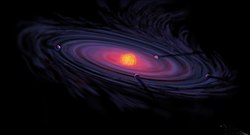
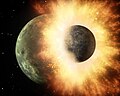
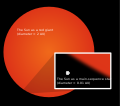
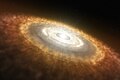
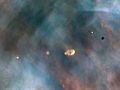
The formation and evolution of the Solar System began 4.6 billion years ago with the gravitational collapse of a small part of a giant molecular cloud. Most of the collapsing mass collected in the centre, forming the Sun, while the rest flattened into a protoplanetary disc out of which the planets, moons, asteroids, and other small Solar System bodies formed. This widely accepted model, known as the nebular hypothesis, was first developed in the 18th century by Emanuel Swedenborg, Immanuel Kant, and Pierre-Simon Laplace. Beginning with the initial formation, the Solar System has evolved considerably. Many moons formed from circling discs of gas and dust around their parent planets, while many other moons are believed to have been captured or (in the case of the Earth's Moon) to have resulted from a giant collision. Collisions between bodies have occurred continuously up to the present day and are central to the evolution of the system. The planets' positions often shifted outward or inward, and planets have switched places. This planetary migration is now believed to be responsible for much of the Solar System's early evolution. Just as the Sun and planets were born, they will eventually die. In roughly 5 billion years, the Sun will cool and bloat outward to many times its current diameter (becoming a red giant) before casting off its outer layers as a planetary nebula and leaving behind a stellar corpse known as a white dwarf. (Full article...)
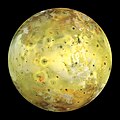
A true-color image of Io, one of the moons of Jupiter, taken by the Galileo spacecraft. The dark spot just left of the center is the erupting volcano Prometheus. The whitish plains on either side of it are coated with volcanically deposited sulfur dioxide frost, whereas the yellower regions contain a higher proportion of sulfur.
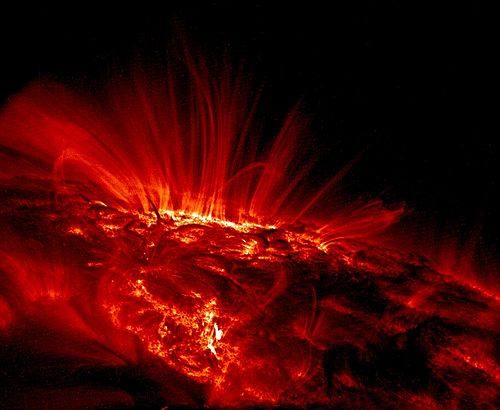
A TRACE image of sunspots on the surface, or photosphere, of the Sun from September 2002, is taken in the far ultraviolet on a relatively quiet day for solar activity. However, the image still shows a large sunspot group visible as a bright area near the horizon. Although sunspots are relatively cool regions on the surface of the Sun, the bright glowing gas flowing around the sunspots have a temperature of over one million °C (1.8 million °F). The high temperatures are thought to be related to the rapidly changing magnetic field loops that channel solar plasma.
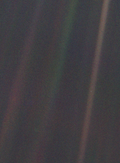
Pale Blue Dot is the name given to this 1990 photo of Earth taken from Voyager 1 when its vantage point reached the edge of the Solar System, a distance of roughly 3.7 billion miles (6 billion kilometres). Earth can be seen as a blueish-white speck approximately halfway down the brown band to the right. The light band over Earth is an artifact of sunlight scattering in the camera's lens, resulting from the small angle between Earth and the Sun. Carl Sagan came up with the idea of turning the spacecraft around to take a composite image of the Solar System. Six years later, he reflected, "All of human history has happened on that tiny pixel, which is our only home."
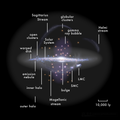
The Milky Way is the galaxy that contains the Solar System, with the name describing the galaxy's appearance from Earth: a hazy band of light seen in the night sky formed from stars that cannot be individually distinguished by the naked eye. The term Milky Way is a translation of the Latin via lactea, from the Greek γαλαξίας κύκλος (galaxías kýklos, 'milky circle'). From Earth, the Milky Way appears as a band because its disk-shaped structure is viewed from within. Galileo Galilei first resolved the band of light into individual stars with his telescope in 1610. Until the early 1920s, most astronomers thought that the Milky Way contained all the stars in the Universe. Following the 1920 Great Debate between the astronomers Harlow Shapley and Heber Curtis, observations by Edwin Hubble showed that the Milky Way is just one of many galaxies.
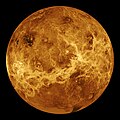
These images are composites of the complete radar image collection obtained by the Magellan mission. The Magellan spacecraft was launched aboard Space Shuttle Atlantis in May 1989 and began mapping the surface of Venus in September 1990. The spacecraft continued to orbit Venus for four years, returning high-resolution images, altimetry, thermal emissions and gravity maps of 98 percent of the surface. Magellan spacecraft operations ended on October 12, 1994, when the radio contact was lost with the spacecraft during its controlled descent into the deeper portions of the Venusian atmosphere.
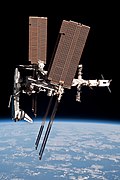
This photograph, taken in 2011 by Italian astronaut Paolo Nespoli from a departing Russian Soyuz spacecraft, shows the ISS and the docked Space Shuttle Endeavour.
The Blue Marble is a famous photograph of Earth. NASA officially credits the image to the entire Apollo 17 crew — Eugene Cernan, Ronald Evans and Jack Schmitt — all of whom took photographic images during the mission. Apollo 17 passed over Africa during daylight hours and Antarctica is also illuminated. The photograph was taken approximately five hours after the spacecraft's launch, while en route to the Moon. Apollo 17, notably, was the last manned lunar mission; no humans since have been at a range where taking a "whole-Earth" photograph such as "The Blue Marble" would be possible.
Hyperion, a moon of Saturn, is one of the largest highly irregular (non-spherical) bodies in the Solar System. Enhanced image processing was used to bring out details and color differences in this photo taken by the Cassini orbiter. Hyperion is entirely saturated with deep, sharp-edged craters that give it the appearance of a giant sponge. Dark material fills the bottom of each crater.
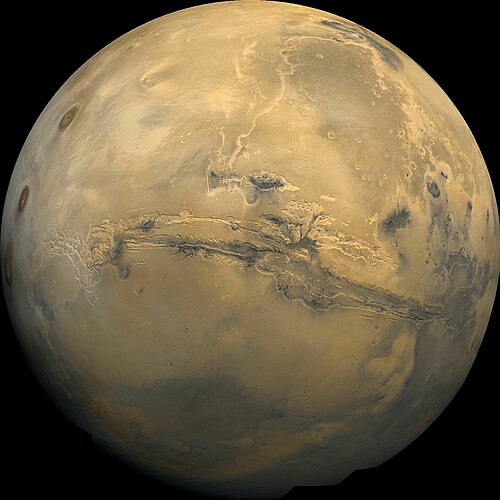
Mars, the fourth planet from the Sun, is named after the Roman god of war because of its blood red color. Mars has two small, oddly-shaped moons, Phobos and Deimos, named after the sons of the Greek god Ares. At some point in the future Phobos will be broken up by gravitational forces. The atmosphere on Mars is 95% carbon dioxide. In 2003 methane was also discovered in the atmosphere. Since methane is an unstable gas, this indicates that there must be (or have been within the last few hundred years) a source of the gas on the planet.
A 14-frame clip showing the atmosphere of Jupiter as viewed from the NASA probe Cassini. Taken over a span of 24 Jupiter rotations between October 31 and November 9, 2000, this clip shows various patterns of motion across the planet. The Great Red Spot rotates counterclockwise, and the uneven distribution of its high haze is obvious. To the east (right) of the Red Spot, oval storms, like ball bearings, roll over and pass each other. East-west bands adjacent to each other move at different rates. Strings of small storms rotate around northern-hemisphere ovals. The large grayish-blue "hot spots" at the northern edge of the white Equatorial Zone change over time as they proceed eastward across the planet. Ovals in the north rotate counter to those in the south. Small, very bright features appear quickly and randomly in turbulent regions, possibly lightning storms. The smallest visible features at the equator are about 600 km (370 miles) across.
A 360° panorama taken during the descent from the summit of Husband Hill, one of the Columbia Hills in Gusev crater, Mars. This stitched image is composed of 405 individual images taken with five different filters on the panoramic camera over the course of five Martian days.
A radar image of the surface of Venus, centered at 180 degrees east longitude. This composite image was created from mapping by the Magellan probe, supplemented by data gathered by the Pioneer orbiter, with simulated hues based on color images recorded by Venera 13 and 14. No probe has been able to survive more than a few hours on Venus's surface, which is completely obscured by clouds, because the atmospheric pressure is some 90 times that of the Earth's, and its surface temperature is around 450 °C (842 °F).
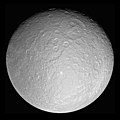
The giant Tirawa impact basin is seen above and to the right of center. Tirawa, and another basin to its southwest, are both covered in impact craters, indicating they are quite ancient.
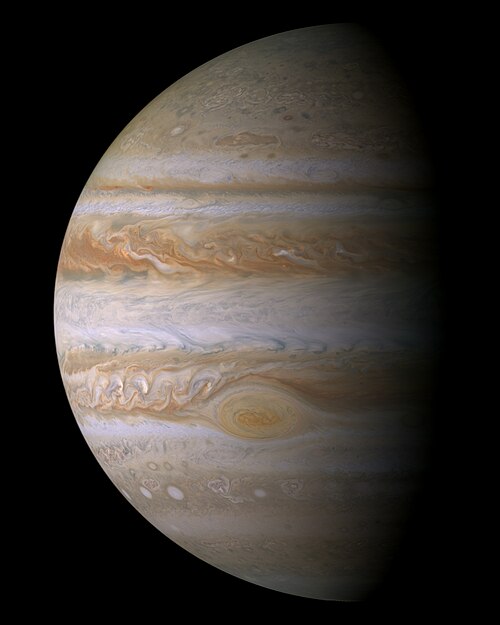
Jupiter is the fifth planet from the Sun and by far the largest within the Solar System. It is 318 times more massive than Earth, with a diameter 11 times that of Earth, and with a volume 1300 times that of Earth. Its best known feature is the Great Red Spot, a storm larger than Earth, which was first observed by Galileo four centuries ago. This picture, taken by the Cassini orbiter was one of 26 thousand images taken of Jupiter during the course of its flyby and is the most detailed global color portrait of the planet ever produced.
C/2014 Q2 (Lovejoy) is a long-period comet discovered in 2014 by Australian astronomer Terry Lovejoy using a 0.2-meter (8 in) Schmidt–Cassegrain telescope. It was discovered at apparent magnitude 15 in the southern constellation of Puppis, and is the fifth comet discovered by Lovejoy. Its blue-green glow is the result of organic molecules and water released by the comet fluorescing under the harsh UV and optical light of the sun as it passes through space.
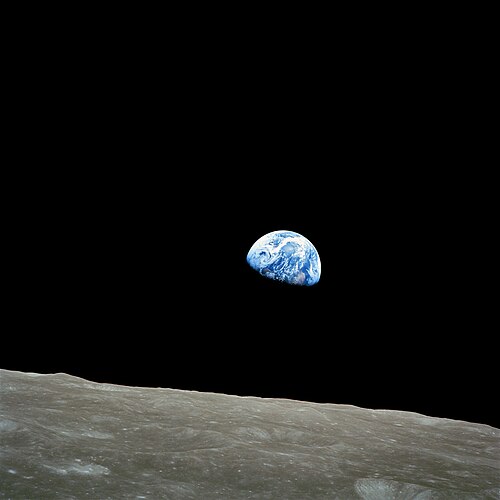
Earthrise, the first occasion in which humans saw the Earth seemingly rising above the surface of the Moon, taken during the Apollo 8 mission on December 24, 1968. This view was seen by the crew at the beginning of its fourth orbit around the Moon, although the first photograph taken was in black-and-white. Note that the Earth is in shadow here. A photo of a fully lit Earth would not be taken until the Apollo 17 mission.
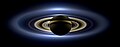
The Day the Earth Smiled refers to the date July 19, 2013, on which the Cassini spacecraft turned to image Saturn, its entire ring system, and the Earth from a position where Saturn eclipsed the Sun. Cassini imaging team leader and planetary scientist Carolyn Porco called for all the world's people to reflect on humanity's place in the cosmos, to marvel at life on Earth, and to look up and smile in celebration. The final mosaic, shown here, was released four months later and includes planets Earth, Mars, and Venus, and a host of Saturnian moons.
The Moon is the only natural satellite of Earth and the fifth largest moon in the Solar System. Owing to its synchronous rotation around Earth, the Moon always shows essentially the same face: its near side, which is marked by dark volcanic maria, as well as the bright ancient crustal highlands and the prominent impact craters. However, variations in the Moon's orbital speed due to its orbital eccentricity cause a libration of several degrees of longitude; the alignment of the Moon's orbital plane causes a similar libration in latitude. The Moon was first reached in September 1959 by the Soviet Union's unmanned Luna 2, followed by the first successful soft landing by Luna 9 in 1966. The United States Apollo program achieved the only manned lunar missions to date, including Apollo 8 in 1968, the first manned orbital mission, as well as Apollo 11, the first of six manned landings between 1969 and 1972.
This picture shows the near side of the Moon close to its greatest northern ecliptic latitude, so the southern craters are especially prominent. Tranquility Base, Apollo 11's landing site, is located near the mid-right in the photograph.
Neptune is the eighth and farthest known planet from the Sun in the Solar System. In the Solar System, it is the fourth-largest planet by diameter, the third-most-massive planet and the densest giant planet. Neptune is 17 times the mass of Earth, slightly more massive than its near-twin Uranus. Neptune is denser and physically smaller than Uranus because its greater mass causes more gravitational compression of its atmosphere. Neptune orbits the Sun once every 164.8 years at an average distance of 30.1 au (4.5 billion km; 2.8 billion mi). It is named after the Roman god of the sea and has the astronomical symbol ♆, a stylised version of the god Neptune's trident.
This picture of Neptune was taken by NASA's Voyager 2 spacecraft in 1989, at a range of 4.4 million miles (7.1 million kilometres) from the planet, approximately four days before closest approach. The photograph shows the Great Dark Spot, a storm about the size of Earth, in the centre, while the fast-moving bright feature nicknamed the "Scooter" and the Small Dark Spot can be seen on the western limb. These clouds were seen to persist for as long as the spacecraft's cameras could resolve them.
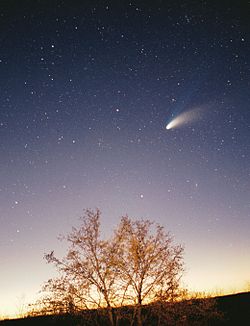
Comet Hale–Bopp sails across the sky in the vicinity of Pazin in Istria, Croatia. To the lower right of the comet the Andromeda Galaxy is also faintly visible. The comet was visible to the naked eye for a record 18 months, twice as long as the Great Comet of 1811. At perihelion, it shone brighter than any star in the sky except Sirius, and its two tails stretched 30-40 degrees across the sky. The passage of Hale-Bopp was notable also for inciting a degree of panic about comets not seen for decades. Rumours that the comet was being followed by an alienspacecraft inspired a mass suicide among followers of the Heaven's Gatecult.
Image 7Solar system diagram by Emanuel Bowen in 1747, when neither Uranus, Neptune, nor the asteroid belts had yet been discovered. Orbits of planets are to scale, but the orbits of moons and the sizes of bodies are not. (from Solar System)
Image 9Animations of the Solar System's outer planets orbiting. This animation is 100 times faster than the inner planet animation. (from Solar System)
Image 10Plot of objects around the Kuiper belt and other asteroid populations. J, S, U and N denotes Jupiter, Saturn, Uranus and Neptune. (from Solar System)
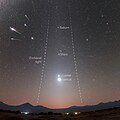
Image 11A color enhanced photograph from the Moon of a range of components of the Solar System. The three dots at the lower left are from left to right the planets Saturn, Mars, and Mercury, and in the middle of the picture rises the Sun's corona over the dark limb of the Moon, which is from the right lit by earthshine. (from Solar System)
Image 12The outer planets Jupiter, Saturn, Uranus and Neptune, compared to the inner planets Earth, Venus, Mars, and Mercury at the bottom right (from Solar System)
Image 13The orbital eccentricities and inclinations of the scattered disc population compared to the classical and resonant Kuiper belt objects (from Solar System)
Image 19Diagram of the Local Interstellar Cloud, the G-Cloud and surrounding stars. As of 2022[update], the exact position of the Solar System within the interstellar clouds remains an unresolved question in astronomy. (from Solar System)
Image 21Comparison of the distances between planets, with the white bar showing orbital variations. The size of the planets is not to scale. (from Solar System)
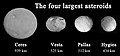
Image 23The four largest asteroids: Ceres, Vesta, Pallas, Hygiea. Only Ceres and Vesta have been visited by a spacecraft and thus have a detailed picture. (from Solar System)
Image 27Simulation showing outer planets and Kuiper belt: a) Before Jupiter/Saturn 2:1 resonance b) Scattering of Kuiper belt objects into the Solar System after the orbital shift of Neptune c) After ejection of Kuiper belt bodies by Jupiter
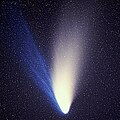
Image 35The sparse plasma (blue) and dust (white) in the tail of comet Hale–Bopp are being shaped by pressure from solar radiation and the solar wind, respectively.
























.jpg)




.jpg)


_(2023-152).jpg)



![👁 Image 19Diagram of the Local Interstellar Cloud, the G-Cloud and surrounding stars. As of 2022[update], the exact position of the Solar System within the interstellar clouds remains an unresolved question in astronomy. (from Solar System)](https://upload.wikimedia.org/wikipedia/commons/thumb/7/7c/The_Local_Interstellar_Cloud_and_neighboring_G-cloud_complex.svg/120px-The_Local_Interstellar_Cloud_and_neighboring_G-cloud_complex.svg.png)









.jpg)