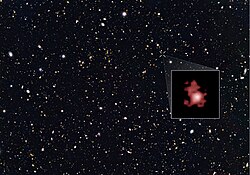
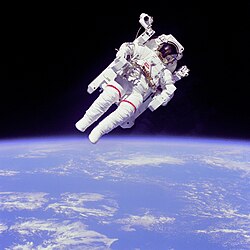
Outer space does not begin at a definite altitude above Earth's surface. The Kármán line, an altitude of 100 km (62 mi) above sea level, is conventionally used as the start of outer space in space treaties and for aerospace records keeping. Certain portions of the upper stratosphere and the mesosphere are sometimes referred to as "near space". The framework for international space law was established by the Outer Space Treaty, which entered into force on 10 October 1967. This treaty precludes any claims of national sovereignty and permits all states to freely explore outer space. Despite the drafting of UN resolutions for the peaceful uses of outer space, anti-satellite weapons have been tested in Earth orbit.
The concept that the space between the Earth and the Moon must be a vacuum was first proposed in the 17th century after scientists discovered that air pressure decreased with altitude. The immense scale of outer space was grasped in the 20th century when the distance to the Andromeda Galaxy was first measured. Humans began the physical exploration of space later in the same century with the advent of high-altitude balloon flights. This was followed by crewed rocket flights and, then, crewed Earth orbit, first achieved by Yuri Gagarin of the Soviet Union in 1961. The economic cost of putting objects, including humans, into space is very high, limiting human spaceflight to low Earth orbit and the Moon. On the other hand, uncrewed spacecraft have reached all of the known planets in the Solar System. Outer space represents a challenging environment for human exploration because of the hazards of vacuum and radiation. Microgravity has a negative effect on human physiology that causes both muscle atrophy and bone loss. (Full article...)
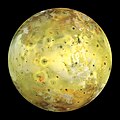
Io is the innermost of the four Galilean moons of the planet Jupiter and, with a diameter of 3,642 kilometres (2,263 mi), the fourth-largest moon in the Solar System. It was named after the mythological character of Io, a priestess of Hera who became one of the lovers of Zeus. With over 400 active volcanoes, Io is the most geologically active object in the Solar System. This extreme geologic activity is the result of tidal heating from friction generated within Io's interior as it is pulled between Jupiter and the other Galilean satellites—Europa, Ganymede and Callisto. Several volcanoes produce plumes of sulfur and sulfur dioxide that climb as high as 500 km (300 mi) above the surface. Io's surface is also dotted with more than 100 mountains that have been uplifted by extensive compression at the base of the moon's silicate crust. Some of these peaks are taller than Earth's Mount Everest. Unlike most satellites in the outer Solar System, which are mostly composed of water-ice, Io is primarily composed of silicate rock surrounding a molten iron or iron sulfide core. Most of Io's surface is characterized by extensive plains coated with sulfur and sulfur dioxide frost. Io's volcanism is responsible for many of the satellite's unique features. Its volcanic plumes and lava flows produce large surface changes and paint the surface in various shades of yellow, red, white, black, and green, largely due to allotropes and compounds of sulfur. Numerous extensive lava flows, several more than 500 km (300 mi) in length, also mark the surface. The materials produced by this volcanism provide material for Io's thin, patchy atmosphere and Jupiter's extensive magnetosphere. Io's volcanic ejecta also produce a large plasma torus around Jupiter.
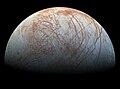
Realistic-color mosaic of images of Jupiter's moon Europa taken by NASA's Jupiter orbiter Galileo in 1995 and 1998. This view of the moon's anti-Jovian hemisphere shows numerous lineae, linear features created via a tectonic process in which crustal plates of water ice floating on a subsurface ocean (kept warm by tidal flexing) shift in relative position. Reddish regions are areas where the ice has a higher mineral content. The north polar region is at right. (Geologic features are annotated in Commons.)
A composite photo of the Orion Nebula, the closest region of star formation to Earth. It is composed of 520 separate images and NASA calls it "one of the most detailed astronomical images ever produced". The nebula is located below Orion's Belt and is visible to the naked eye at night. It is one of the most scrutinized and photographed objects in the night sky, and is among the most intensely-studied celestial features.
Neptune is the eighth and farthest known planet from the Sun in the Solar System. In the Solar System, it is the fourth-largest planet by diameter, the third-most-massive planet and the densest giant planet. Neptune is 17 times the mass of Earth, slightly more massive than its near-twin Uranus. Neptune is denser and physically smaller than Uranus because its greater mass causes more gravitational compression of its atmosphere. Neptune orbits the Sun once every 164.8 years at an average distance of 30.1 au (4.5 billion km; 2.8 billion mi). It is named after the Roman god of the sea and has the astronomical symbol ♆, a stylised version of the god Neptune's trident.
This picture of Neptune was taken by NASA's Voyager 2 spacecraft in 1989, at a range of 4.4 million miles (7.1 million kilometres) from the planet, approximately four days before closest approach. The photograph shows the Great Dark Spot, a storm about the size of Earth, in the centre, while the fast-moving bright feature nicknamed the "Scooter" and the Small Dark Spot can be seen on the western limb. These clouds were seen to persist for as long as the spacecraft's cameras could resolve them.
The Sombrero Galaxy is a spiral galaxy in the Virgo constellation. It was discovered in the late 1700s. It is about 28 million light years away and is just faint enough to be invisible to the naked eye but easily visible with small telescopes. In our sky, it is about one-fifth the diameter of the full moon. M104 is moving away from Earth at about 1,000 kilometers per second.
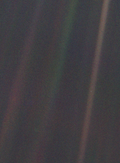
Pale Blue Dot is the name given to this 1990 photo of Earth taken from Voyager 1 when its vantage point reached the edge of the Solar System, a distance of roughly 3.7 billion miles (6 billion kilometres). Earth can be seen as a blueish-white speck approximately halfway down the brown band to the right. The light band over Earth is an artifact of sunlight scattering in the camera's lens, resulting from the small angle between Earth and the Sun. Carl Sagan came up with the idea of turning the spacecraft around to take a composite image of the Solar System. Six years later, he reflected, "All of human history has happened on that tiny pixel, which is our only home."
An animated view of Voyager I's approach to Jupiter. One frame of this image was taken each Jupiter day (approximately 10 hours) between January 6 and February 9, 1979, as the space probe flew from 58 million to 31 million kilometers from Jupiter during that time. The small, round, dark spots appearing in some frames are the shadows cast by the moons passing between Jupiter and the Sun, while the small, white flashes around the planet, are the moons themselves.
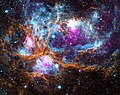
NGC 6357 is a diffuse nebula in the constellation Scorpius. This composite image of the nebula contains X-ray data from the Chandra X-ray Observatory and the ROSAT telescope (purple), infrared data from the Spitzer Space Telescope (orange), and optical data from the SuperCosmos Sky Survey (blue). Radiation from hot, young stars is energizing the cooler gas in the clouds that surround them. Often known as the Lobster Nebula, the astronomical object has also been termed the Madokami Nebula by fans of the anime Madoka Magica due to its supposed resemblance to the main character. Scientists at the Midcourse Space Experiment prefer the name War and Peace Nebula, because the bright, western part resembles a dove, while the eastern part looks like a skull in infrared images.
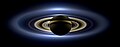
The Day the Earth Smiled refers to the date July 19, 2013, on which the Cassini spacecraft turned to image Saturn, its entire ring system, and the Earth from a position where Saturn eclipsed the Sun. Cassini imaging team leader and planetary scientist Carolyn Porco called for all the world's people to reflect on humanity's place in the cosmos, to marvel at life on Earth, and to look up and smile in celebration. The final mosaic, shown here, was released four months later and includes planets Earth, Mars, and Venus, and a host of Saturnian moons.
A laser shoots towards the centre of the Milky Way from the Very Large Telescope facility in Chile, to provide a laser guide star, a reference point in the sky for the telescope's adaptive optics (AO) system. AO technology improves the performance of optical systems by reducing the effect of atmospheric distortion. AO was first envisioned by Horace W. Babcock in 1953, but did not come into common usage until advances in computer technology during the 1990s made the technique practical.
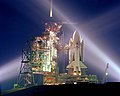
A timed exposure of the first Space Shuttle mission, STS-1. The shuttle Columbia stands on launch pad A at Kennedy Space Center, the night before launch. The objectives of the maiden flight were to check out the overall Shuttle system, accomplish a safe ascent into orbit and to return to Earth for a safe landing.
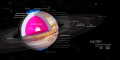
A diagram of Jupiter showing a model of the planet's interior, with a rocky core overlaid by a deep layer of liquid metallic hydrogen and an outer layer predominantly of molecular hydrogen. Jupiter's true interior composition is uncertain. For instance, the core may have shrunk as convection currents of hot liquid metallic hydrogen mixed with the molten core and carried its contents to higher levels in the planetary interior. Furthermore, there is no clear physical boundary between the hydrogen layers—with increasing depth the gas increases smoothly in temperature and density, ultimately becoming liquid.
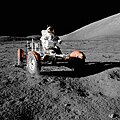
Astronaut Eugene Cernan makes a short test drive of the lunar rover (officially, Lunar Roving Vehicle or LRV) during the early part of the first Apollo 17extravehicular activity. The LRV was only used in the last three Apollo missions, but it performed without any major problems and allowed the astronauts to cover far more ground than in previous missions. All three LRVs were abandoned on the Moon.
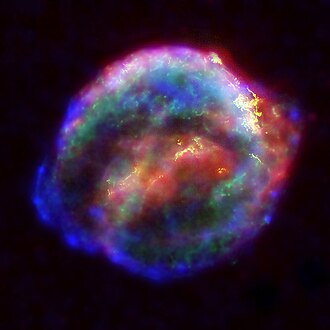
This Supernova remnant of Kepler'sSupernova (SN 1604) is made up of the materials left behind by the gigantic explosion of a star. There are two possible routes to this end: either a massive star may cease to generate fusion energy in its core, and collapse inward under the force of its own gravity, or a white dwarf star may accumulate material from a companion star until it reaches a critical mass and undergoes a similar collapse. In either case, the resulting supernova explosion expels much or all of the stellar material with great force.
Photograph: NASA, ESA, and the Hubble Heritage Team
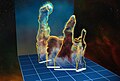
The Pillars of Creation, a series of elephant trunks of interstellar gas and dust in the Eagle Nebula, are the subject of a famous Hubble Space Telescope photograph taken in 1995. They are so named because the depicted gas and dust, while being eroded by the light from nearby stars, are in the process of creating new stars. Shown here is a 2014 rephotograph, which was unveiled in 2015 as part of the telescope's 25th anniversary celebrations.
A TRACE image of sunspots on the surface, or photosphere, of the sun from September 2002, is taken in the far ultraviolet on a relatively quiet day for solar activity. However, the image still shows a large sunspot group visible as a bright area near the horizon. Although sunspots are relatively cool regions on the surface of the sun, the bright glowing gas flowing around the sunspots have a temperature of over one million °C (1.8 million °F). The high temperatures are thought to be related to the rapidly changing magnetic field loops that channel solar plasma.
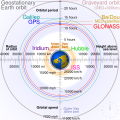
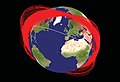
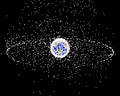
Image 5Near-Earth space showing the low-Earth (blue), medium Earth (green), and high Earth (red) orbits. The last extends beyond the radius of geosynchronous orbits (from Outer space)
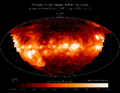
Image 8The distribution of ionized hydrogen (known by astronomers as H II from old spectroscopic terminology) in the parts of the Galactic interstellar medium visible from the Earth's northern hemisphere as observed with the Wisconsin Hα Mapper (Haffner et al. 2003) harv error: no target: CITEREFHaffnerReynoldsTufteMadsen2003 (help). (from Interstellar medium)
Image 30Timeline of the expansion of the universe, where space is represented schematically at each time by circular sections. On the left, the dramatic expansion of inflation; at the center, the expansion accelerates (artist's concept; neither time nor size are to scale) (from Outer space)
Image 34The diversity found in the different types and scales of astronomical objects make the field of study increasingly specialized. (from Outline of space science)
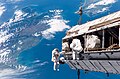
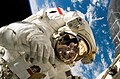
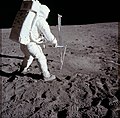
Image 35Astronaut Piers Sellers during the third spacewalk of STS-121, a demonstration of orbiter heat shield repair techniques (from Outline of space science)
Image 38For the first time, the NASA / ESA / Canadian Space Agency / James Webb Space Telescope has observed the chemical signature of carbon-rich dust grains at redshift z ≈ 7, which is roughly equivalent to one billion years after the birth of the Universe, this observation suggests exciting avenues of investigation into both the production of cosmic dust and the earliest stellar populations in our Universe. (from Cosmic dust)
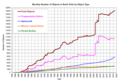
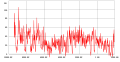
Image 39Growth of tracked objects in orbit and related events; efforts to manage outer space global commons have so far not reduced the total amount of debris or the growth of objects in orbit. (from Space debris)
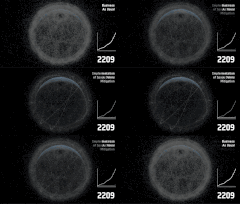
Image 54A computer-generated animation by the European Space Agency representing space debris in low earth orbit at the current rate of growth compared to mitigation measures being taken (from Space debris)
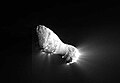
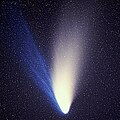
Image 55The sparse plasma (blue) and dust (white) in the tail of comet Hale–Bopp are being shaped by pressure from solar radiation and the solar wind, respectively.
Image 59Gabbard diagram of almost 300 pieces of debris from the disintegration of the five-month-old third stage of the Chinese Long March 4 booster on 11 March 2000 (from Space debris)
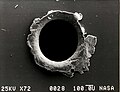
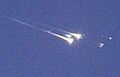
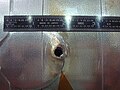
Image 68Space ShuttleEndeavour had a major impact on its radiator during STS-118. The entry hole is about 5.5 mm (0.22 in), and the exit hole is twice as large. (from Space debris)
Image 70Collision on Launch Avoidance lead to delayed spacecraft launches to avoid potential conjunctions/collisions during launch. Seen here is a Collision Avoidance analysis that mandated a four-minute delay for the launch of SPADEX in 2024. (from Space debris)
Image 73Astronomers used the James Webb Space Telescope to image the warm dust around a nearby young star, Fomalhaut, in order to study the first asteroid belt ever seen outside of the Solar System in infrared light. (from Cosmic dust)
Image 74Debris impacts on Mir's solar panels degraded their performance. The damage is most noticeable on the panel on the right, which is facing the camera with a high degree of contrast. Extensive damage to the smaller panel below is due to impact with a Progress spacecraft rather than space debris. (from Space debris)
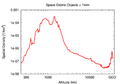
Image 75Spatial density of space debris by altitude according to ESA MASTER-2001, without debris from the Chinese ASAT and 2009 collision events (from Space debris)
Image 77A wide field view of outer space as seen from Earth's surface at night. The interplanetary dust cloud is visible as the horizontal band of zodiacal light, including the false dawn (edges) and gegenschein (center), which is visually crossed by the Milky Way (from Outer space)
Image 80Atmospheric attenuation in dB/km as a function of frequency over the EHF band. Peaks in absorption at specific frequencies are a problem, due to atmosphere constituents such as water vapor (H2O) and carbon dioxide (CO2). (from Interstellar medium)
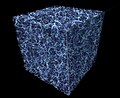
Image 82Distribution of Matter in a cubic section of the universe. The blue fiber-like structures represent matter, while the empty regions show the cosmic voids (from Outer space)



.jpg)










.jpg)




































_(53057957393).jpg)

.png)









.jpg)





.jpg)










.jpg)




.jpg)




.jpg)






_on_Jul_14_2020_aligned_to_stars.jpg)







.png)