| Discovery | |
|---|---|
| Discovered by | NEAT |
| Discovery date | 15 March 2002 |
| Designations | |
| P/2002 EX12 | |
| Orbital characteristics[1][2] | |
| Epoch | 21 November 2025 (JD 2461000.5) |
| Observation arc | 36.15 years |
| Earliest precovery date | 7 March 1989 |
| Number of observations | 1,374 |
| Aphelion | 4.603 AU |
| Perihelion | 0.604 AU |
| Semi-major axis | 2.604 AU |
| Eccentricity | 0.76796 |
| Orbital period | 4.201 years |
| Inclination | 11.285° |
| 176.04° | |
| Argument of periapsis | 218.13° |
| Mean anomaly | 288.59° |
| Last perihelion | 9 July 2022 |
| Next perihelion | 21 September 2026 |
| TJupiter | 2.888 |
| Earth MOID | 0.142 AU |
| Jupiter MOID | 0.978 AU |
| Physical characteristics[3] | |
Mean radius | 2.5 km (1.6 mi) |
| 8.369 hours | |
| Comet total magnitude (M1) | 16.8 |
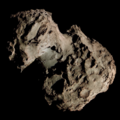
169/NEAT is a periodic comet in the Solar System. It is the parent body of the alpha Capricornids meteor shower in late July. 169/NEAT may be related to comet P/2003 T12 (SOHO).[4][5]
Physical characteristics
[edit]169P is a low activity comet roughly about 5.0 km (3.1 mi) in diameter,[3][6] with a rotation period lasting about 8.4 hours.[3] It could have originated from the main asteroid belt.[5]
Orbit
[edit]It last came to perihelion (closest approach to the Sun) on 9 July 2022.[2] On 13 July 2022 passed 0.1395 AU (20.87 million km) from Venus.[1] On 11 August 2026, it will pass 0.1672 AU (25.01 million km) from Earth and then come to perihelion on 21 September 2026.
169P has a similar stable orbit with the smaller body P/2003 T12 (SOHO), both avoiding close encounters with Jupiter. It is possible that both comets likely fragmented from a parent body a bit over 2,000 years ago.[5][6] A further fragmentation even about 4,500 to 5,000 years ago could have produced the meteors of the alpha Capricornids meteor shower. The total estimated mass of the meteors is similar to that of the surviving comet.[7]
References
[edit]- ^ a b "169P/NEAT – JPL Small-Body Database Lookup". ssd.jpl.nasa.gov. Jet Propulsion Laboratory. Retrieved 22 June 2022.
- ^ a b "169P/NEAT Orbit". Minor Planet Center. Retrieved 2 June 2014.
- ^ a b c B. E. A. Mueller; N. H. Samarasinha (2018). "Further Investigation of Changes in Cometary Rotation". The Astronomical Journal. 156 (3): 107–114. arXiv:1806.11158. Bibcode:2018AJ....156..107M. doi:10.3847/1538-3881/aad0a1.
- ^ 169P NEAT and P/2003 T12 - 300 years ago
- ^ a b c S. R. Alvarez; A. S. Oyarzabal (2024). "Comet P/2003 T12 (SOHO): A possible fragment of comet 169P/NEAT?". Planetary and Space Science. 246 105902. doi:10.1016/j.pss.2024.105902.
- ^ a b A. Sosa; J. A. Fernández; A. Fitzsimmons (2015). "Comets 169P/NEAT and P/2003 T12 (SOHO): Two possible fragments of a common ancestor?". American Astronomical Society. 29. Bibcode:2015IAUGA..2255583S.
- ^ P. Jenniskens; J. Vaubaillon (2010). "Minor Planet 2002 EX12 (169P/NEAT) and the Alpha Capricornid Shower". The Astronomical Journal. 139 (5): 1822–1830. doi:10.1088/0004-6256/139/5/1822.
External links
[edit]

.png)