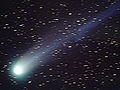
| 👁 Image Tuttle's Comet and the Triangulum Galaxy photographed from Mount Laguna, California on December 30, 2007 | |
| Discovery | |
|---|---|
| Discovered by | Horace Parnell Tuttle |
| Discovery date | January 5, 1858 |
| Designations | |
| P/1790 A2, P/1858 A1 P/1871 T1 | |
| |
| Orbital characteristics[4][5] | |
| Epoch | January 21, 2022 (JD 2459600.5) |
| Observation arc | 232.14 years |
| Earliest precovery date | January 28, 1790[1] |
| Number of observations | 316 |
| Aphelion | 10.39 AU |
| Perihelion | 1.026 AU |
| Semi-major axis | 5.707 AU |
| Eccentricity | 0.82023 |
| Orbital period | 13.6 years |
| Inclination | 54.911° |
| 270.20° | |
| Argument of periapsis | 207.49° |
| Mean anomaly | 10.573° |
| Last perihelion | August 27, 2021[2] |
| Next perihelion | April 18, 2035[3] |
| TJupiter | 1.601 |
| Earth MOID | 0.095 AU |
| Jupiter MOID | 0.738 AU |
| Physical characteristics[5][6] | |
| Dimensions | 4.5 km (2.8 mi) |
| 11.4 hours | |
| (V–R) = 0.53±0.04 | |
| Comet total magnitude (M1) | 14.6 |


8P/Tuttle (also known as Tuttle's Comet or Comet Tuttle) is a periodic comet with a 13.6-year orbit. It fits the classical definition of a Jupiter-family comet with an orbital period of less than 20 years, but does not fit the modern definition of (2 < TJupiter< 3).[5] Its last perihelion passage was 27 August 2021 when it had a solar elongation of 26 degrees at approximately apparent magnitude 9.[7] Two weeks later, on September 12, 2021, it was about 1.8 AU (270 million km) from Earth which is about as far from Earth as the comet can get when the comet is near perihelion.
Comet 8P/Tuttle is responsible for the Ursid meteor shower in late December.[8]
2008 perihelion
[edit]

Sun · Venus · Earth · Mars · Jupiter · Saturn · 8P/Tuttle
Under dark skies, the comet was a naked-eye object. On December 30, 2007, it was in close conjunction with the Triangulum Galaxy. On January 1, 2008, it passed Earth at a distance of 0.25282 AU (37.821 million km).[5] It was visible telescopically to Southern Hemisphere observers in the constellation Eridanus throughout February 2008.
Predictions that the 2007 Ursid meteor shower could have possibly been stronger than usual due to the return of the comet,[9] did not appear to materialize, as counts were in the range of normal distribution.
Physical characteristics
[edit]Radar observations of Comet Tuttle in January 2008 by the Arecibo Observatory show it to be a contact binary.[10][11] The comet nucleus is estimated at 4.5 km (2.8 mi) in diameter, using the equivalent diameter of a sphere having a volume equal to the sum of a 3 km × 4 km (1.9 mi × 2.5 mi) sphere.[5]
Exploration
[edit]In 2019, 8P/Tuttle was listed as one of 10 backup targets of the European Space Agency's Comet Interceptor mission.[12] Scheduled for launch on 2029, the spacecraft may conduct a flyby of 8P on March 26, 2035 if selected.[12]
Gallery
[edit]-
8P/Tuttle on December 3, 2007 from Mount Laguna, California
-
8P/Tuttle about 1.2 degrees from M33 on December 30, 2007.
-
Radar image of the nucleus of 8P/Tuttle as seen from Arecibo in 2008


References
[edit]- ^ W. F. Denning (1916). "Mechain-Tuttle's Comet of 1790–1858 and a Meteoric Shower". The Observatory. 39 (506): 466–467. Bibcode:1916Obs....39..466D.
- ^ K. Kinoshita (January 24, 2008). "8P/Tuttle". Comet Orbits.
- ^ "Horizons Batch for 8P/Tuttle (90000180) on 2035-Apr-18" (Perihelion occurs when rdot flips from negative to positive). JPL Horizons. Archived from the original on June 15, 2022. Retrieved September 25, 2025. (JPL K215/24 Soln.date: 2022-May-02)
- ^ "8P/Tuttle Orbit". Minor Planet Center. Retrieved January 13, 2021.
- ^ a b c d e "8P/Tuttle – JPL Small-Body Database Lookup". ssd.jpl.nasa.gov. Jet Propulsion Laboratory. Retrieved February 25, 2010.
- ^ M. M. Knight; R. Kokotanekova; N. H. Samarasinha (2024). "Physical and Surface Properties of Comet Nuclei from Remote Observations". In K. J. Meech (ed.). Comets III. University of Arizona Press. pp. 361–404. arXiv:2304.09309. JSTOR jj.21819446.18.
- ^ S. Yoshida (June 28, 2020). "8P/Tuttle". www.aerith.net. Retrieved July 20, 2020.
- ^ "Meteor Streams". ssd.jpl.nasa.gov. Jet Propulsion Laboratory. Retrieved July 28, 2014.
- ^ P. Jenniskens; E. Lyytinen; M. Nissinen; I. Yrjölä; J. Vaubaillon (2007). "Strong Ursid shower predicted for 2007 December 22" (PDF). WGN, Journal of the International Meteor Organization. 35 (6): 125–133. Bibcode:2007JIMO...35..125J.
- ^ G. Schilling (October 14, 2008). "Comet Tuttle's Split Personality". Science. Retrieved October 25, 2008.
- ^ J. K. Harmon; M. C. Nolan; E. S. Howell; J. D. Giorgini (July 13–18, 2008). Comet 8P/Tuttle: Arecibo Radar Observations of the First Bilobate Comet (PDF). 10th Asteroids, Comets, Meteors. Baltimore, Maryland: Lunar and Planetary Institute.
- ^ a b M. E. Schwamb; M. M. Knight; G. H. Jones; et al. (2020). "Potential Backup Targets for Comet Interceptor". Research Notes of the American Astronomical Society. 4 (2): 21. arXiv:2002.01744. Bibcode:2020RNAAS...4...21S. doi:10.3847/2515-5172/ab7300.
External links
[edit]- 8P/Tuttle at the JPL Small-Body Database
- 8P/Tuttle – Seiichi Yoshida @ aerith.net
- 8P at Kronk's Cometography
- 8P/Tuttle time sequence
- Comet Tuttle Seen To Be Returning
- Comet 8P/Tuttle. Canary Islands, Tenerife. 06.01.2008 Archived March 11, 2016, at the Wayback Machine
- NASA Orbital Diagram


.png)