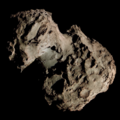
| 👁 Image Comet 126P/IRAS photographed from the Zwicky Transient Facility on 27 July 2023 | |
| Discovery[1][2] | |
|---|---|
| Discovered by | Infrared Astronomical Satellite |
| Discovery date | 26 July 1983 |
| Designations | |
| P/1983 M1, P/1996 P1 | |
| 1983 XIV, 1983j | |
| Orbital characteristics[3][4] | |
| Epoch | 27 May 2021 (JD 2459361.5) |
| Observation arc | 27.52 years |
| Number of observations | 1,717 |
| Aphelion | 9.573 AU |
| Perihelion | 1.713 AU |
| Semi-major axis | 5.640 AU |
| Eccentricity | 0.69628 |
| Orbital period | 13.395 years |
| Inclination | 45.869° |
| 357.86° | |
| Argument of periapsis | 356.52° |
| Mean anomaly | 303.38° |
| Last perihelion | 5 July 2023 |
| Next perihelion | 11 October 2036 |
| TJupiter | 1.964 |
| Earth MOID | 0.711 AU |
| Jupiter MOID | 2.771 AU |
| Physical characteristics[3] | |
| Dimensions | 1.57±0.14 km[5] |
| 0.15±0.03[6] | |
| Comet total magnitude (M1) | 11.8 |
| Comet nuclear magnitude (M2) | 14.9 |


126P/IRAS is a Jupiter-family comet with an orbital period of 13.4 years. It was discovered in images taken by the Infrared Astronomical Satellite (IRAS) on 28 July 1983 by J. Davies.[1] The discovery was confirmed with images taken with the 1.2-m Schmidt telescope at Palomar Observatory.[2][7]
Observational history
[edit]Upon discovery the comet had an apparent magnitude of 15 and appeared stellar in appearance.[1] The comet brightened and in mid September 1983 reached an apparent magnitude of 11 while a tail 3.5 arcminutes long was observed. Brian G. Marsden computed its orbit and found it is a short period comet with an orbital period of 13.32 years.[7] The comet was observed again during its next apparition in 1996, when it brightened up to magnitude of about 11 in September 1996 and faded to about 12 in October.[8][9] The comet was observed during its 2010 and 2023 apparitions.[10]
During the 1996 apparition, the comet was observed by the Infrared Space Observatory (ISO) when it was near perihelion. At the time, the comet had a 15 arcminute long tail in mid-infrared.
Physical characteristics
[edit]The surface was covered with dust grains smaller than 5 microns, a grain size similar to Halley's Comet. The dust mass loss rate was between 150–600 kg/s, while the comet shed 3.3 times more dust mass than gas mass. The albedo of the dust grain in the tail was estimated to be 0.15±0.03.[6] The nucleus is estimated to have a radius of 1.57 ± 0.14 km (0.976 ± 0.087 mi) based on infrared observations.[5]
Possible meteor shower
[edit]It has been proposed that meteoroids expelled from the comet about 13,000 years ago could reach Earth, producing a diffuse meteor shower.[11]
References
[edit]- ^ a b c J. Davies; J. Gibson (1 July 1983). D. W. Green (ed.). "Possible Comet". IAU Circular. 3833 (1). Bibcode:1983IAUC.3833....1D. ISSN 0081-0304.
- ^ a b J. Davies; A. C. Gilmore; P. M. Kilmartin (7 July 1983). B. G. Marsden (ed.). "Comet IRAS (1983j)". IAU Circular. 3837 (1). Bibcode:1983IAUC.3837....1G. ISSN 0081-0304.
- ^ a b "126P/IRAS – JPL Small-Body Database Lookup". ssd.jpl.nasa.gov. Jet Propulsion Laboratory. Retrieved 20 July 2023.
- ^ "126P/IRAS Orbit". Minor Planet Center. Retrieved 30 November 2025.
- ^ a b O. Groussin; P. Lamy; L. Jorda; I. Toth (2004). "The nuclei of comets 126P/IRAS and 103P/Hartley 2" (PDF). Astronomy & Astrophysics. 419 (1): 375–383. Bibcode:2004A&A...419..375G. doi:10.1051/0004-6361:20040073.
- ^ a b C. M. Lisse; Y. R. Fernández; M. F. A'Hearn; E. Grün; H. U. Käufl; et al. (2004). "A tale of two very different comets: ISO and MSX measurements of dust emission from 126P/IRAS (1996) and 2P/Encke (1997)". Icarus. 171 (2): 444–462. Bibcode:2004Icar..171..444L. doi:10.1016/j.icarus.2004.05.015.
- ^ a b G. W. Kronk. "126P/IRAS". Cometography.com. Retrieved 20 July 2023.
- ^ B. G. Marsden; D. A. J. Seargent; P. Camilleri; J. Kobayashi; A. Hale (2 October 1996). "Comet 126P/IRAS". IAU Circular. 6483 (2). Bibcode:1996IAUC.6483....2M. ISSN 0081-0304.
- ^ R. Keen; J. Carvajal; K. Sarneczky; D. A. J. Seargent; J. Hu (24 October 1996). D. W. Green (ed.). "Comet 126P/IRAS". IAU Circular. 6497 (2). Bibcode:1996IAUC.6497....2K. ISSN 0081-0304.
- ^ S. Yoshida. "126P/IRAS". www.aerith.net. Retrieved 20 July 2023.
- ^ D. Tomko; L. Neslušan (2012). "Search for New Parent Bodies of Meteoroid Streams Among Comets I: Showers of Comets 126P/1996 P1 and 161P/2004 V2 with Radiants on Southern Sky" (PDF). Earth, Moon, & Planets. 108 (2): 123–138. Bibcode:2012EM&P..108..123T. doi:10.1007/s11038-012-9387-x.
External links
[edit]- 126P/IRAS at the JPL Small-Body Database
- 126P/IRAS at Gary W. Kronk's Cometography
- 126P/IRAS at Seiichi Yoshida's website

.png)