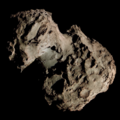
| 👁 Image Comet Giclas photographed from the Zwicky Transient Facility on 14 August 2020 | |
| Discovery[1] | |
|---|---|
| Discovered by | Henry L. Giclas |
| Discovery site | Lowell Observatory, USA |
| Discovery date | 8 September 1978 |
| Designations | |
| |
| |
| Orbital characteristics[5][6] | |
| Epoch | 21 November 2025 (JD 2461000.5) |
| Observation arc | 89.43 years |
| Earliest precovery date | 12 September 1931[3] |
| Number of observations | 1,792 |
| Aphelion | 5.381 AU |
| Perihelion | 1.719 AU |
| Semi-major axis | 3.550 AU |
| Eccentricity | 0.51562 |
| Orbital period | 6.689 years |
| Inclination | 7.553° |
| 108.08° | |
| Argument of periapsis | 281.74° |
| Mean anomaly | 293.89° |
| Last perihelion | 3 June 2020 |
| Next perihelion | 12 February 2027[4] |
| TJupiter | 2.872 |
| Earth MOID | 0.862 AU |
| Jupiter MOID | 0.555 AU |
| Physical characteristics[5] | |
Mean radius | 0.90 ± 0.05 km (0.559 ± 0.031 mi)[7] |
| 0.04 (assumed) | |
| (V–R) = 0.32±0.03[7] | |
| Comet total magnitude (M1) | 14.2 |


84P/Giclas is a Jupiter-family comet with a 6.69-year orbit around the Sun. It is the only comet discovered by American astronomer, Henry L. Giclas.
Observational history
[edit]1931 apparition
[edit]It was announced in 1995 that Clyde W. Tombaugh had observed a previously unknown comet for three nights in September 1931.[3] Designated as D/1931 R1,[2] it was later confirmed to be an earlier apparition of 84P/Giclas upon reconstructing its orbit using non-gravitational accelerations in a 1996 study by Grzegorz Sitarski [pl].[8]
1979 apparition
[edit]The comet was discovered by Henry L. Giclas from the Lowell Observatory on 8 September 1978.[1] At the time it was a diffuse 15th-magnitude object within the constellation Cetus.[a] He confirmed his discovery about two days later,[10] where Brian G. Marsden soon determined that it follows a 6.74-year periodic orbit around the Sun.[11] Throughout its 1978–1979 apparition, it remained mostly a photographic object.[9]
Follow-up observations
[edit]During the 2020 apparition, it was not more than 60 degrees from the Sun until September 2020. On 11 June 2033, the comet will pass 0.0387 AU (5.79 million km; 3.60 million mi) from the asteroid 4 Vesta.[5]
Physical characteristics
[edit]Based on observations by the Hubble Space Telescope in 1999–2000, the nucleus of the comet has a radius of 0.90±0.05 km, assuming a geometric albedo of 0.04.[7]
Notes
[edit]References
[edit]- ^ a b H. L. Giclas; M. L. Kantz (13 September 1978). B. G. Marsden (ed.). "Comet Giclas (1978k)". IAU Circular. 3264 (2). Bibcode:1978IAUC.3264....2G.
- ^ a b B. A. Skiff; D. H. Levy (13 April 1995). D. W. Green (ed.). "Comet D/1931 R1". IAU Circular. 6161 (3). ISSN 0081-0304.
- ^ a b R. J. Bouma (5 May 1995). D. W. Green (ed.). "Comet 84P/Giclas". IAU Circular. 6168 (4). ISSN 0081-0304.
- ^ "Horizons Batch for 84P/Giclas (90000868) on 2027-Feb-12" (Perihelion occurs when rdot flips from negative to positive). JPL Horizons. Retrieved 19 June 2022. (JPL#49 Soln.date: 2021-Mar-29)
- ^ a b c "84P/Giclas – JPL Small-Body Database Lookup". ssd.jpl.nasa.gov. Jet Propulsion Laboratory. Retrieved 18 February 2012.
- ^ "84P/Giclas Orbit". Minor Planet Center. Retrieved 16 June 2014.
- ^ a b c P. L. Lamy; I. Toth; H. A. Weaver; M. F. A'Hearn; L. Jorda (2009). "Properties of the nuclei and comae of 13 ecliptic comets from Hubble Space Telescope snapshot observations" (PDF). Astronomy & Astrophysics. 508 (2): 1045–1056. Bibcode:2009A&A...508.1045L. doi:10.1051/0004-6361/200811462. S2CID 125249770.
- ^ G. Sitarski (1996). "On the Identity of the Periodic Comets 84P/Giclas and D/1931 R1" (PDF). Acta Astronomica. 46 (1): 47–49. Bibcode:1996AcA....46...47S.
- ^ a b G. W. Kronk; M. Meyer (2010). Cometography: A Catalog of Comets. Vol. 5: 1960–1982. Cambridge University Press. pp. 613–614. ISBN 978-0-521-87226-3.
- ^ H. L. Giclas; M. L. Kantz (14 September 1978). B. G. Marsden (ed.). "Comet Giclas (1978k)". IAU Circular. 3266 (1). Bibcode:1978IAUC.3266....1G.
- ^ C. Y. Shao (18 September 1978). B. G. Marsden (ed.). "Periodic Comet Giclas (1978k)". IAU Circular. 3269 (2). Bibcode:1978IAUC.3269....2S.
External links
[edit]- 84P/Giclas at the JPL Small-Body Database
- 84P/Giclas at Gary W. Kronk's Cometography
- 84P/Giclas at Seiichi Yoshida's website
- 84P/Giclas at Syuichi Nakano's website

.png)